
How Much Does a Tankless Water Heater Save Per Year?
How much does a tankless water heater save per year depends on your fuel type and how much hot water your household uses — but here's a quick breakdown based on U.S. Department of Energy data:
Water Heater TypeEstimated Annual Savings vs. Traditional TankGas tankless (average)~$108/yearElectric tankless (average)~$44/yearENERGY STAR condensing gas tankless (4-person home)~$95/yearLow-usage home (under 41 gal/day)24–34% more energy efficientHigh-usage home (86+ gal/day)8–14% more energy efficient
Most households switching from a traditional tank water heater to a tankless model save somewhere between $100 and $180 per year on their energy bills — or roughly $8 to $15 per month.
Those numbers might not sound dramatic at first. But here's the thing: water heating accounts for about 13% of the average American household's annual energy bill. That's a meaningful chunk of your monthly utility costs quietly draining away — especially when a traditional tank heats water around the clock, whether you're using it or not.
Tankless water heaters solve this by heating water only when you turn on a tap. No standby heat loss. No reheating a 50-gallon tank at 2 a.m. Just hot water on demand, and energy you only pay for when you actually use it.
For homeowners and business owners in Wichita and across South Central Kansas, where winters can push groundwater temperatures down and energy costs add up season after season, those annual savings become even more worth paying attention to.
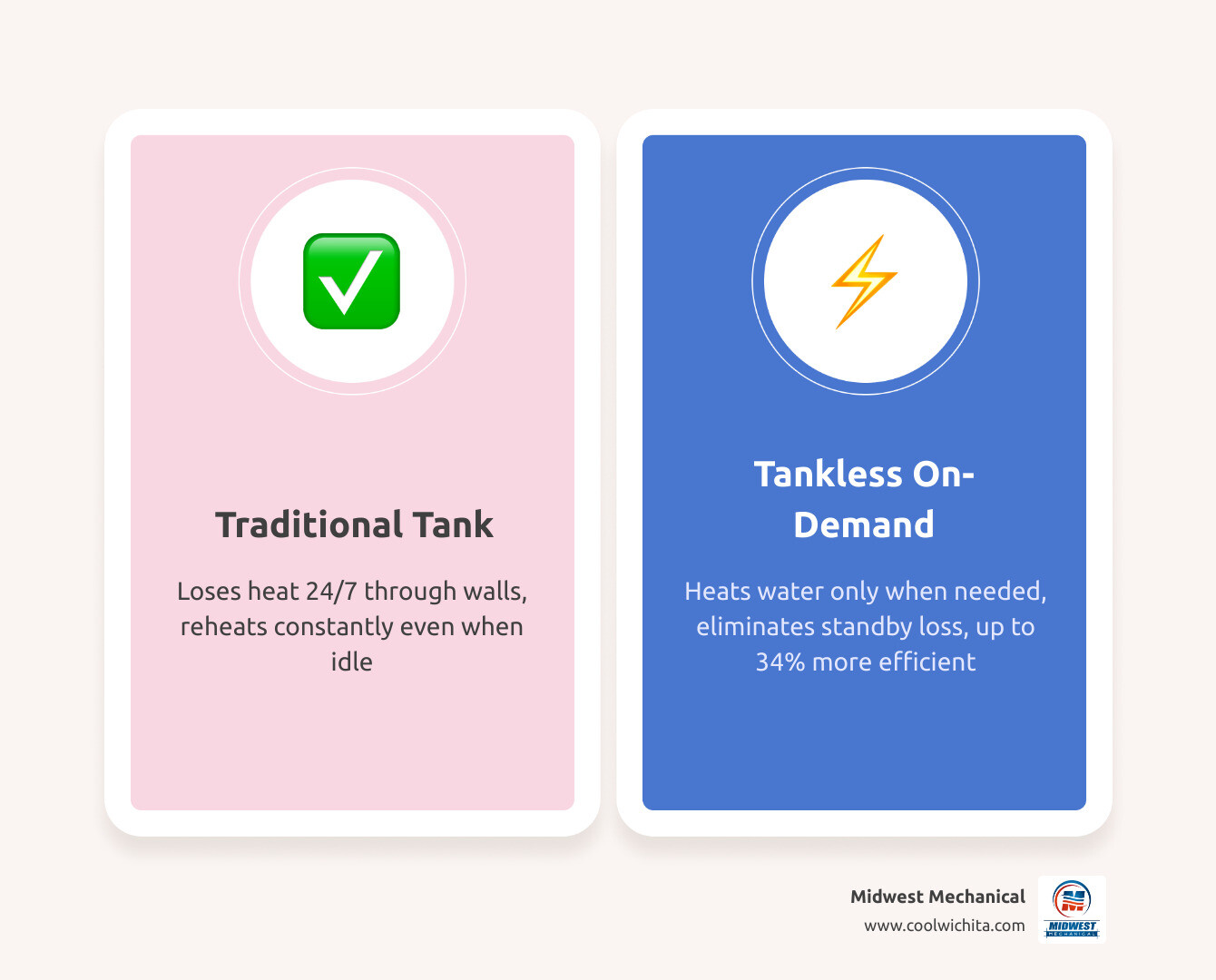
When we look at the advantages of a tankless water heater, the primary financial driver is the elimination of standby energy loss. Traditional storage tanks are essentially giant, insulated kettles that lose heat through the tank walls 24 hours a day. Even when you are sleeping or at work, your tank is cycling on and off to maintain a set temperature. Tankless units, often called "demand" heaters, remain idle until a sensor detects water flow, instantly firing up burners or electric elements.
This fundamental difference in operation leads to significant benefits of tankless water heaters, particularly in how they manage annual utility reductions. By heating only the water you need, these systems can be up to 34% more energy efficient in smaller households. Over the course of a year, those percentage points translate into real dollars staying in your bank account rather than going to the utility company.
Maximizing efficiency with Energy Star models
If you want to squeeze every possible penny of savings out of your upgrade, looking for the Energy Star logo is the way to go. These units are rated using the Uniform Energy Factor (UEF), which is the current standard for measuring water heater efficiency. The higher the UEF, the more hot water you get for every unit of fuel consumed.
One of the most efficient options we install is condensing technology. While standard gas tankless units vent hot exhaust gases outside, condensing models use a second heat exchanger to capture that "waste" heat and use it to pre-heat the incoming cold water. This pushes efficiency levels toward the 95% to 99% range. Checking the energy efficiency ratings for water heaters before you buy ensures you are choosing a model that offers the lowest possible carbon footprint and the highest annual savings.
Comparing gas and electric annual savings
The fuel source you choose plays a massive role in how much does a tankless water heater save per year. Generally, gas-fired tankless heaters offer higher annual savings—averaging about $108 per year—compared to electric models, which average around $44 per year. This is largely because natural gas is often a more cost-effective fuel for high-intensity heating than electricity in South Central Kansas.
However, electric tankless units have their own perks. They are nearly 99% thermally efficient, produce zero combustion emissions indoors, and don't require the complex venting systems that gas models do. When exploring the different types of water heaters for home, we look at your existing infrastructure. If your home isn't already piped for high-capacity gas, an electric model might be the more practical path to energy savings.
Variables That Impact Your Yearly Utility Reductions

Every home in Wichita is different, and your neighbor's savings might look very different from yours. When you choose the right water heater for your home, several variables will dictate your actual return on investment. It isn't just about the unit itself; it's about how your family interacts with it.
Understanding how to know which type of water heater is best requires a look at your specific usage patterns. If you have a small household that uses less than 41 gallons of hot water a day, your efficiency gains are maximized because you avoid the massive standby losses of a 50-gallon tank that you barely use.
How much does a tankless water heater save per year for large families?
For high-usage households—those using 86 gallons or more daily—the savings math shifts slightly. While the percentage of efficiency gain is lower (about 8% to 14%), the total volume of energy saved can still be significant. Large families often find that the biggest "saving" isn't just on the bill, but in the elimination of the "cold shower" lottery.
To ensure high-usage homes actually see savings, proper sizing is critical. We use a tankless flow rate guide 2025 to determine how many gallons per minute (GPM) your household needs. If you try to run two showers, the dishwasher, and the laundry at once, an undersized unit will struggle. Following tips choosing right water heater size ensures you get the "endless" hot water you were promised without overworking the system.
How much does a tankless water heater save per year in cold climates?
In places like Wichita, Andover, and Derby, our groundwater gets quite chilly in the winter. This is a factor many national "savings calculators" miss. When groundwater enters your home at 45°F instead of 70°F, the tankless unit has to work harder to reach a comfortable 120°F. This is known as the "temperature rise."
Because of these seasonal fluctuations, Water Heaters Wichita KS must be robust enough to handle Kansas winters. While you'll still save money compared to a tank heater (which also has to work harder in winter), your savings might be slightly lower during the coldest months than they are in the summer. However, the year-round average usually stays within that $100 to $180 range.
Beyond the Bill: Long-Term ROI and Performance
When calculating how much does a tankless water heater save per year, it’s a mistake to only look at the monthly gas or electric bill. The real financial "win" often comes from the system's longevity and reliability.
A traditional tank water heater typically lasts 8 to 12 years before the tank corrodes and begins to leak. In contrast, a well-maintained tankless unit can last 20 years or more. When you ask how long does a tankless water heater last, you realize that over a 20-year period, you would likely have purchased and installed two traditional tanks. By avoiding that second replacement, you've effectively saved thousands of dollars in equipment and labor.
Furthermore, tankless units are designed with replaceable parts. If a component fails, we can often perform a tankless hot water service to swap out a single part. With a tank heater, once the tank rusts, the whole thing is junk. Our tankless water heater repair guide highlights how this modular design protects your investment over the long haul.
The impact of water quality on annual savings
Kansas is known for having "hard" water—water rich in minerals like calcium and magnesium. This can be the "kryptonite" for tankless savings. As water is heated instantly, these minerals can solidify and create scale inside the heat exchanger. If scale builds up, the unit has to run longer and hotter to heat the water, which eats into your annual savings.
If you notice a water heater leaking Wichita KS, it’s often too late for a tank system. For tankless, we recommend annual descaling to keep the heat exchanger clear. This simple maintenance task ensures your unit continues to operate at peak efficiency, protecting those yearly utility reductions you're counting on.
Space savings and home value
One often-overlooked financial benefit is the "recovery" of square footage. A standard 50-gallon tank takes up about 9 to 12 square feet of floor space. A tankless unit is about the size of a suitcase and mounts on the wall.
When navigating water heater options, think about what you could do with an extra closet's worth of space. In modern real estate, energy-efficient upgrades are highly attractive to buyers. Installing a tankless system is a "green" upgrade that can increase your home's resale value and appeal, making it a smart move even if you don't plan to stay for the full 20-year lifespan of the unit.
2026 Incentives: Tax Credits and Energy Star Benefits

April 2026 is a fantastic time to go tankless because of the current landscape of financial incentives. Thanks to the Inflation Reduction Act and various local programs, the net cost of an efficient water heater replacement is lower than it has been in years. These incentives don't just lower the upfront hurdle; they increase your effective annual savings by accelerating your "break-even" point.
If you are looking at a water heater replacement guide Valley Center, make sure you check for qualifying high-efficiency models. Not every tankless unit qualifies for the top-tier credits, so picking the right model is essential.
Understanding the 2026 federal tax credit
As of 2026, federal tax credits for energy-efficient home improvements are still a major factor. Homeowners and business owners can often claim a percentage of the project cost—up to specific limits—as a direct credit against their federal tax liability.
For gas tankless water heaters, the unit generally needs to meet a UEF of 0.95 or higher to qualify. These are non-refundable credits, meaning they can reduce the tax you owe to zero, but they won't result in a "refund" check if you don't owe taxes. We always recommend following expert tips for water heater installation and keeping all your receipts and manufacturer certification statements for your tax preparer.
Utility-specific rebates in South Central Kansas
Beyond the federal level, local utility providers in the Wichita area often offer their own incentives. These can range from mail-in rebates to instant discounts on high-efficiency equipment. Our water heater installation Wichita guide often highlights these local opportunities.
Because these programs change frequently, we help our customers navigate the application processes to ensure no money is left on the table. When you combine a federal tax credit with a local utility rebate, the "extra" cost of going tankless can be significantly offset, making those annual energy savings even sweeter.
Frequently Asked Questions about Tankless Savings
We get a lot of questions from folks in Maize, Park City, and Bel Aire about the realities of tankless living. Here are the most common things people ask when they're trying to calculate how much does a tankless water heater save per year.
Do tankless water heaters save more for low-usage households?
Yes, the percentage of energy saved is actually highest for households that use a smaller amount of hot water (typically 41 gallons or less per day). In these homes, a tankless system can be 24% to 34% more energy efficient than a storage tank. This is because a tank heater spends most of its energy just keeping that unused water hot, whereas the tankless unit only uses energy for the small amount of water actually consumed. If you find yourself needing a water heater repair Wichita KS on an old, oversized tank, switching to a smaller tankless unit is often a brilliant financial move.
Is professional maintenance required to keep savings high?
Absolutely. To keep those energy bills low, your tankless unit needs to breathe and heat efficiently. This involves annual flushing to remove mineral scale and cleaning the air intake filter. Regular water heater installation Wichita KS service ensures that your warranty remains valid and that the heat exchanger stays in top condition. Neglecting maintenance can cause the unit to work harder, eventually leading to higher bills and a shorter lifespan.
Can a tankless system provide endless hot water?
Yes—with a caveat. As long as you stay within the unit's GPM (gallons per minute) capacity, it will heat water indefinitely. You could theoretically shower for three hours and the water would stay hot. However, if you exceed the capacity (like running three showers at once), the water might not be as hot as you'd like. That’s why we focus on water heater replacement Wichita KS strategies that properly match the unit's capacity to your home's peak demand.
Conclusion
Switching to a tankless system is one of the most effective ways to lower your home's energy footprint and enjoy a more comfortable daily routine. While the question of how much does a tankless water heater save per year has a range of answers, the consensus for most Wichita homeowners and business owners is a solid $100 to $180 in direct energy savings, plus the long-term "hidden" savings of a 20-year lifespan.
At Midwest Mechanical, we are proud to serve Wichita and surrounding communities like Andover, Derby, Haysville, Park City, Maize, and Bel Aire. We don't just swap out units; we look at your whole home to ensure you get the best ROI possible. Whether you need a professional tankless water heater replacement in Wichita KS or you're just starting to explore Tankless Water Heater Wichita KS options, we're here to help.
Ready to stop paying to heat water you aren't using? Give us a call or visit our website to schedule a consultation. Your wallet—and your morning shower—will thank you.


We have partnered with GoodLeap to offer flexible payment options for your project. GoodLeap uses a soft credit check until funding and the highest score from all 3 bureaus to see if you qualify. It also takes just a few minutes to get started.






.svg)