


The Myth of the Pantry Cure for Extreme Mineral Scale
In our experience at Midwest Mechanical, when evaluating a Commercial Descaler vs Vinegar: A Side-by-Side Flush Comparison, the truth about everyday white vinegar often surprises homeowners. White vinegar is frequently touted as the ultimate, all-natural cure for everything from dirty windows to heavy plumbing calcification. However, relying on this common pantry staple to clear severe mineral scale from your high-efficiency water heater or boiler is a misconception that can cost you dearly in system performance. While vinegar might work perfectly fine for descaling a household coffee maker, a high-output heat exchanger demands a completely different level of chemical intervention.
As we enter the early fall pre-heating season, groundwater temperatures begin to drop significantly. This colder inlet water forces your heating equipment to burn more fuel and work much harder to reach your desired output temperature. Right now, you are faced with a crucial decision: attempt a DIY vinegar flush and hope it clears the buildup, or utilize a professional commercial-grade descaler to ensure your system is fully prepared for the heavy winter workload. For comprehensive plumbing services and proactive water heater maintenance, our team knows that securing the right professional treatment makes a massive difference in how your equipment performs when you need it most.
The Mechanics of Calcification in High-Hardness Zones
To understand why specific cleaning agents succeed or fail, you first have to understand how scale forms inside your plumbing equipment. The process is driven by heat and the specific mineral makeup of your local water supply.
The Thermodynamics of Mineral Precipitation
Water naturally carries dissolved minerals, primarily calcium and magnesium. When cold water enters a tankless water heater or boiler and is rapidly heated to 120 degrees Fahrenheit or higher, a chemical reaction occurs. The heat causes the dissolved calcium bicarbonate to break down and precipitate out of the water as solid calcium carbonate. This solid mineral bakes directly onto the metallic walls of the heat exchanger. Over time, this creates a thick, rock-hard layer of insulation between the heat source and your water.
Why Local Municipal Water Accelerates the Problem
This calcification process happens everywhere, but it is highly dependent on local climate and geological factors. In our years of servicing local plumbing systems, our Midwest Mechanical team has seen firsthand that Wichita is classified as having "very hard" municipal water due to the heavy concentration of dissolved minerals in the regional supply. This specific climate context accelerates mineral scale buildup much faster than national averages. A heat exchanger in our service region can accumulate a quarter-inch of solid scale in a fraction of the time it takes in a soft-water region. For a deeper dive into this regional challenge, you can read about how Wichita's hard water impacts tankless heat exchangers.
The Compounding Effect of Winter Inlet Temperatures
The efficiency trap: Scale is an excellent insulator. When a thick layer of calcium coats the heat exchanger, the burner has to run longer and hotter to push thermal energy through the rock layer and into the water. As groundwater gets colder in the winter, the unit is already working overtime to bridge the temperature gap. If the heat exchanger is heavily scaled, restricted flow and poor heat transfer force the unit to burn significantly more fuel just to maintain a basic warm shower.
Household Vinegar: Analyzing the 5% Acetic Acid Limitations
Many online tutorials suggest hooking up a submersible pump and circulating white vinegar through your system for an hour. To understand why this fails in heavy-scale scenarios, we have to look at the chemistry.
The Problem: Persistent Scale After a DIY Flush
Every fall, our technicians respond to calls from frustrated homeowners who spent an entire Saturday afternoon running gallons of vinegar through their plumbing, only to find that their system still throws error codes or struggles to deliver hot water. The assumption is that because the vinegar turned slightly cloudy, the system is fully clean. In reality, the core blockage remains intact.
The Cause: Chemical pH and Acidity Concentration Differences
Standard white household vinegar is essentially a 5% acetic acid solution suspended in 95% water. It typically registers at a pH of around 2.5. While this is acidic enough to dissolve light water spots on a shower glass, it lacks the concentrated chemical power to break down thick, baked-on calcium carbonate quickly. When examining the chemical pH and acidity concentration differences between food-grade vinegar and targeted industrial acids, the limitations become obvious. Acetic acid is a weak organic acid; it does not fully dissociate in water, meaning it has fewer free hydrogen ions available to attack the mineral matrix.
The Solution: Moving Beyond Pantry Staples
Because vinegar is so weak, it merely scratches the surface of thick calcification. To achieve even a moderate level of descaling with 5% acetic acid, you would need to circulate the fluid for many hours—sometimes days—which is entirely impractical and puts unnecessary wear and tear on circulation pumps. The solution is moving away from ineffective DIY methods and utilizing targeted solutions that actually dissolve the scale rather than just polishing the top layer. Incomplete descaling leaves residual scale that continues to insulate the heat exchanger and degrade your system's efficiency.
Commercial Descalers: Professional-Grade Mineral Breakdown
When our professionals tackle heavy calcification, we leave the vinegar in the kitchen. Professional-grade descalers are engineered specifically for the rapid, safe breakdown of heavy mineral deposits inside complex plumbing equipment.
Targeted Chemical Formulations
Instead of weak acetic acid, commercial descalers utilize active ingredients like sulfamic acid or phosphoric acid. These are targeted, specialty acids designed specifically to react violently with calcium carbonate. When these professional solutions make contact with heavy scale, they immediately begin dissolving the rock into a liquid state, turning the solid blockage into dissolved gas and suspended liquid that simply washes out of the system.
Balancing Aggression with Component Safety
A common fear is that stronger acids will eat through the copper or stainless steel tubing inside the unit. However, high-quality commercial descalers are formulated with specialized buffering agents and corrosion inhibitors. These additives ensure that the solution maintains a safe pH balance for the specific metals used in heat exchangers. The chemical aggressively attacks the calcium but stops at the bare metal, ensuring no etching or degradation of the plumbing components occurs.
The Professional Equipment Advantage
Handling these specialized chemicals requires professional equipment and strict safety protocols. Midwest Mechanical's technicians utilize professional-grade, high-volume circulation pumps and specialized isolation valves that ensure the descaler flows at the exact velocity needed to strip away the scale. Combined with our deep understanding of how to apply these specific chemical solutions to combat local hard water challenges effectively, professional application guarantees a complete, bare-metal restoration in a fraction of the time it takes weaker acids.
Side-by-Side Flush Comparison: Speed, Safety, and Scale Removal
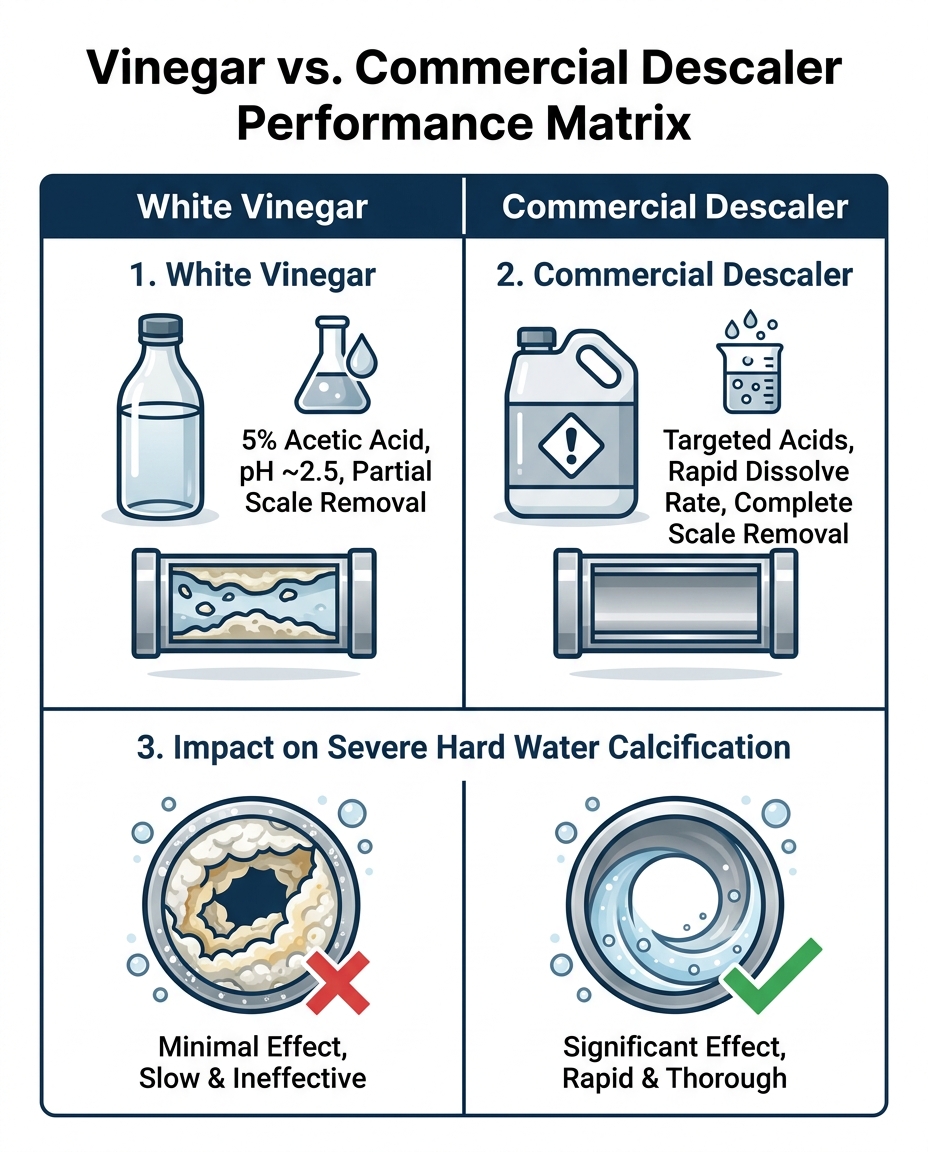
To clearly illustrate the differences between a DIY pantry approach and a professional intervention, here is a direct comparison of the two fluids across key performance metrics.
• Acidity and pH Levels — Household Vinegar (5% Acetic Acid): pH ~2.5 (Weak organic acid concentration) — Professional Commercial Descaler: Targeted sulfamic/phosphoric acids (Highly concentrated)
• Required Flush Time — Household Vinegar (5% Acetic Acid): Several hours of inadequate circulation — Professional Commercial Descaler: Rapid breakdown in 30 to 45 minutes
• Effectiveness on Severe Scale — Household Vinegar (5% Acetic Acid): Surface-level removal only; leaves residual layer — Professional Commercial Descaler: Complete bare-metal restoration
• Recommended Use — Household Vinegar (5% Acetic Acid): Light maintenance in extremely soft water zones — Professional Commercial Descaler: Mandatory for heavy municipal hard water buildup
The clear takeaway: While vinegar is safe and readily available, it simply does not possess the chemical strength required to restore a heavily scaled heat exchanger to factory efficiency.

Troubleshooting: When Inadequate Flushing Leads to Cold Water
One of the most common issues our service team at Midwest Mechanical encounters when we get called out after a homeowner's DIY flush is a tankless water heater not getting hot. This frustrating scenario is a direct result of the chemical limitations discussed above.
The Problem: Lukewarm or Cold Water Deliveries
You spent hours pumping vinegar through your system, reconnected the hoses, and turned the unit back on. But when you turn on the shower, the water is lukewarm, or it starts hot and suddenly drops to freezing cold. This phenomenon is incredibly common when extreme hard water scale is treated with weak acids.
The Cause: Residual Scale Insulating the Heat Exchanger
Because the vinegar only dissolved the top fraction of a millimeter of the scale, a thick layer of calcium carbonate remains baked onto the heat exchanger. This residual scale tricks the unit's internal sensors. The thermistor (temperature sensor) registers that the heat exchanger is getting dangerously hot because the thermal energy cannot pass through the rock layer into the water. To protect the unit from melting or cracking, the system's computer triggers an automatic safety shutoff. The burner cuts out, and you are left standing in a cold shower.
The Solution: Definitive Diagnostic Flushing
When a system locks out due to overheating, a comprehensive professional flush is the definitive diagnostic and corrective step. By using a commercial-grade descaler, a technician can strip away the hidden residual scale that is insulating the sensors and blocking heat transfer. Enrolling in a preventative maintenance plan ensures this level of professional cleaning happens on a reliable schedule, preventing these lockouts before they occur.
Frequently Asked Questions About Tankless Water Heater Descaling
Is commercial descaler better than vinegar?
Yes, commercial descalers are significantly more effective. They use targeted, specialized acids that dissolve calcium carbonate much faster and more thoroughly than the weak 5% acetic acid found in household vinegar. This ensures a complete restoration of the heat exchanger rather than just a superficial cleaning.
Can I use vinegar to descale my tankless water heater?
While vinegar is often cited for light maintenance, it falls short for heavy jobs. It is generally ineffective against the severe scale buildup caused by extremely hard municipal water. Relying on it in areas with high mineral content usually leaves thick residual scale behind.
Why is my tankless water heater not getting hot after a flush?
This usually points to an incomplete cleaning process. If a weak acid like vinegar was used, residual scale may still be insulating the heat exchanger. This prevents proper heat transfer into the water and often causes the unit to overheat internally, triggering automatic safety shutoffs that cut the burner.
Are commercial descalers safe for heat exchangers?
Yes, they are highly safe when applied correctly. When applied by a professional using the correct dilution and specialized pump equipment, commercial descalers utilize buffering agents formulated to protect copper and stainless steel while aggressively destroying mineral scale.
How long does a professional tankless water heater flush take compared to a DIY vinegar flush?
A professional flush is remarkably faster. A commercial-grade descaler typically breaks down heavy scale in 30 to 45 minutes of circulation. In contrast, attempting to achieve similar results with vinegar can require several hours to a full day of continuous pumping, which strains equipment and wastes time.
Secure Your System's Efficiency Before Winter Arrives
Understanding the chemical limitations of household vinegar provides a solid, scientific rationale for choosing professional descaling. While pantry staples have their place in light household cleaning, the heavy mineral calcification caused by very hard water requires targeted, professional-grade solutions. Weak acids simply leave too much insulating scale behind, forcing your system to work harder, burn more fuel, and risk safety lockouts.
The urgency of addressing this scale during the early fall pre-heating season cannot be overstated. As incoming groundwater temperatures drop, your system needs every bit of its factory efficiency to keep your home comfortable. Skip the ineffective DIY route and rely on our expert Midwest Mechanical technicians for thorough, bare-metal maintenance. Take action today and schedule a professional flush to secure your system's reliability for the cold months ahead.
Customer Testimonials
Hear from satisfied customers who trust us for reliable HVAC and plumbing service across Wichita.





Plus, the technician, Lee was very professional, knowledgeable and informative.
We will definitely be doing business with them sometime again in the past.
I'm prompt to my appointment. Thank you Midwest Mechanical.
I'm prompt to my appointment. Thank you Midwest Mechanical.

We have partnered with GoodLeap to offer flexible payment options for your project. GoodLeap uses a soft credit check until funding and the highest score from all 3 bureaus to see if you qualify. It also takes just a few minutes to get started.




Service Areas
.svg)