


Why Your Plumbing Pressure Spikes in Late Summer
Your water heater's relief valve is weeping, or you are noticing unexpected pressure spikes at your faucets, and you are wondering how to test the air pressure in your water heater expansion tank to find the culprit. It is a common scenario we see in the field, especially as August and late summer heat sets in, putting extra stress on municipal water supplies and residential plumbing systems alike just as the back-to-school transition begins. Before you assume the entire water heater is failing, our team at Midwest Mechanical often traces the issue back to a small, basketball-sized component sitting right above it. If you are experiencing these pressure fluctuations, you may eventually need professional plumbing services to resolve the underlying issue.
The underlying problem: Whenever water heats up inside a closed plumbing system, it expands. This physical reaction creates excess volume that has nowhere to go. Without a dedicated pressure management strategy, that expanding water pushes relentlessly against your pipes, valves, and the water heater itself. This is why modern plumbing codes require a specific mechanism to handle the load safely.
The standard solution: The water heater expansion tank is designed specifically to absorb this excess pressure. It acts as a shock absorber for your plumbing. However, these tanks do not last forever. The internal components degrade over time due to constant pressure cycling and temperature fluctuations. When the tank fails, your plumbing system loses its primary defense against thermal expansion.
The good news is that diagnosing this specific component is a straightforward process. You do not need specialized plumbing equipment to find out if your expansion tank is doing its job. By setting the stage for a safe, do-it-yourself diagnostic check using everyday tools, you can determine exactly what is happening inside that tank before you decide to call our licensed professionals for a replacement.
The Role of the Expansion Tank in Managing Thermal Expansion
To understand why your plumbing system is suddenly under stress, you have to look at the physics of thermal expansion. When water is heated from average room temperature to standard water heater settings—typically around 120 to 140 degrees Fahrenheit—it expands in volume by about 2% to 3%. In an open plumbing system, that extra volume simply pushes back into the city water main. However, most modern homes are equipped with closed-loop systems due to check valves or pressure-reducing valves installed at the water meter.
Because the expanding water cannot flow backward into the municipal supply, the pressure inside your home's pipes skyrockets. This is where Wichita's seasonal temperature swings become a significant factor. During the intense heat of August and late summer, municipal water supply temperatures naturally increase. Our technicians frequently see this warmer baseline alter the incoming pressure dynamics. When your water heater applies even more heat to that already-warm supply, the thermal expansion effect is exacerbated, pushing your system closer to its limits.
The Uniform Plumbing Code (UPC) recognizes this danger. To protect the actual water heater tank from splitting or leaking prematurely, the code requires strict thermal expansion control. The expansion tank is the industry-standard method for meeting this requirement.
How the Internal Bladder Works
The magic of the expansion tank lies in its internal design. The tank is not just an empty metal canister; it is divided into two distinct chambers separated by a flexible, heavy-duty rubber bladder (or diaphragm).
• The water chamber: Connected directly to your home's plumbing, this side fills with expanding hot water as the water heater does its job.
• The air chamber: Located on the opposite side of the bladder, this chamber is pre-charged with pressurized air.
Because air is compressible and water is not, the air chamber acts as a cushion. As the heated water expands, it pushes against the rubber bladder. The bladder flexes, compressing the air on the other side and safely absorbing the excess volume without raising the overall pressure in your pipes.
If that rubber bladder fails, tears, or degrades, the physical separation is lost. Water floods into the air chamber, creating what plumbers call a "waterlogged" tank. Once waterlogged, the tank can no longer absorb pressure, rendering it completely useless and leaving your plumbing system vulnerable to severe stress.
Recognizing the Symptoms of a Bad Water Heater Expansion Tank
Before you even reach for your tools to perform a diagnostic test, your plumbing system will usually give you physical clues that the expansion tank has failed. In our years of servicing local homes, we've found that recognizing these symptoms early can save your main water heater from catastrophic damage.
The tap test: A functioning expansion tank is mostly filled with air. If you lightly tap on the outside of the metal canister with your knuckles, the top half (or the side opposite the plumbing connection) should sound hollow. If the tank sounds completely solid, or if you try to gently wiggle it and it feels incredibly heavy, it is likely completely full of water. A waterlogged tank is a dead tank.
Secondary plumbing issues: When the expansion tank stops working, the excess pressure has to escape somewhere. The most common release point is the temperature and pressure (T&P) relief valve on the side of your water heater. If you notice a dripping or weeping T&P valve, it is often a direct secondary symptom of a failed bladder. Understanding why your water heater relief valve is leaking is usually the first step in realizing the expansion tank has stopped absorbing the load.
Premature wear on fixtures: Beyond the water heater, unchecked thermal expansion takes a toll on your entire house. You might notice toilet fill valves running randomly, faucets developing sudden drips, or unexpected bursts of high pressure when you first turn on a sink. Without a functioning expansion tank, the water heater bears the full brunt of the pressure, which risks premature leaks in the main tank itself.
While these physical signs are strong indicators, they are not definitive proof. To confirm the exact condition of the internal rubber bladder, you must transition into an accurate diagnostic test using the tank's air valve.
Preparing for the Test: Locating the Schrader Valve
To safely test the pressure inside your expansion tank, you first need to locate the correct testing point. Every standard expansion tank is equipped with a Schrader valve. If you have ever added air to a bicycle tire or checked the pressure on your car's tires, you are already familiar with a Schrader valve. It features a threaded outer edge and a small, spring-loaded pin in the center.
Where to find the valve: The valve is always located on the air chamber side of the tank. Because most expansion tanks are installed vertically above the water heater with the plumbing connection at the top, the Schrader valve is typically found on the very bottom of the tank. It is usually protected by a small, twist-off plastic cap. If your tank is mounted horizontally, look for the cap on the end opposite the pipe connection.
Crucial safety precautions: Before you begin, understand that you are working near an active water heater. The tank itself, the surrounding copper or steel pipes, and any nearby exhaust flues may be extremely hot to the touch. Ensure the area is well-lit and clear of obstructions so you can work comfortably without brushing against hot surfaces.
Establishing a baseline: You cannot get an accurate reading of the air pressure inside the tank while the plumbing system is actively pushing water against the bladder. To get a true reading of the tank's pre-charge, you must relieve the static water pressure in the house. This means the water supply to the heater must be turned off, and a nearby faucet must be opened. If you skip this step, your gauge will simply read the current water pressure of the house, not the actual health of the air chamber.
How to Check Expansion Tank Pressure with a Tire Gauge
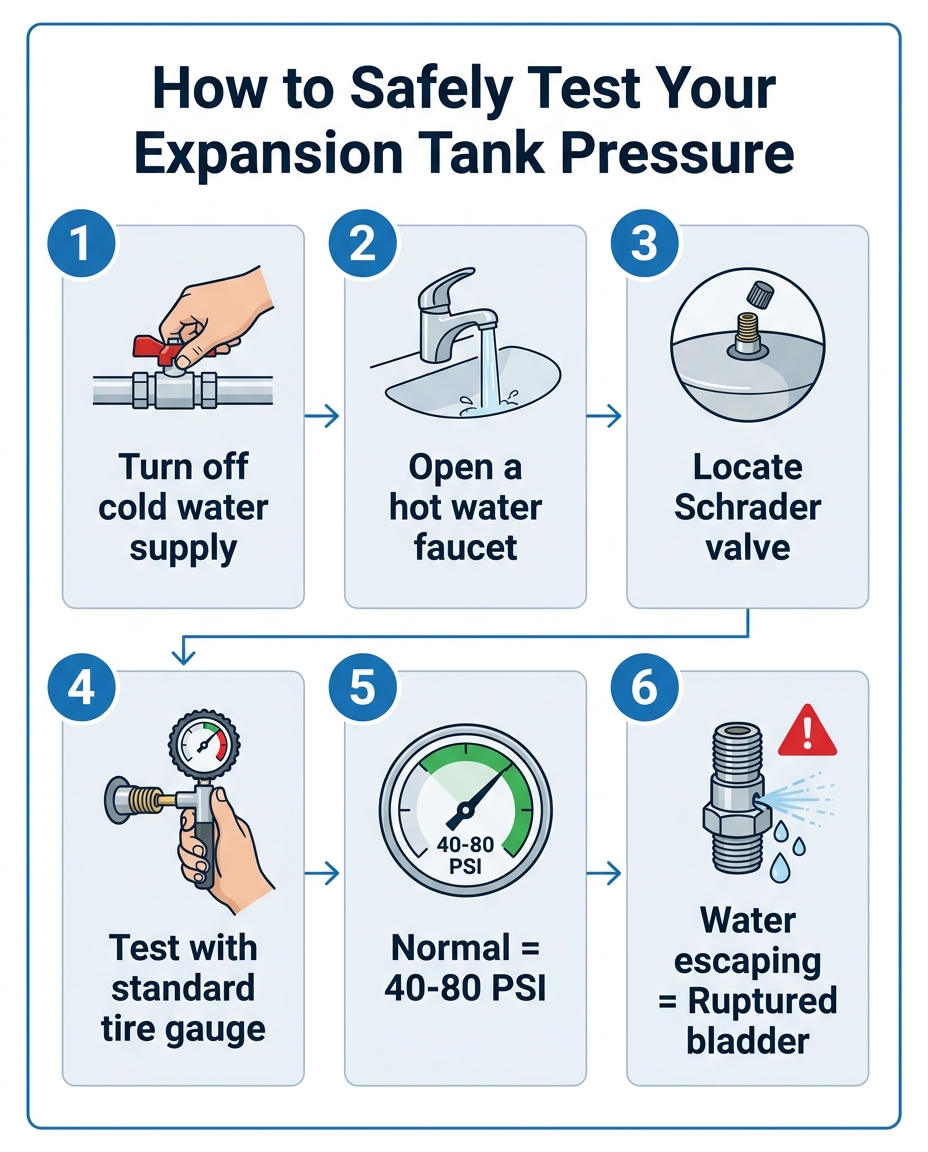
Once you have located the valve and cleared the area, you are ready to perform the test. You do not need specialized plumbing tools for this; a standard tire gauge PSI reading is all you need to diagnose the health of the internal bladder.
1. Shut off the cold water supply valve: Locate the shut-off valve on the cold water pipe leading into the top of your water heater. Turn it completely clockwise (or perpendicular if it is a lever-style ball valve) to stop incoming water flow.
2. Open a hot water faucet: Go to a nearby sink—preferably on the same floor or a lower floor—and turn on the hot water tap. Let it run until the flow stops and it just drips. Leave the faucet open. This relieves the static system pressure, ensuring the bladder is resting in its natural state.
3. Remove the protective cap: Twist the small plastic cap off the expansion tank's Schrader valve and set it aside safely.
4. Firmly press the tire gauge onto the valve: Take your standard tire pressure gauge and press it squarely and firmly onto the Schrader valve. You should hear a brief hiss of air before the gauge seals and registers a reading.
5. Record the PSI: Look at the standard tire gauge PSI reading (pounds per square inch). Note the number carefully, as you will need to compare it to your home's incoming static water pressure to determine the next steps.

Interpreting Your Gauge Reading: Air vs. Water
Taking the reading is only half the battle; knowing what that standard tire gauge PSI reading means is how you determine the fate of the expansion tank. The results will fall into one of three distinct categories.
The ideal scenario (Normal Pressure): In a perfectly functioning system, the air pressure inside the expansion tank should exactly match the incoming static water pressure of your home. For most residential properties, this falls between 40 and 80 PSI. If your home's water pressure is 60 PSI, the expansion tank should read 60 PSI. If the numbers match and the tank sounds hollow, the bladder is intact and functioning correctly.
The low-pressure scenario (Air Leak): If the gauge reads zero, or significantly lower than your home's water pressure (for example, 15 PSI when your home is at 60 PSI), the tank has lost its pre-charge. This often happens over time as air slowly escapes through the Schrader valve, much like a car tire slowly going flat. If no water comes out of the valve, a professional can often use a bicycle pump to recharge the air chamber back to the correct PSI.
The definitive failure scenario (Water Escaping): This is the most critical result to watch for. When you press the tire gauge onto the Schrader valve, or if you briefly depress the center pin with a small screwdriver, only air should come out. If a spray of water escapes from the air valve, the internal rubber bladder has completely ruptured.
• Matches home pressure (40-80 PSI) — Internal Diagnosis: Bladder intact, properly charged — Required Action: None. Tank is functioning normally.
• Low or Zero PSI (Air only) — Internal Diagnosis: Air leak or deflated chamber — Required Action: Recharge with air to match home PSI.
• Water sprays from valve — Internal Diagnosis: Ruptured bladder (Waterlogged) — Required Action: Full tank replacement required.
It is vital to understand that a waterlogged tank is unrepairable. You cannot patch or replace the internal rubber bladder. The entire canister must be fully replaced to restore thermal expansion control. If your test reveals water in the air chamber, it is time to look into professional water heater repair and installation.
DIY Testing vs. Professional Repair Boundaries
Taking the initiative to safely diagnose the issue using a tire gauge is excellent homeowner maintenance. By testing the air valve, you have gathered the exact data needed to understand the health of your plumbing system. However, it is crucial to explicitly define the safety boundary between a DIY diagnostic check and a professional plumbing repair.
The limits of DIY: Testing the air valve is a safe, non-invasive task. But replacing a waterlogged expansion tank is a completely different undertaking. A failed, water-filled tank can weigh upwards of 40 to 50 pounds. Removing it requires cutting thick copper or PEX piping, managing that heavy, awkward weight while standing over a hot appliance, and ensuring the new connections are completely watertight.
The professional requirement: Proper installation is not just about threading a new tank onto a pipe. A licensed plumber must measure your home's exact static water pressure and manually adjust the new expansion tank's pre-charge pressure to match it perfectly *before* installation. If the new tank is installed straight out of the box without matching the pressure, the bladder will immediately stretch out of shape, leading to premature failure. Furthermore, the new tank must be properly braced and supported to ensure code compliance.
As a trusted local authority serving the community since 2004, our team at Midwest Mechanical always recommends clearly defining when a licensed plumber is necessary for safe, code-compliant replacement. We've seen too many DIY replacements go wrong because the tank wasn't pressurized correctly. Proactive plumbing care is the best way to catch these issues before they stress the main water heater tank. Scheduling routine plumbing maintenance ensures that components like the expansion tank and the T&P valve are tested annually by certified professionals.
Frequently Asked Questions About Expansion Tank Maintenance
What should the pressure be in a water heater expansion tank?
The pressure in a water heater expansion tank should exactly match the incoming static water pressure of your home. For most residential properties, this standard pressure falls between 40 and 80 PSI. If the tank pressure is higher or lower than the home's water pressure, the internal rubber bladder cannot flex properly to absorb thermal expansion. A licensed plumber will always measure your home's static pressure and adjust the tank's pre-charge to match before finalizing an installation.
How do I know if my water heater expansion tank is bad?
A bad expansion tank often presents physical signs before you even test it. If you tap the tank and it sounds completely solid rather than hollow, or if it feels incredibly heavy, it is likely filled with water. Secondary symptoms include a weeping temperature and pressure (T&P) relief valve on the water heater, or sudden, unexplained high-pressure bursts when you turn on a faucet. The most definitive sign of failure is when water, rather than air, escapes from the Schrader valve during a pressure test.
Can you check expansion tank pressure with water on?
No, you cannot get an accurate reading of the expansion tank's internal air pre-charge while the water supply is on and pressurized. If the water is on, the gauge will simply read the current active pressure pushing against the bladder, not the actual health of the air chamber itself. You must turn off the cold water supply to the heater and open a nearby hot water faucet to relieve the static pressure before applying a tire gauge to the Schrader valve.
What happens if expansion tank pressure is too low?
If the air pressure inside the expansion tank is too low, the internal rubber bladder will remain pushed flush against the air chamber wall even under normal conditions. Because the cushion of air is missing, the tank loses its ability to absorb the excess volume created by thermal expansion. This forces the expanding hot water to push violently against the water heater tank and the home's piping, which can lead to premature leaks and a weeping relief valve.
Why is water coming out of my expansion tank air valve?
Water coming out of the expansion tank air valve (the Schrader valve) means the internal rubber bladder has ruptured. The tank is designed to keep water and pressurized air strictly separated. When the bladder tears, water floods the air chamber, creating a "waterlogged" tank. Once this physical separation fails, the tank is permanently broken, unrepairable, and must be completely replaced by a professional.
How often should you test your water heater expansion tank?
You should test your water heater expansion tank at least once a year as part of your annual plumbing maintenance routine. Regular testing ensures the air pre-charge still matches your home's water pressure and confirms that the rubber bladder is intact. Catching a deflated or ruptured tank early prevents severe thermal expansion stress from damaging your main water heater and the surrounding pipe connections.
Take Control of Your Plumbing Safety Today
Knowing how to test the air pressure in your water heater expansion tank empowers you to protect your entire plumbing system from the hidden dangers of thermal expansion. By taking a few minutes to locate the Schrader valve, relieve the static pressure, and apply a standard tire gauge, you can gather the exact diagnostic data needed to understand the health of your system.
Remember that if your diagnostic test reveals a zero PSI reading that will not hold air, or if you see water escaping the air valve, expert help is the immediate next step. A waterlogged tank puts immense strain on your water heater. If you have discovered a ruptured bladder, reach out to a licensed professional to explore safe, code-compliant water heater repair and installation options. (If you end up needing a full water heater upgrade, be sure to ask us about generic local utility incentives or energy rebates that may apply to energy-efficient models.) Restore your home's plumbing integrity today with the help of Midwest Mechanical.
Customer Testimonials
Hear from satisfied customers who trust us for reliable HVAC and plumbing service across Wichita.





Plus, the technician, Lee was very professional, knowledgeable and informative.
We will definitely be doing business with them sometime again in the past.
I'm prompt to my appointment. Thank you Midwest Mechanical.
I'm prompt to my appointment. Thank you Midwest Mechanical.

We have partnered with GoodLeap to offer flexible payment options for your project. GoodLeap uses a soft credit check until funding and the highest score from all 3 bureaus to see if you qualify. It also takes just a few minutes to get started.




Service Areas
.svg)