


The Widespread Myth About Draining Aging Water Heaters
It is a common piece of neighborhood lore we hear on service calls throughout Wichita, but does flushing an old water heater actually cause leaks? Many homeowners believe that if an aging appliance has been running quietly in the utility room for years, the best course of action is to leave it entirely alone. There is a widespread fear that touching a system—especially one that has been neglected—will somehow "break the seal" and cause water to flood the basement or garage. This hesitation becomes especially pronounced when dealing with 8+ year old tanks that have never seen a day of routine maintenance.
When you are preparing your home for the colder months, this fear creates a difficult decision point: do you leave the unit alone and hope for the best, or do you perform necessary maintenance and risk uncovering a problem? Understanding the truth about how sediment interacts with the steel inside your tank is critical before winter demand hits. If you are unsure about the condition of your home's system, reaching out for professional plumbing services is the best way to get a clear picture of your equipment's health without putting your property at risk.
The Psychology of Appliance Neglect
It is entirely human to avoid disturbing something that appears to be working. When hot water comes out of the tap every morning, it is easy to assume the tank is in perfect condition. However, water heaters are out-of-sight, out-of-mind appliances that endure constant thermal stress and chemical reactions. The longer a tank sits without professional attention, the more severe the internal degradation becomes. Homeowners often mistake silence for health, when in reality, a quiet but aging tank might be slowly suffocating under a thick blanket of hardened minerals.
As we move into the early fall pre-heating season, the demand on your plumbing system is about to increase dramatically. Ignoring the appliance now only guarantees that if a failure does happen, it will occur on the coldest day of the year when the system is working its hardest. Dispelling the myth about flushing is the first step toward securing your home's comfort for the winter.
The Short Answer: Does Flushing Cause the Leak?
No, the act of flushing a water heater does not create new holes in the tank. If an older unit begins to leak immediately after a flush, it means the structural integrity of the tank was already compromised. The flush did not cause the damage; it simply exposed the damage that was already there. This is a crucial distinction for homeowners to understand when evaluating their 8+ year old tanks for seasonal maintenance.
When you rely on our expert team for water heater repair and installation, our technicians are trained to assess whether a tank is healthy enough to be serviced. Avoiding maintenance because you are afraid of a leak only delays an inevitable—and likely much more severe—failure. A controlled discovery of a compromised tank during a scheduled fall tune-up is vastly preferable to a sudden, catastrophic rupture in the middle of a freezing January night.
Causing Damage vs. Exposing Damage
To better understand why the flushing process is blamed for leaks, it helps to look at the difference between the root cause of tank failure and the event that reveals it.
• Draining the Tank — The Myth (What People Think Happens): The water pressure changes and punches a hole in the rusted steel. — The Reality (What Actually Happens): The water drains out, taking away the loose sediment that was temporarily blocking an existing rust hole.
• Opening the Valve — The Myth (What People Think Happens): Turning the valve breaks the internal seal of the tank. — The Reality (What Actually Happens): The valve itself may be brittle from age, but opening it does not damage the inner steel lining of the tank.
• Removing Scale — The Myth (What People Think Happens): Scraping away scale removes the protective coating keeping the tank intact. — The Reality (What Actually Happens): Removing scale eliminates the "false seal," revealing the severe corrosion that the scale was hiding.
As the table illustrates, the maintenance procedure is merely the messenger. The true culprit behind the structural failure is years of uninterrupted chemical corrosion and mineral buildup.
The 'Sediment Seal' Illusion: What's Really Happening Inside
To understand why a tank might leak after being serviced, we have to look at the mechanics of hard water and heated metals. When water is heated, the dissolved minerals within it—primarily calcium and magnesium—precipitate out of the liquid. Because these minerals are heavier than water, they settle at the bottom of the tank. Over months and years, this loose sediment bakes into a hard, rock-like substance known as scale.
This process is especially relevant here in our region. In our decades of servicing local plumbing systems, we've seen firsthand how Wichita's municipal water supply contains high levels of dissolved calcium and magnesium, accelerating this specific sediment formation and making the "false seal" effect highly prevalent locally. For 8+ year old tanks operating in this environment without routine flushing, the buildup can be several inches thick.
The Anatomy of a False Seal
While the sediment is building up, a secondary process is occurring: corrosion. Every traditional tank has a sacrificial anode rod designed to attract corrosive elements and rust away so the steel tank does not. However, once that rod is fully depleted—usually after a few years—the corrosive elements begin attacking the steel walls and bottom of the tank itself.
Here is how the illusion takes shape:
1. Corrosion creates a breach: The unprotected steel rusts, eventually creating microscopic pinholes in the bottom of the tank.
2. Sediment fills the void: The heavy, hardened scale at the bottom of the tank pushes into these pinholes.
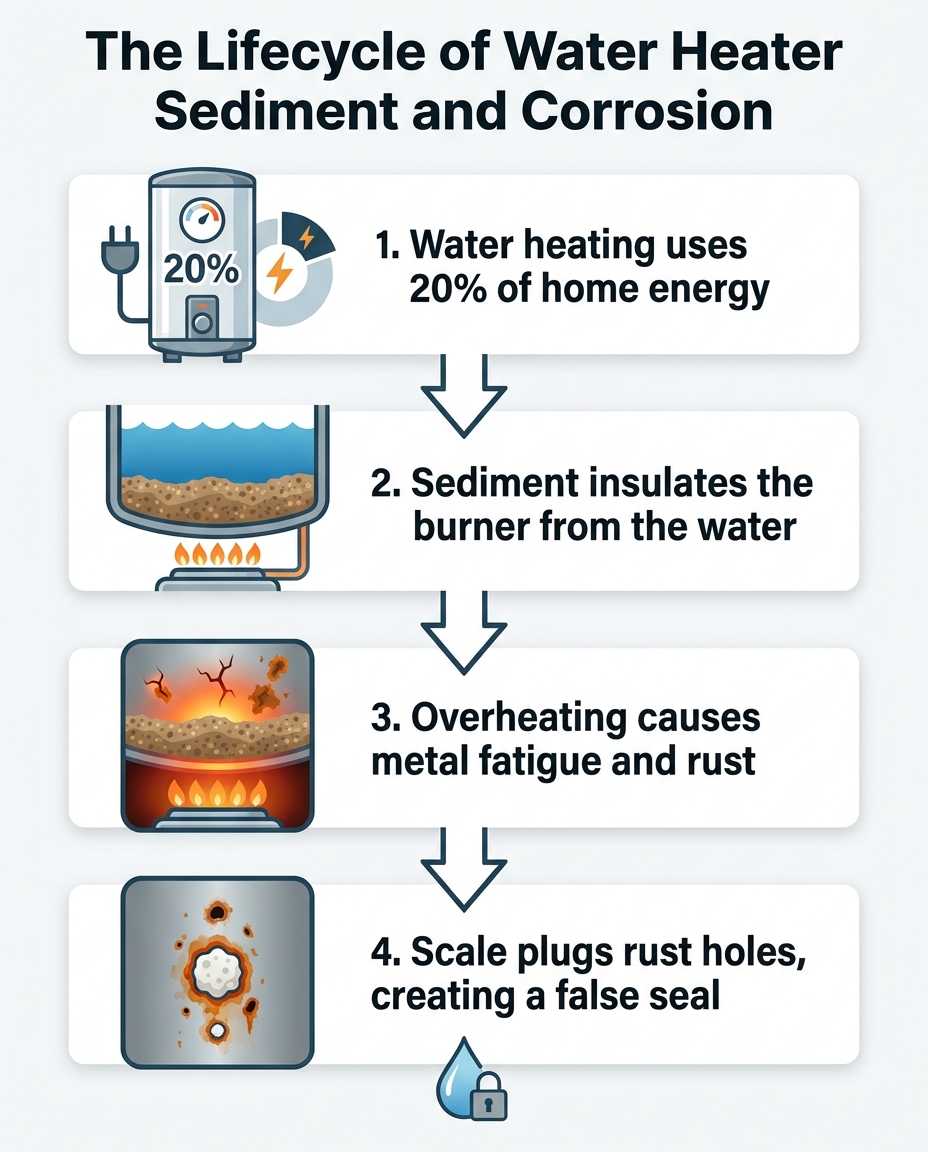
3. The false seal forms: The hardened minerals temporarily plug the rust holes, preventing water from escaping onto your floor.
4. The plug is removed: When the tank is eventually flushed, the agitation and water flow wash away the mineral plug.
5. The leak is revealed: With the plug gone, water flows freely through the existing rust hole.
The sediment was never protecting the tank; it was acting as a temporary, highly unreliable bandage over a fatal wound.
Thermodynamics: How Sediment Actively Destroys the Tank Bottom
We must shift the perspective from sediment being a protective seal to recognizing it as the root cause of the damage. Water heating accounts for roughly 20% of a home's energy usage, making efficiency a critical factor in your household's overall energy consumption. When a thick layer of sediment forms at the bottom of your tank, it fundamentally alters the thermodynamics of the appliance.
In a gas-powered unit, the burner sits directly beneath the bottom of the steel tank. The goal is to transfer heat through the steel and directly into the water. However, calcium carbonate (the primary component of scale) is an excellent thermal insulator. When a thick layer of this rock-like sediment sits between the steel bottom and the water above, it blocks the heat transfer.
The Cycle of Overheating and Metal Fatigue
Because the heat cannot easily reach the water, the thermostat tells the burner to run longer and hotter to achieve the desired water temperature. This prolonged exposure to intense heat causes the steel at the bottom of the tank to overheat drastically.
The thermal stress cycle:
• Expansion: The overheated steel expands more than it was engineered to withstand.
• Weakening: The constant extreme expansion and contraction cause metal fatigue, weakening the structural integrity of the tank bottom.
• Fracturing: The glass lining inside the tank cracks under the stress, exposing raw steel to water.
• Rusting through: The raw steel rusts rapidly, eventually fracturing entirely.
In this way, the sediment is not just a harmless byproduct of hard water; it is an active participant in the destruction of your 8+ year old tanks.

The Dangers of Ignoring Tank Maintenance Before Winter
Understanding the destructive nature of sediment is only half the equation; timing is the other. Leaving sediment untouched is a massive risk, particularly as we enter the early fall pre-heating season. Every September, our team at Midwest Mechanical prepares for the significant shift in operational demands placed on our customers' plumbing infrastructure as the seasons change.
The Problem: As late fall and winter approach, the temperature of the incoming municipal ground water drops significantly. In the summer, the water entering your home might be relatively mild, requiring less energy to bring it up to the standard 120 degrees Fahrenheit. In the winter, that incoming water is frigid.
The Cause: This colder incoming water forces the unit to work much harder and run for significantly longer cycles to reach the set temperature. If your tank is suffering from a thick layer of insulating sediment, the burner is already struggling to transfer heat. The sudden influx of freezing ground water pushes the system to its absolute limits, exacerbating the overheating of the weakened tank bottom.
The Solution: Proactive assessment. Connecting this increased winter workload to a weakened, sediment-insulated tank bottom illustrates why ignoring the issue is so dangerous. Choosing to skip maintenance out of fear risks a sudden, catastrophic tank rupture during the coldest months of the year, precisely when you need reliable hot water the most.
Why DIY Flushing is Highly Risky for Aging Units
While the myth that flushing causes leaks is false, there are still very real dangers associated with servicing older units—specifically when homeowners attempt to do it themselves. Assessing the structural integrity of a tank and its components requires a licensed professional. A pattern we see often in our Wichita service area is DIY attempts on 8+ year old tanks ending in disaster, not because the tank bursts, but because the external components fail under pressure.
One of the most vulnerable parts of an aging unit is the drain valve located near the bottom of the tank. On many older models, these valves are made of plastic. Over years of constant exposure to high heat and expanding metal, this plastic becomes incredibly brittle.
The Drain Valve Danger Zone
When an untrained individual attempts to force open a calcified, stuck drain valve, the brittle plastic can easily snap off entirely. If the tank is full of hot water when this happens, the result is an unstoppable flood of scalding water into the home.
Furthermore, even if the valve opens successfully, there is a high risk of large chunks of sediment flowing into the narrow valve opening and blocking it halfway through the flush. When this occurs, the valve cannot be closed fully, resulting in a continuous, heavy drip that cannot be stopped without professional intervention. This is similar to the mechanical failures we discuss when understanding why your water heater relief valve is leaking; old, calcified components simply do not operate as intended. A licensed professional knows how to safely test these valves and has the equipment to manage a failure if one occurs.
Professional Evaluation: The Safe Approach to Older Units
Because of the risks associated with brittle valves and hidden corrosion, a professional evaluation is the only safe way to handle a potentially compromised tank. Since opening our doors in 2004, our team at Midwest Mechanical has provided long-standing local expertise in safely evaluating aging plumbing systems without putting Wichita homes at risk of a DIY flood.
When a professional arrives during the early fall pre-heating season, they do much more than simply hook up a hose. They perform a comprehensive diagnostic check to determine if the unit can be safely flushed or if it is too degraded to withstand the process.
Comprehensive Tank Diagnostics
A professional evaluation typically entails:
• Visual Inspection: Checking the exterior of the tank, the fittings, and the supply lines for early signs of rust or weeping joints.
• Valve Testing: Carefully testing the Temperature and Pressure (T&P) relief valve to ensure it operates safely and can release excess pressure.
• Anode Rod Assessment: Inspecting the sacrificial anode rod (if accessible) to determine if the tank has been operating without internal corrosion protection.
• Controlled Draining: Utilizing professional-grade tools to safely clear the drain valve and manage sediment blockages without snapping brittle components.
Enrolling in our preventative maintenance plan ensures these checks happen on a safe, predictable schedule. The peace of mind that comes from knowing your unit has been cleared by a professional—and won't fail unexpectedly when the winter freeze sets in—is invaluable. This assessment is a critical part of comprehensive home winterization.
Frequently Asked Questions About Aging Water Heaters
Is it too late to flush my 8 year old water heater?
It is not necessarily too late, but it requires caution and professional oversight. If 8+ year old tanks have never been flushed, a professional should evaluate the tank's integrity first to ensure the valves and lining can withstand the process. Flushing a severely neglected tank without an assessment might expose existing leaks that were temporarily plugged by scale.
Does sediment hold a water heater together?
No, sediment does not provide any structural support to the appliance. It can temporarily plug holes caused by rust, creating a false sense of security that the tank is completely intact. In reality, the sediment is actually the primary cause of the corrosion because it overheats the metal beneath it.
What happens if you don't flush your water heater?
Sediment builds up at the bottom of the tank and acts as a thick thermal insulator between the burner and the water. The unit loses energy efficiency and costs significantly more to operate as it struggles to transfer heat. Ultimately, the bottom of the tank overheats, accelerating metal fatigue and leading to a complete structural failure.
Can you break a water heater by flushing it?
Flushing correctly does not break the internal steel tank of the heater. However, forcing a brittle, calcified drain valve can break the valve itself, leading to an uncontrolled leak. This is exactly why professional servicing is strongly recommended for older units rather than attempting a DIY drain.
How often should Wichita homeowners flush their water heaters?
Due to the hard water in our region, our plumbers highly recommend annual flushing to keep the system healthy. Regular maintenance prevents the dangerous, thick buildup of scale that leads to overheating. Consistent professional check-ups extend the overall lifespan of the unit and ensure it runs efficiently through the winter.
Protect Your Home With an Expert Assessment Before Winter
Ultimately, knowing the true condition of your tank is always better than ignoring it and hoping for the best. The myth that maintenance causes leaks only serves to keep homeowners in the dark about the real, hidden damage occurring inside their appliances. As we move through the early fall pre-heating season, the importance of acting before the cold weather sets in cannot be overstated. We encourage you to schedule a professional evaluation with Midwest Mechanical to safely assess your options, clear out damaging sediment, and ensure your home is protected with a reliable, efficient source of hot water all winter long.
Customer Testimonials
Hear from satisfied customers who trust us for reliable HVAC and plumbing service across Wichita.





Plus, the technician, Lee was very professional, knowledgeable and informative.
We will definitely be doing business with them sometime again in the past.
I'm prompt to my appointment. Thank you Midwest Mechanical.
I'm prompt to my appointment. Thank you Midwest Mechanical.

We have partnered with GoodLeap to offer flexible payment options for your project. GoodLeap uses a soft credit check until funding and the highest score from all 3 bureaus to see if you qualify. It also takes just a few minutes to get started.




Service Areas
.svg)