


The Frustration of the False Fix: Why Your Kitchen Sink Keeps Backing Up
Your sink is backing up again, and resolving Kitchen Sink Clogs: Grease Buildup vs Foreign Objects requires understanding exactly what is blocking your pipe before you try to clear it. You likely plunged the drain, or maybe you even used a basic hand auger, and the water finally went down. For a few days, everything seemed completely normal. Then, you poured out a pot of pasta water or rinsed a dinner plate, and the dirty water immediately started pooling around the drain all over again. This cycle of temporary relief followed by immediate failure is incredibly frustrating for homeowners.
At Midwest Mechanical, our team sees this exact scenario play out in Wichita residential homes almost daily, with homeowners assuming a quick plunge or a few turns of a consumer-grade snake will fix the issue forever. The reality is that misdiagnosing the clog inevitably leads to applying the wrong clearing method. If you do not know whether you are fighting a hard physical object lodged in the P-trap or a thick, sticky wall of sludge coating the entire plumbing line, the problem will persist. Determining the true nature of the blockage is the critical first step in professional Plumbing Services to ensure a permanent solution rather than a temporary bandage.
Identifying Solid Blockages: Foreign Object Clogs
A foreign object clog occurs when a specific, physical item becomes lodged inside the plumbing system, creating a static barrier that prevents water from flowing freely. In a kitchen setting, these objects are typically items that should never have gone down the drain in the first place, or items that a garbage disposal failed to properly pulverize. In our experience, common culprits include un-grindable food scraps like fibrous celery stalks, thick potato peels, or tough bone fragments. Occasionally, non-food items like small utensils, bottle caps, or pieces of plastic packaging slip past the sink strainer and become wedged in the curved section of the pipe known as the P-trap.
Because these objects are completely solid, they create a static physical obstruction. They sit in one specific location within the pipe. As water flows past the obstruction, the solid object acts like a net, catching smaller debris, hair, and minor food particles over time. Eventually, this accumulation blocks the diameter of the pipe entirely. However, the fundamental nature of the clog remains static. It does not grow on its own, nor does it coat the walls of the pipe for several feet in either direction.
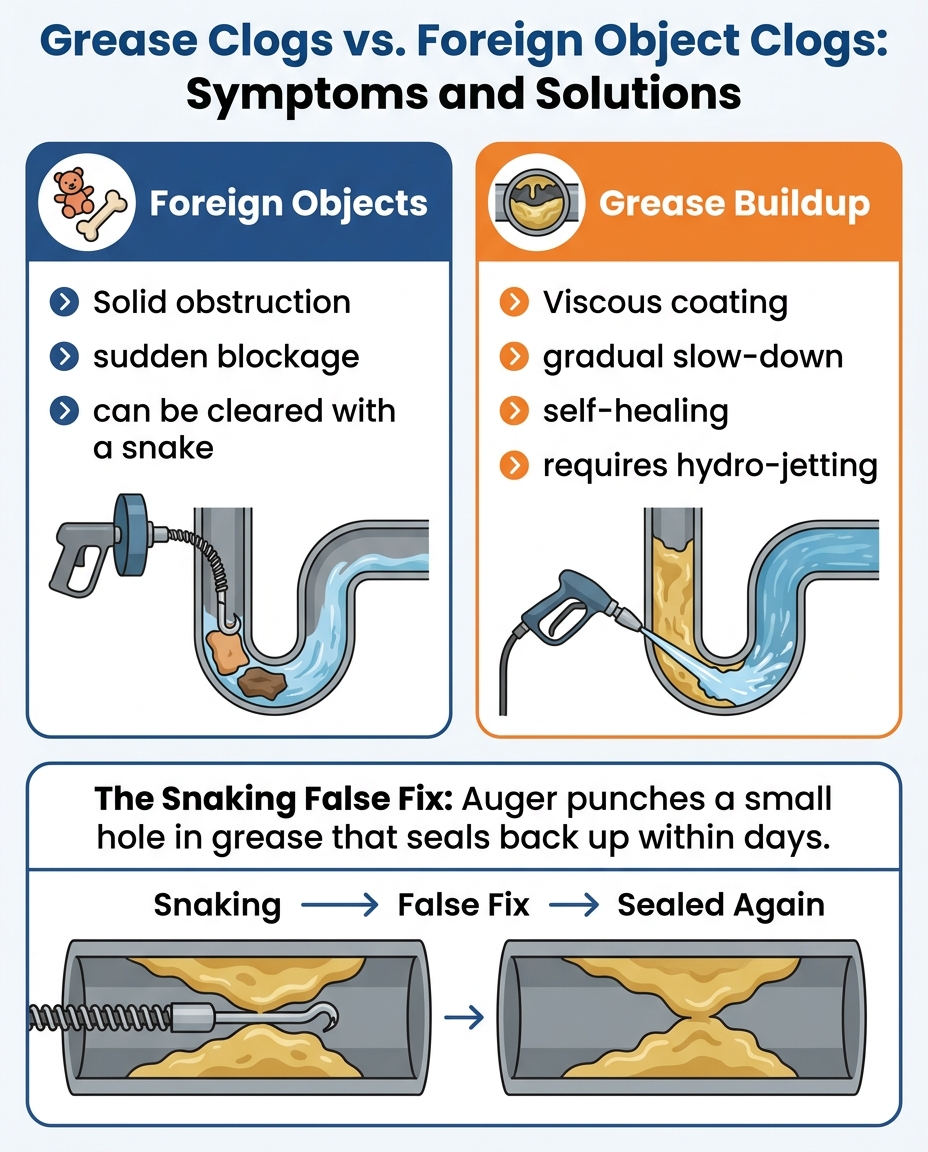
This static nature is exactly why solid object clogs can usually be resolved with standard mechanical tools. A professional plumbing auger, commonly referred to as a snake, is designed specifically for this type of blockage. The metal coil can hook onto the solid object, break it apart into smaller, flushable pieces, or push it completely through the system into the wider municipal sewer line. Once the object is removed or destroyed, the pipe is immediately clear, and normal water flow resumes.
Signs Your Clog is a Solid Object
Correctly identifying a foreign object clog saves time and prevents unnecessary frustration. Here are the most common indicators that your drain is blocked by a solid item rather than a buildup of sludge:
• Sudden, immediate blockage: The sink was draining perfectly fine yesterday, but today the water stops completely. There was no gradual slowing of the drain over several weeks.
• Occurs after disposal use: The backup happens immediately after running the garbage disposal, usually indicating that a large piece of debris was pushed into a narrow pipe section.
• Immediate resolution upon removal: Once the specific object is retrieved from the P-trap or pushed through by an auger, the water drains normally and the issue does not return a few days later.
• No foul, rancid odors: While there may be a mild smell of stagnant water, solid object clogs generally lack the intense, rotting odor associated with decaying grease and organic sludge.
The Self-Healing Trap: How Grease Clogs Behave Differently
Fats, Oils, and Grease—commonly referred to in the plumbing industry as FOG—behave entirely differently than solid objects. When you pour warm bacon grease, cooking oil, or even seemingly harmless dairy products down the kitchen sink, they enter the drain as a warm, free-flowing liquid. Because they are liquid, they easily pass through the sink strainer and the initial sections of the plumbing. However, this liquid state is strictly temporary.
As the FOG travels further down the plumbing line, it rapidly cools and congeals. Instead of settling in one specific spot like a dropped spoon or a bone fragment, grease coats the entire inner circumference of the pipe wall. Layer by layer, meal after meal, this sticky coating grows thicker. It gradually restricts the interior diameter of the pipe, reducing water flow until it eventually closes completely. This process can span several feet of the plumbing line, creating an extensive, viscous barrier rather than a localized blockage.
Furthermore, grease acts as an incredibly effective, sticky trap. As it coats the pipe walls, it catches everything else that washes down the drain. Coffee grounds, soap scum, tiny food particles, and mineral deposits embed themselves into the sticky grease wall, creating a dense, concrete-like sludge. Because grease clogs are dynamic and viscous, they can shift, settle, and mold themselves to the shape of the pipe.
This rapid solidification is heavily influenced by external temperatures. As we head into the September early fall transition, our technicians typically see a spike in these calls, as dropping overnight temperatures cause uninsulated or exterior-facing pipes to cool rapidly. Liquid cooking fats turn into solid blockages much faster in these cooler pipes than they do in the heat of peak summer. What might have made it all the way to the municipal sewer line in July will often freeze into a solid wall of grease just a few feet past your kitchen wall in late September.

Why a Standard Plumbing Snake Fails on Grease
The core frustration for many homeowners facing recurring sink backups stems from a misunderstanding of how standard plumbing tools interact with different types of blockages. A plumbing snake, or auger, is a highly effective tool for retrieving or breaking apart solid objects. It features a coiled metal cable with a specialized tip designed to bore into roots, hook onto debris, or smash through hard physical barriers. However, when this mechanical action is applied to a dense wall of viscous grease, the physics of the tool work against it.
When an auger is pushed into a pipe coated with heavy FOG buildup, it does exactly what it was designed to do: it bores a hole. The metal coil pushes through the sticky sludge, creating a narrow tunnel directly through the center of the grease wall. It does not scrape the walls clean, nor does it remove the grease from the system. It merely displaces the sludge enough to let the cable pass through.
This creates the dreaded "false fix" phenomenon. Once the auger is retracted, the homeowner turns on the faucet and sees the water draining perfectly. The water is flowing through the narrow tunnel the snake just created. The homeowner assumes the clog is completely resolved and goes back to their normal routine. However, the vast majority of the grease is still clinging to the walls of the pipe.
Because grease is a viscous, self-healing material, that narrow tunnel will not stay open for long. Within days, or sometimes even hours, the sticky grease collapses back in on itself, sealing the pipe completely shut once again. The next time you try to drain a large volume of water, it backs up immediately, leaving you right back where you started.
The Cycle of Recurring Backups
This false sense of security leads to a frustrating cycle of recurring backups. Homeowners often blame themselves for poor drain habits, assuming they must have dropped something down the sink again. In reality, the real issue is an uncleared grease wall that was never properly addressed. Repeatedly snaking the line only continues to poke temporary holes without removing the underlying FOG buildup. Every time the snake is used, the tunnel is reopened, and every time the snake is removed, the grease slowly slumps back down to choke off the water supply.
Chemical Drain Cleaners: A Risky Reaction to Recurring Clogs
When plunging and snaking continually fail to provide a lasting solution, we often see frustrated homeowners resort to pouring liquid chemical drain cleaners down the sink. The marketing on these bottles promises to dissolve tough clogs and restore free-flowing drains in minutes. However, relying on harsh chemicals to clear a heavy grease blockage is not only ineffective, but it also introduces significant risks to your plumbing system and your safety.
The primary issue with chemical drain cleaners is how they interact with dense FOG buildup. Most commercial drain cleaners are heavier than water, designed to sink through standing water to reach the clog. But when they encounter a solid wall of congealed grease, they often fail to penetrate it. Instead, the caustic chemicals sit directly on top of the dense grease clog, creating a hazardous pool of highly reactive, toxic water inside your pipes.
These chemicals rely on intense exothermic reactions to generate heat, theoretically melting the blockage. When these chemicals sit stagnant on top of a grease wall, that intense heat is directed outward into the pipe walls rather than downward into the clog. Over time, this localized heat can warp PVC pipes, weaken pipe joints, and accelerate corrosion in older metal plumbing systems. You can read more about this exact process in our detailed guide on Why Chemical Drain Cleaners Are Making Your Slow Drain Worse.
Furthermore, if the chemicals fail to clear the blockage—which is highly likely with severe grease buildup—the pipe remains clogged, but now it is filled with caustic, burning liquid. If a professional plumber has to open the pipe later to mechanically clear the drain, they are put at serious risk of chemical burns. Professional mechanical clearing is always safer for both the integrity of your plumbing system and the environment.
Scouring the Pipe Walls: The Power of Hydro-Jetting
If snaking only pokes a hole and chemicals only damage the pipe, how do you permanently resolve a heavy grease clog? The definitive, required professional solution for completely resetting grease-choked pipes is hydro-jetting. This advanced plumbing technology abandons the mechanical boring action of a snake in favor of the sheer scouring power of highly pressurized water.
Hydro-jetting utilizes a specialized machine to pump water at extreme pressures—often between 3,000 and 4,000 PSI—through a heavy-duty hose. The end of the hose is fitted with a specialized, multi-directional nozzle. As the hose is fed into the clogged plumbing line, the nozzle blasts water forward to break apart the initial blockage, while simultaneously blasting water backward at an angle to propel the hose forward and scour the interior pipe walls.
Unlike snaking, which merely displaces the grease, hydro-jetting physically shears the sticky sludge off the interior circumference of the pipe. The high-pressure water breaks the congealed fats into tiny, harmless particles and flushes them entirely out of the residential system and into the main municipal sewer line. This process restores the pipe to its original interior condition, completely stopping the cycle of recurring backups.
• Plumbing Snake — Mechanism of Action: Mechanical boring and hooking — Effect on Grease Clogs: Punches a small tunnel through the sludge — Long-Term Result: Temporary flow; grease collapses back quickly
• Chemical Cleaners — Mechanism of Action: Exothermic heat reaction — Effect on Grease Clogs: Sits on top, attempting to melt the surface — Long-Term Result: Ineffective clearing; risks severe pipe damage
• Hydro-Jetting — Mechanism of Action: High-pressure water scouring — Effect on Grease Clogs: Shears grease off the entire pipe circumference — Long-Term Result: Permanent reset; restores full pipe diameter
It is important to note that hydro-jetting is strictly a professional service. The extreme water pressure required to clear heavy grease can damage fragile or severely compromised pipes if applied incorrectly. Established in 2004, our experienced professionals at Midwest Mechanical understand the specific nuances of local pipe systems across all Wichita Service Areas. A thorough video camera inspection is always performed before jetting to ensure the plumbing infrastructure can safely handle the pressure required for a complete reset.
Stopping the Cycle: Best Practices for Kitchen Sink Drains
Once a professional hydro-jetting service has restored your kitchen drain to its original, free-flowing condition, keeping it that way requires a shift in daily habits. Bridging the gap from a technical repair to proactive, preventative maintenance is the best way to ensure you never have to deal with a severe grease clog again. By controlling what enters your plumbing system, you can extend the life of your pipes and maintain optimal drainage.
Here are the best practices for keeping your kitchen sink drains clear long-term:
1. Wipe down greasy pans before washing: Never rinse a pan coated in bacon grease, butter, or cooking oil directly into the sink. Use a paper towel to wipe out the majority of the residual FOG and throw the paper towel in the trash before washing the pan with soap and water.
2. Collect excess cooking oils properly: If you have a large volume of cooking oil from deep-frying or searing, pour it into a disposable container, such as an old coffee can or a glass jar. Let it solidify at room temperature, then dispose of the entire container in the regular household trash.
3. Run cold water with the disposal: When running your garbage disposal, always use cold water rather than hot water. Hot water melts incidental fats, allowing them to travel deeper into the pipe before solidifying. Cold water helps any small amounts of fat remain solid so they can be ground up by the disposal blades and safely flushed away.
4. Use sink strainers: Invest in a high-quality mesh sink strainer to catch un-grindable food scraps, coffee grounds, and small physical debris before they can enter the P-trap and create a solid blockage.
5. Schedule routine inspections: Especially during the September early fall transition when dropping temperatures accelerate grease solidification, routine professional drain inspections can catch minor buildup before it causes a complete blockage. Enrolling in a comprehensive Preventative Maintenance Plan ensures your plumbing system is regularly monitored and maintained by experienced technicians.
Frequently Asked Questions About Stubborn Kitchen Sink Clogs
Will a plumbing snake clear a grease clog?
No, a standard plumbing snake will not permanently clear a grease clog. The mechanical auger is designed to hook solid objects, so when it hits a wall of viscous grease, it only punches a temporary hole through the sludge. Once the snake is removed, the sticky grease quickly collapses back into the tunnel, sealing the pipe shut and causing the sink to back up again within days.
Why does my kitchen sink keep clogging after being snaked?
If your kitchen sink keeps clogging shortly after being snaked, the blockage is almost certainly caused by grease buildup rather than a solid object. The snake did not remove the grease from the interior pipe walls; it merely displaced it temporarily. Because the actual volume of sludge remains inside the plumbing line, the rapid recurrence of the backup is inevitable until the pipe is properly scoured.
How do plumbers remove hard grease from pipes?
Professionals remove hard grease from pipes using a specialized process called hydro-jetting. This equipment utilizes highly pressurized water pumped through a multi-directional nozzle to scour the interior pipe walls. The intense water pressure breaks the congealed grease away from the pipe surface and flushes the sludge completely out of the residential plumbing system.
What is the difference between snaking and hydro jetting?
The primary difference lies in their mechanism of action. Snaking uses a physical, mechanical auger cable to break up or retrieve solid objects like food scraps or utensils lodged in the pipe. Hydro-jetting uses highly pressurized water to wash away sticky, viscous buildup like grease and soap scum, effectively restoring the interior diameter of the pipe to its original condition.
Can boiling water clear a grease clog in the main line?
Boiling water is generally ineffective for clearing a grease clog in a main plumbing line. While it may temporarily soften minor grease deposits near the immediate drain opening, the water cools rapidly as it travels deeper into the plumbing system. This often just pushes the melted grease further down the pipe, where it quickly solidifies again and creates a much harder blockage to reach.
How fast does grease solidify in residential plumbing?
Grease can solidify within minutes of cooling down. This process happens exceptionally fast in exterior-facing pipes or uninsulated crawlspaces, particularly during colder seasonal transitions when pipe temperatures drop significantly. Once the liquid fat hits the cold pipe wall, it congeals almost instantly, beginning the process of restricting water flow.
Break the Cycle of Recurring Sink Backups
Dealing with a kitchen sink that refuses to drain is stressful, but dealing with a sink that drains fine one day and backs up the next is infuriating. The short answer is that understanding the fundamental difference between grease buildup and foreign object clogs is the absolute key to securing a permanent fix. While solid objects can be easily hooked and removed, the self-healing, viscous nature of grease requires a much more robust approach.
If you have been caught in the frustrating cycle of plunging, snaking, and watching the water back up all over again, our team is here to help you step away from the temporary fixes. Hydro-jetting is the necessary professional solution to scour your pipe walls clean and stop the cycle of recurring grease backups for good. Reach out to Midwest Mechanical for a professional diagnostic today to determine exactly what is blocking your pipes, and get the clear, free-flowing drains your home deserves.
Customer Testimonials
Hear from satisfied customers who trust us for reliable HVAC and plumbing service across Wichita.





Plus, the technician, Lee was very professional, knowledgeable and informative.
We will definitely be doing business with them sometime again in the past.
I'm prompt to my appointment. Thank you Midwest Mechanical.
I'm prompt to my appointment. Thank you Midwest Mechanical.

We have partnered with GoodLeap to offer flexible payment options for your project. GoodLeap uses a soft credit check until funding and the highest score from all 3 bureaus to see if you qualify. It also takes just a few minutes to get started.




Service Areas
.svg)