


The Hidden Electrical Surprise During Late-Summer Kitchen Upgrades
Many homeowners believe that replacing a broken garbage disposal is a simple, straightforward task. The reality of Upgrading Your Kitchen Sink: Hardwired vs Plug-in Garbage Disposals is often much more complicated. You buy a shiny new unit, clear out the cabinet under the sink, and suddenly discover a major mismatch: your new appliance has a standard wall plug, but your old unit is wired directly into the wall. There is no outlet to be found, just a metal cable disappearing into the drywall.
These discoveries frequently happen during late-summer kitchen upgrades, right when families are putting heavy wear and tear on their appliances before the back-to-school rush. After months of processing summer produce and handling extra meals, older disposals often burn out, prompting a sudden need for a replacement. What starts as a quick weekend swap quickly becomes a complex electrical puzzle.
Resolving this mismatch safely requires professional plumbing services to ensure both your water lines and electrical connections are secure. You cannot simply cut the plug off a new appliance and twist the wires together. Understanding the differences between these two power delivery methods is the first step toward making a safe, long-lasting upgrade to your kitchen.
Understanding Your Under-Sink Wiring: Hardwired vs. Plug-In Basics
Before making any decisions about your kitchen setup, it helps to understand exactly what you are looking at under the sink. The two primary methods for powering a garbage disposal operate on entirely different principles of electrical delivery.
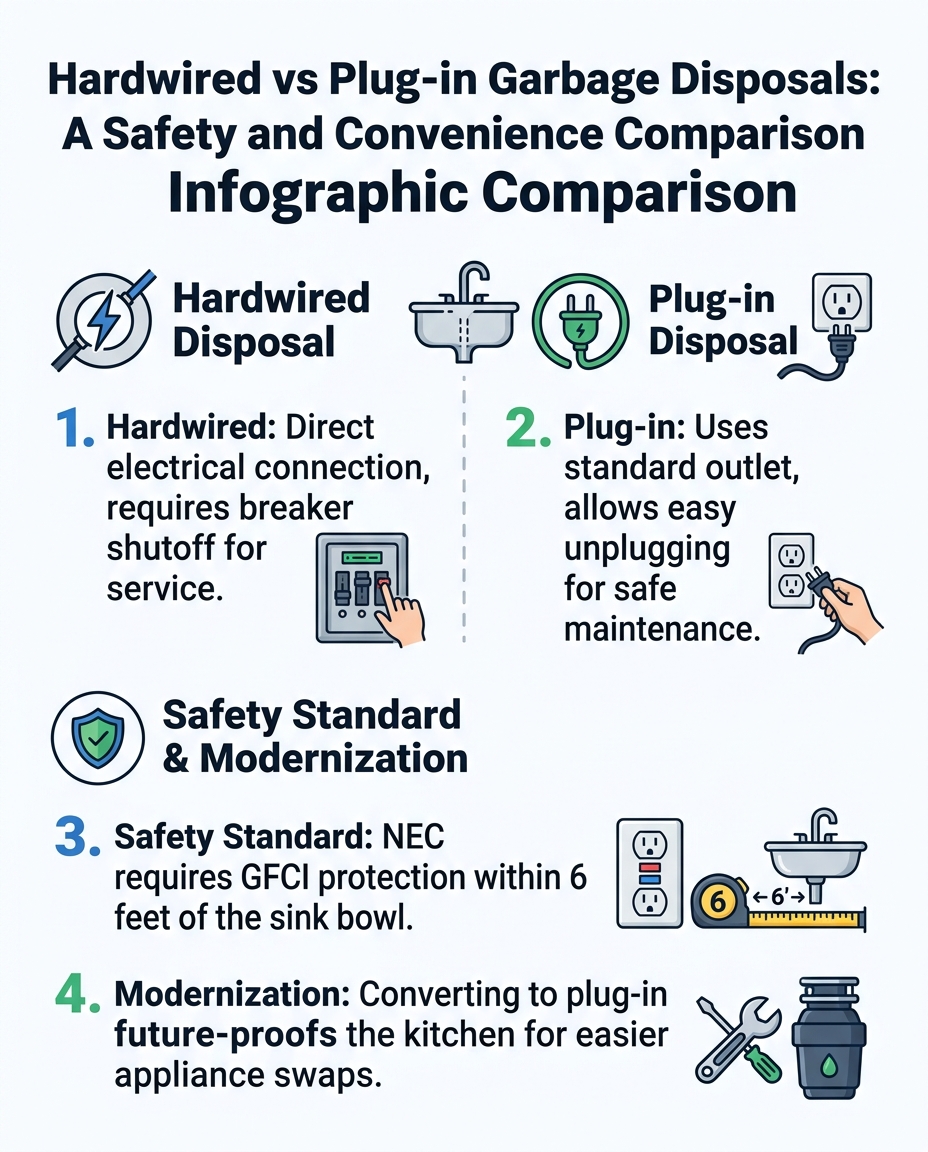
Hardwired disposals are units that do not have a traditional power cord. Instead, the home's electrical cable (usually protected by flexible metal conduit) runs directly into the bottom of the disposal unit. Inside a small access panel on the appliance, the home's live wires are spliced directly to the disposal's internal wiring using wire nuts. Because there is no plug to pull, the only way to cut power to a hardwired disposal is to flip the breaker at your main electrical panel.
Plug-in disposals, on the other hand, feature a standard three-prong power cord. This cord plugs directly into a dedicated electrical receptacle located inside the cabinet under the sink. If you need to service or replace the unit, you simply unplug it from the wall, instantly rendering the appliance safe to handle.
Older housing stock in the Wichita area often features legacy hardwired setups that predate current GFCI (Ground Fault Circuit Interrupter) safety standards. Decades ago, hardwiring heavy-duty kitchen appliances was the standard practice for home builders. However, building codes evolve as safety technology improves. Today, altering either of these systems requires licensed plumbing and electrical code compliance rather than guesswork. Attempting to bridge the gap between a legacy hardwired system and a modern plug-in appliance without professional guidance is where many homeowners run into serious trouble.
The Case for Hardwired Garbage Disposals: Pros, Cons, and Limitations
If you discover a hardwired setup under your sink, your first instinct might be to find a compatible hardwired replacement disposal and keep the system exactly as it is. While this is sometimes possible, it requires an objective look at the benefits and drawbacks of legacy wiring.
• Space Requirements — Hardwired Disposals: Eliminates the physical bulk of a wall outlet, saving a tiny amount of cabinet space. — Plug-in Disposals: Requires a mounted electrical box and receptacle inside the cabinet.
• Connection Security — Hardwired Disposals: Wires are physically spliced and housed in conduit; less prone to accidental unpluggings. — Plug-in Disposals: Can technically be bumped or unplugged by tall items stored under the sink.
• Maintenance Difficulty — Hardwired Disposals: Significantly harder to replace or service. Requires shutting off the main breaker and handling bare wires. — Plug-in Disposals: Extremely easy to service. Simply pull the plug from the receptacle to cut power safely.
• Modern Compatibility — Hardwired Disposals: Severely limits your choices, as most modern retail units are designed as plug-in models. — Plug-in Disposals: Universally compatible with almost all modern garbage disposals found in stores today.
The primary limitation of sticking with a hardwired setup is that it does not align with the easiest modern upgrade paths. Every time the disposal needs to be replaced in the future, it will demand licensed plumbing and electrical code compliance to safely disconnect and reconnect the live wires. You are continually kicking the can down the road, ensuring that every future repair remains a complex, dual-trade project.
When Hardwiring Makes Sense
There are rare scenarios where maintaining a hardwired connection is the most logical choice. If you are replacing a unit in a home where updating the electrical panel is currently unfeasible, sticking with the existing infrastructure might be necessary. Additionally, if a professional inspects the existing hardwired circuit and finds it to be in perfect, safe condition with proper grounding, a direct replacement can be performed. However, this is becoming the exception rather than the rule in modern home maintenance.

The Shift to Plug-In Disposals: Modern Convenience and GFCI Safety
The home improvement industry has largely shifted away from hardwired kitchen appliances in favor of plug-in models. This transition is driven by a combination of modern convenience, improved safety standards, and ease of maintenance. Converting an old hardwired line into a dedicated receptacle is often the smartest move a homeowner can make.
• Streamlined future replacements: Once a receptacle is professionally installed, any future disposal replacements become vastly simpler. The unit can be unplugged without ever exposing live wires, making routine maintenance far safer.
• Critical GFCI integration: Plug-in setups allow for the easy integration of GFCI receptacles. These specialized outlets monitor the flow of electricity and instantly cut power if they detect a ground fault, providing critical protection against water-related electrical shocks.
• Appliance versatility: Having a dedicated outlet under the sink opens up possibilities for other modern kitchen upgrades, such as instant hot water dispensers or under-sink water filtration systems that require standard power.
The only notable drawback to this transition is the initial investment required to safely convert the existing hardwired line into a code-compliant receptacle. However, making this upgrade during late-summer kitchen upgrades prepares the home for decades of safe use. It is a one-time structural improvement that pays dividends every time the space needs to be serviced.
Why DIY Under-Sink Electrical Splicing is a Dangerous Gamble
The space beneath a kitchen sink is one of the most hazardous environments in a home for amateur electrical work. It is a dark, confined area packed with pressurized water supply lines, PVC drain pipes, and often an array of liquid cleaning supplies. Mixing exposed electrical wiring into this damp environment without professional training is a severe safety hazard.
Improper DIY splicing can lead to immediate shorts, appliance failure, or severe shock hazards. A wire nut that is not tightened correctly, or a ground wire that is left unattached, turns the metal casing of the disposal into a potential electrocution risk. Furthermore, the vibrations generated by a heavy-duty garbage disposal motor can easily rattle loose amateur wiring connections over time, creating a hidden fire hazard inside the wooden cabinetry.
Beyond the electrical dangers, the physical struggle of trying to balance a heavy disposal while simultaneously twisting wires together often compromises the plumbing connections. Amateur installations frequently result in frustrating plumbing issues, like understanding why your new garbage disposal is leaking under the sink due to improper mounting and uneven flange pressure during the wiring struggle. Water dripping directly onto fresh, amateur electrical splices is a worst-case scenario.
Because of these compounding risks, this type of work absolutely demands licensed plumbing and electrical code compliance. The stakes are simply too high to rely on internet tutorials when dealing with the intersection of water and high-voltage electricity.
Navigating Local Plumbing Codes and National Electrical Standards
When modifying how an appliance draws power, you are no longer just doing a simple home repair; you are engaging with established safety regulations. The National Electrical Code (NEC) provides strict guidelines for how power must be delivered in wet or damp environments, and these rules exist specifically to protect homeowners.
One of the most critical NEC requirements mandates GFCI protection for any receptacles installed within 6 feet of the top inside edge of a sink bowl. Because the area under a kitchen sink falls well within this splash zone, a standard electrical outlet is not sufficient. If a pipe leaks or a drain backs up, a GFCI outlet will detect the moisture-induced electrical imbalance and trip the circuit in milliseconds, preventing a shock.
Additionally, modern codes often require dedicated circuits for heavy-draw kitchen appliances. A garbage disposal motor requires a significant surge of power upon startup. If it shares a circuit with the dishwasher or the microwave, it can easily overload the breaker. Converting a hardwired unit to a plug-in often triggers the requirement to bring that immediate circuit up to current safety standards.
Updating older Wichita homes to meet current Sedgwick County and Kansas electrical and plumbing codes is a standard requirement during these conversions. Navigating these regional requirements can be confusing for a homeowner, which is why relying on professionals offers the peace of mind that comes with guaranteed licensed plumbing and electrical code compliance. The work is done correctly, safely, and legally.
Future-Proofing Your Home's Plumbing and Electrical Systems
The concept of future-proofing involves making strategic investments in your home today that simplify maintenance, reduce hazards, and lower costs later. Converting a legacy hardwired disposal to a modern, code-compliant plug-in system is a textbook example of future-proofing.
Homes are dynamic environments, and the infrastructure hidden behind the walls and inside the cabinets must evolve to keep up with modern demands. You can draw parallels to other critical home system updates, such as water heater upgrades, which also benefit immensely from being brought up to modern safety and efficiency standards. Just as you wouldn't install a new water heater using outdated, corroded piping, you shouldn't install a modern disposal on outdated, legacy wiring.
Tackling these necessary conversions during late-summer kitchen upgrades minimizes disruption to your household routine. Instead of waiting for an emergency failure in the middle of preparing a holiday meal, proactively updating the under-sink electrical infrastructure ensures your kitchen is ready for whatever demands you place on it. The long-term value of moving away from outdated legacy wiring cannot be overstated—it makes your home safer, more functional, and easier to maintain for the next generation of appliances.
The Value of Professional Garbage Disposal Installation
Given the complexities of local codes, the hazards of mixing water and electricity, and the physical difficulty of the installation itself, hiring an expert is the most reliable path forward. Midwest Mechanical stands in a unique position as a dual-threat authority, providing licensed and code-compliant professional installation services that ensure the disposal is both securely plumbed and safely wired.
When a professional handles your kitchen sink upgrade, they execute a precise, multi-step process designed to protect your home:
1. Comprehensive Electrical Assessment: The technician evaluates the existing hardwired circuit to ensure it can handle the load of a modern disposal motor without tripping breakers.
2. Safe Code Conversion: If converting to a plug-in, the technician safely terminates the hardwired connection and installs a dedicated, code-compliant GFCI receptacle inside the cabinet.
3. Watertight Plumbing Integration: The new disposal is securely mounted to the sink flange using professional-grade plumber's putty, and the dishwasher drain and P-trap are precisely aligned to prevent future leaks.
4. Performance Testing: The system is run with heavy water flow to verify that the motor operates smoothly, the electrical draw is stable, and there is zero moisture escaping the plumbing joints.
Professional installation also protects the appliance warranty, as many manufacturers will void the guarantee if the unit is damaged due to improper amateur wiring. To keep your newly installed systems running smoothly year-round, enrolling in a home maintenance plan ensures that both your plumbing and electrical infrastructure receive regular, expert check-ups. Ultimately, professionals handle the heavy lifting and the burden of licensed plumbing and electrical code compliance, leaving you with a perfectly functioning kitchen.
Making the Right Choice for Your Kitchen Sink Setup
Upgrading Your Kitchen Sink: Hardwired vs Plug-in Garbage Disposals doesn't have to be a stressful dilemma. While hardwired setups still exist in many older homes and can occasionally be maintained, converting to a plug-in GFCI receptacle is widely recognized as the safer, more convenient modern standard. It future-proofs your cabinetry, simplifies future maintenance, and brings your home up to current safety codes.
Regardless of which route you choose, licensed plumbing and electrical code compliance is non-negotiable. The risks of amateur electrical work in a wet environment are simply too severe. If you are planning a kitchen update and find yourself staring at confusing wires under the sink, our professional team can evaluate your current setup and recommend the safest path forward. Reach out for expert guidance today, and enjoy the peace of mind that comes with a perfectly installed, code-compliant kitchen appliance.
Frequently Asked Questions
Can you convert a hardwired disposal to a plug-in?
Yes, a hardwired disposal circuit can be converted to a plug-in setup. A licensed professional will safely terminate the existing hardwired cable into a mounted electrical box and install a standard outlet inside the cabinet. This conversion makes future appliance replacements much easier and safer.
Does a garbage disposal need a GFCI outlet?
Yes, modern electrical codes require GFCI protection for garbage disposals. The National Electrical Code mandates that any receptacle installed within six feet of the top inside edge of a sink bowl must be GFCI protected to prevent electrical shocks in wet environments. A professional can ensure your under-sink outlet meets this standard.
Why hire a professional for garbage disposal installation?
Hiring a professional ensures that both the plumbing and electrical components are handled safely and legally. Garbage disposals require watertight drain connections and secure, code-compliant electrical integration. A professional prevents dangerous leaks, avoids electrical shock hazards, and ensures the new appliance operates at peak performance without voiding the manufacturer's warranty.
Does a garbage disposal need a dedicated circuit?
In most modern installations, a garbage disposal should be on a dedicated circuit. Disposal motors draw a significant amount of power when they first turn on. If they share a circuit with other heavy-draw kitchen appliances like dishwashers or microwaves, they can easily overload the system and trip the breaker.
Is it better to hardwire or plug in a garbage disposal?
Plugging in a garbage disposal is generally considered better for modern homes. A plug-in setup allows for immediate, safe disconnection from power during maintenance and makes future appliance swaps a simple process. While hardwiring is acceptable if it meets current codes, it makes servicing the unit much more difficult.
What are the local code requirements for under-sink electrical in older homes?
Local codes typically require that any new electrical work, including converting a legacy hardwired system to a plug-in, must be brought up to current safety standards. This usually means installing a GFCI-protected receptacle and ensuring the circuit can handle the appliance's electrical load. A licensed professional will navigate these specific regional requirements to ensure full compliance and safety.
Customer Testimonials
Hear from satisfied customers who trust us for reliable HVAC and plumbing service across Wichita.




Plus, the technician, Lee was very professional, knowledgeable and informative.
We will definitely be doing business with them sometime again in the past.
I'm prompt to my appointment. Thank you Midwest Mechanical.
I'm prompt to my appointment. Thank you Midwest Mechanical.

We have partnered with GoodLeap to offer flexible payment options for your project. GoodLeap uses a soft credit check until funding and the highest score from all 3 bureaus to see if you qualify. It also takes just a few minutes to get started.




Service Areas
.svg)