


Solving the Simultaneous Shower Dilemma During Busy Summer Routines
Sizing a tankless water heater for two showers running at once requires specific mathematical calculations to ensure your home never runs out of hot water during peak usage hours. Here at Midwest Mechanical, our team regularly helps Wichita families navigate sudden spikes in hot water demand when multiple family members return home at the same time. It is July peak summer, and after a long afternoon of yard work, youth sports practices, and outdoor heat, the entire family wants to wash off immediately. When you rely on guesswork to choose a unit size, the result is often a frustrating drop in water pressure or a sudden blast of lukewarm water right in the middle of your routine.
Ensuring a continuous, comfortable supply of hot water requires understanding two critical metrics: Flow Rate (measured in Gallons Per Minute, or GPM) and Temperature Rise. If a unit cannot handle both of these variables simultaneously, it will fail to meet your household's expectations. To ensure your home is fully equipped for this high demand, reaching out for professional plumbing services is the smartest first step before making any equipment decisions.
The Baseline Math: Decoding Gallons Per Minute (GPM)
To accurately size a system, you must first calculate the total volume of water your fixtures demand at any given moment. Gallons Per Minute (GPM) is the standard measurement used to determine how much water flows through your pipes and out of your fixtures. When multiple fixtures run at the same time, their individual GPM ratings stack together, creating a cumulative demand on your water heating system.
In our years of servicing local plumbing systems, we have found that understanding this step-by-step breakdown of how to calculate the baseline GPM for your bathrooms is incredibly helpful for homeowners:
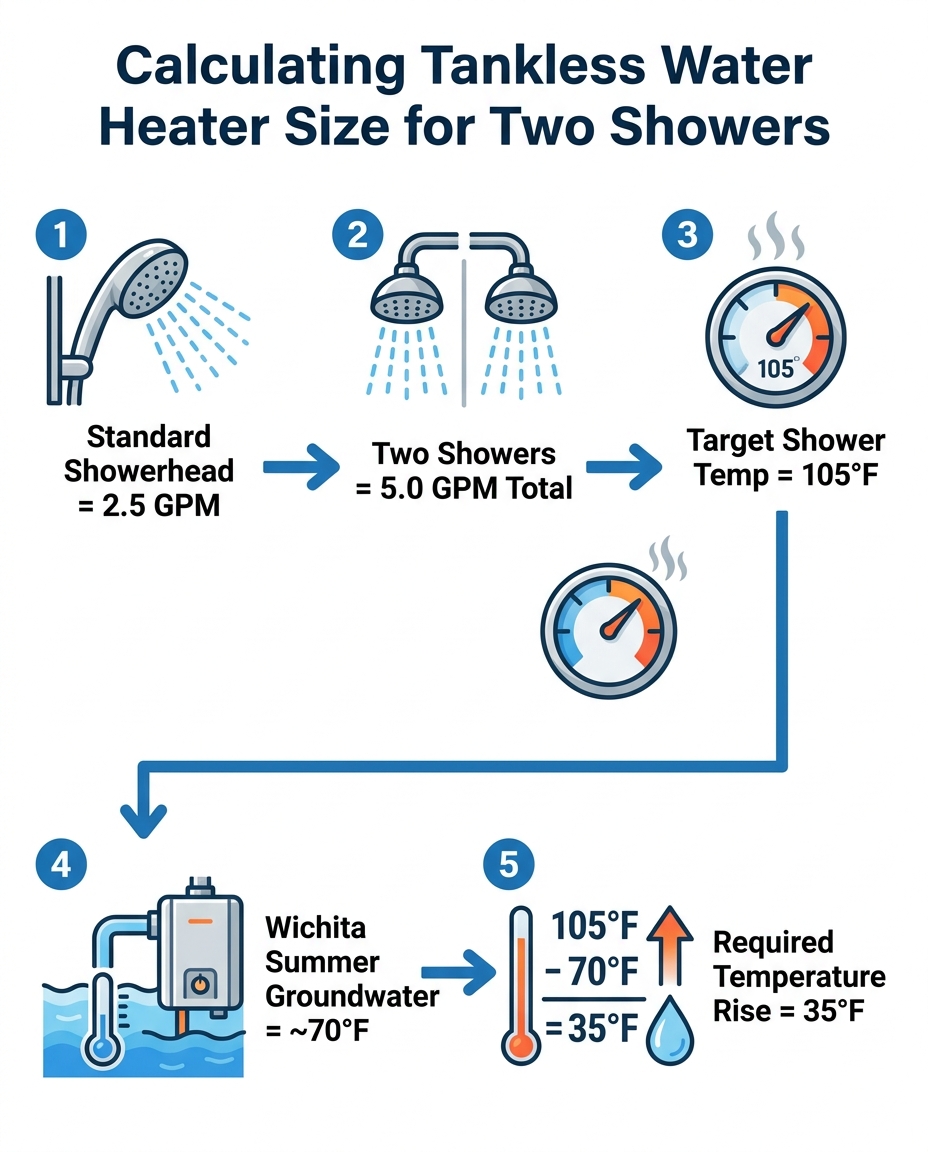
1. Identify the standard flow rate: According to current appliance manufacturing standards, a standard showerhead typically uses exactly 2.5 GPM.
2. Calculate the simultaneous demand: Running two standard showers at the exact same time requires a total flow rate of 5.0 GPM (2.5 GPM per standard showerhead multiplied by two).
3. Account for fixture variations: If your home features high-flow rainfall showerheads or body sprayers, the individual demand per bathroom could jump to 3.0 or even 4.0 GPM.
4. Establish the absolute minimum baseline: Even if you use low-flow fixtures rated at 1.5 GPM, sizing your unit for a 5.0 GPM total demand ensures a safe, reliable buffer for standard household usage.
The fixture flow rate comparison:
• Ultra Low-Flow (Eco) — Single Fixture GPM: 1.5 GPM — Two Simultaneous Showers GPM: 3.0 GPM
• Standard Fixture — Single Fixture GPM: 2.5 GPM — Two Simultaneous Showers GPM: 5.0 GPM
• Rainfall / High-Flow — Single Fixture GPM: 3.0+ GPM — Two Simultaneous Showers GPM: 6.0+ GPM
Understanding this mathematical baseline is non-negotiable. If you purchase a unit capable of delivering only 4.0 GPM, but your family routinely demands 5.0 GPM, our plumbers can tell you firsthand that the system will physically not be able to keep up with the volume of water moving through the pipes.
Temperature Rise: The Second Half of the Equation
Flow rate is only one piece of the puzzle. The second, equally critical metric is temperature rise. Temperature rise is defined as the difference between the temperature of the cooler groundwater entering your home and the desired output temperature at your fixture. The average comfortable shower temperature for most adults is roughly 105 degrees Fahrenheit. Your unit must bridge the gap between the municipal supply entering your home and that 105-degree target.
The heat exchanger inside the unit rapidly fires up to transfer thermal energy into the water as it passes through the system. If the water enters the home at a cooler temperature, the water must either pass through the heat exchanger more slowly to absorb enough heat, or the burner must use more energy to reach the target temperature.
One of the primary advantages of a tankless water heater is the promise of endless hot water, but this is only true if the temperature rise calculation is accurate for your specific geographic location. A unit rated for a high GPM in a warm coastal state might produce a lower GPM here in the Midwest depending on the exact groundwater metrics.
Factoring in Local Groundwater Temperatures for Accurate Sizing
The most common mistake our technicians at Midwest Mechanical see homeowners make when selecting a unit is relying on national average groundwater temperatures rather than local data. National sizing charts often assume a baseline groundwater temperature that simply does not reflect the reality of your local municipal supply.
The local climate context: In Wichita, KS, summer groundwater temperatures typically hover around 65 to 70 degrees Fahrenheit. While this is relatively warm, it still requires a specific mathematical calculation to ensure peak summer routines go off without a hitch.
The math for your target temperature: To reach a comfortable 105-degree shower from 70-degree summer groundwater, the unit must achieve a 35-degree temperature rise. The system you choose must be capable of delivering your full 5.0 GPM volume requirement while simultaneously achieving this specific 35-degree temperature rise. Understanding the summer math explains why even during peak heat, a heavily used system requires robust heating power to keep two showers running at optimal temperatures.

What Happens When Demand Exceeds Unit Capacity?
We frequently field mid-summer service calls from homeowners complaining of a sudden drop in water pressure, only to discover their undersized unit is actively protecting its temperature output through a mechanical process called flow-rate throttling. Modern systems are engineered with built-in mechanisms that prioritize water temperature over water volume. The computer board inside the unit constantly monitors the incoming temperature, the outgoing temperature, and the flow rate.
If your two showers demand 5.0 GPM, but the unit calculates that it can only heat 4.0 GPM to your desired 105 degrees based on the current groundwater temperature, it will physically restrict the flow of water leaving the unit. The result is a noticeable, sudden drop in water pressure in both bathrooms. You will still receive 105-degree water, but it will come out as a weak trickle rather than a strong spray. This flow-rate throttling is incredibly frustrating during busy morning or evening routines when multiple people are trying to get ready quickly.
Factors that reduce capacity over time:
• Mineral scale buildup: Hard water leaves calcium and magnesium deposits on the heat exchanger.
• Reduced heat transfer: Scale acts as an insulator, forcing the burner to work harder to heat the water.
• Restricted flow sensors: Debris can interfere with the internal sensors that dictate burner modulation.
Keeping the system clear of scale buildup through routine plumbing maintenance is essential. Our team recommends annual flushing with a specialized descaling solution to remove these mineral deposits, ensuring the unit maintains its maximum rated flow capacity and heat transfer efficiency over its lifespan.
Calculating Total Household Demand Beyond the Bathrooms
While sizing a unit for two simultaneous showers is an excellent starting point, our plumbers always remind customers that a truly accurate assessment must account for the entire household's plumbing footprint. Bathrooms are rarely the only fixtures drawing hot water during peak usage hours. You must broaden the mathematical scope to account for other appliances that might run concurrently with your showers.
Consider a typical July evening we often hear about: two family members are showering after a baseball game, someone else is rinsing dinner plates at the kitchen sink, and the washing machine is running a load of grass-stained clothes. Every single one of these fixtures adds to the total GPM demand. To find the true peak demand of your household, you must stack these GPM requirements together.
Common Appliance Flow Rates
To accurately calculate your peak household demand, add the following typical flow rates to your baseline 5.0 GPM shower requirement if these appliances will run simultaneously:
• Kitchen Faucet: 1.5 to 2.0 GPM
• Dishwasher: 1.0 to 2.5 GPM
• Washing Machine: 1.5 to 3.0 GPM
• Bathroom Sink Faucet: 1.0 to 1.5 GPM
If you run two showers (5.0 GPM) and a kitchen sink (1.5 GPM) simultaneously, your new target is 6.5 GPM at a 35-degree temperature rise. Homeowners have two choices when facing high total household demand: adjust your daily behavior by staggering appliance use (running the dishwasher only at night), or size up the unit to comfortably handle the absolute worst-case scenario without ever experiencing flow-rate throttling.
Why Professional Sizing Outperforms DIY Guesswork
Transitioning from educational math to final equipment selection requires a level of technical precision that online calculators simply cannot provide. Balancing simultaneous GPM demand with local temperature rise requirements is a complex mechanical assessment. Manufacturer sizing charts printed on the side of the box can be highly misleading if they are not read with specific local groundwater data in mind.
When you work with our team at Midwest Mechanical, you benefit from our specific, on-the-ground experience in sizing systems for Kansas's unique groundwater temperatures, ensuring precise GPM calculations. We will not just guess your flow rate based on averages; our professionals measure the actual fixture flow rates in your home using dynamic flow tests. Furthermore, sizing the water heater is only half the battle. A professional assessment also determines if your home's existing infrastructure can support the new unit.
Professional assessments include verifying:
• Gas line capacity: High-output units require significantly larger gas lines (often upgrading from a 1/2-inch to a 3/4-inch line) to deliver the necessary BTUs for rapid heating.
• Venting requirements: High-efficiency condensing units require specific PVC or concentric venting to safely exhaust combustion gases and manage acidic condensation.
• Electrical requirements: Even gas-powered units require dedicated electrical circuits to power the computer boards, sensors, and freeze-protection heaters.
This level of local knowledge and technical assessment ensures your family never runs out of hot water during peak usage, while maintaining strict adherence to local building codes and safety regulations. Additionally, installing a qualifying high-efficiency tankless system may make you eligible for generic federal tax credits or local utility incentive programs; we always advise homeowners to verify current programs with their utility provider or a tax professional.
Frequently Asked Questions About Tankless Sizing
How many GPM do I need for a tankless water heater?
The exact GPM you need depends entirely on how many fixtures you plan to run simultaneously. For a baseline, a single standard showerhead requires 2.5 GPM. If you want to run a shower and a kitchen sink at the same time, you will need a unit capable of delivering at least 4.0 to 4.5 GPM at your local temperature rise. A professional assessment will calculate your specific household peak demand to provide an exact number.
Can a tankless water heater run 2 showers at the same time?
Yes, a properly sized tankless water heater can easily run two showers at the exact same time. To do this without a drop in water pressure, the unit must be rated to deliver at least 5.0 GPM (2.5 GPM per shower) while successfully heating your local incoming groundwater to 105 degrees. If the unit is undersized for your climate, it will restrict the water flow to maintain the temperature.
What size tankless water heater do I need for a family of 4?
A family of four typically requires a unit capable of delivering between 7.0 and 10.0 GPM to comfortably handle simultaneous morning or evening routines. This sizing allows for two showers to run concurrently alongside a secondary appliance like a dishwasher or washing machine. The exact size will vary based on your local groundwater temperature and the specific flow rates of your chosen fixtures.
How do you calculate temperature rise for a water heater?
You calculate temperature rise by subtracting the temperature of your incoming cold groundwater from your desired hot water output temperature. For example, if your target shower temperature is 105 degrees Fahrenheit and your local summer groundwater is 70 degrees, your required temperature rise is 35 degrees. The water heater must have the BTU capacity to bridge that 35-degree gap at your required GPM.
Will summer heat affect my tankless water heater's performance?
Summer heat actually makes it easier for your tankless water heater to reach your desired output temperature. Because the municipal groundwater is warmer in the summer (often 65 to 70 degrees) than it is during cooler months, the unit requires a smaller temperature rise to hit 105 degrees. This means the unit can often deliver a slightly higher GPM flow rate during the summer months without throttling the water pressure.
Ensure Your Home Is Ready for Peak Demand
Understanding the mathematical breakdown of GPM and temperature rise gives you the confidence to make informed decisions about your home's plumbing infrastructure. To verify your household's specific flow rate needs and local temperature rise requirements, consult with a professional. Explore your tankless water heater installation options today to guarantee endless comfort for your family.
Customer Testimonials
Hear from satisfied customers who trust us for reliable HVAC and plumbing service across Wichita.





Plus, the technician, Lee was very professional, knowledgeable and informative.
We will definitely be doing business with them sometime again in the past.
I'm prompt to my appointment. Thank you Midwest Mechanical.
I'm prompt to my appointment. Thank you Midwest Mechanical.

We have partnered with GoodLeap to offer flexible payment options for your project. GoodLeap uses a soft credit check until funding and the highest score from all 3 bureaus to see if you qualify. It also takes just a few minutes to get started.




Service Areas
.svg)