


The Frustration of a Persistently Frozen Dehumidifier Coil
You walk downstairs expecting a dry space, but instead, you find a solid block of ice, and you quickly realize that cleaning the filter won't fix a frozen dehumidifier coil. At Midwest Mechanical, we hear this frustration often from homeowners whose equipment has failed during the peak humidity of a Midwest August, leaving their homes vulnerable to rapidly rising moisture levels. You did exactly what the manual suggested by checking and washing the air filter, hoping for an easy fix. But when that basic maintenance fails and the ice returns the very next day, the issue lies much deeper within the sealed mechanical system. Your dehumidifier is essentially a miniature cooling unit, and when it freezes repeatedly, it impacts your overall environment and requires a professional mechanical diagnosis.
For professional guidance on your home's climate systems, explore our Air Conditioning services and Indoor Air Quality solutions.
Validating the First Step: Why You Were Right to Check the Filter
Before diving into complex mechanical failures, our team wants to acknowledge that you took the correct first step. When a dehumidifier freezes, airflow restriction is always the primary suspect. By cleaning the filter, you successfully eliminated the most common, easily solvable cause of a frozen coil in Wichita basements.
The Problem of Restricted Airflow
To understand why a dirty filter causes freezing, you have to look at how heat exchange works. Your dehumidifier relies on a constant stream of warm, ambient room air blowing across its cold evaporator coil. This warm air prevents the coil from dropping below the freezing point of water. When an air filter becomes clogged with dust, pet hair, and debris, it acts like a wall. The warm room air can no longer reach the coil, but the internal refrigeration cycle continues to run. Without that crucial heat exchange, the coil's temperature plummets.
The Cause of the Ice Buildup
Once the coil drops below 32 degrees Fahrenheit, any trace amount of moisture in the air that manages to reach the coil will freeze instantly on contact. Over a matter of hours, this creates a compounding problem. The thin layer of frost further insulates the coil, making it even colder, which in turn causes more ice to form. Eventually, the entire mechanism is encased in a solid block of ice.
The Solution and the Process of Elimination
Cleaning or replacing the filter is the definitive solution for basic airflow restriction. By washing the filter, you restore the necessary flow of warm air. However, this is where the troubleshooting process shifts from DIY maintenance to professional diagnostics. If you have a completely clean filter, unobstructed intake vents, and the unit still freezes solid, you have successfully ruled out airflow restriction as the root cause. The persistent freezing confirms that the failure is now mechanical.
• Unit freezes with a clogged, visibly dirty filter — Likely Cause: Basic airflow restriction — Required Action: Clean or replace the filter and monitor
• Unit freezes with a perfectly clean filter — Likely Cause: Mechanical or refrigerant failure — Required Action: Requires professional diagnostic
• Unit runs constantly but extracts no water — Likely Cause: Loss of refrigerant / failed compressor — Required Action: Requires professional sealed-system repair
The Physics Behind the Ice: Dehumidifiers as Miniature Air Conditioners
To understand why a clean unit continues to freeze, it helps to look at the underlying science. Most homeowners do not realize that a dehumidifier operates using the exact same sealed refrigeration cycle as a central cooling system. It is not just a fan moving air over a cold plate; it is a complex mechanical system governed by strict thermodynamic principles.
The Refrigeration Cycle Explained
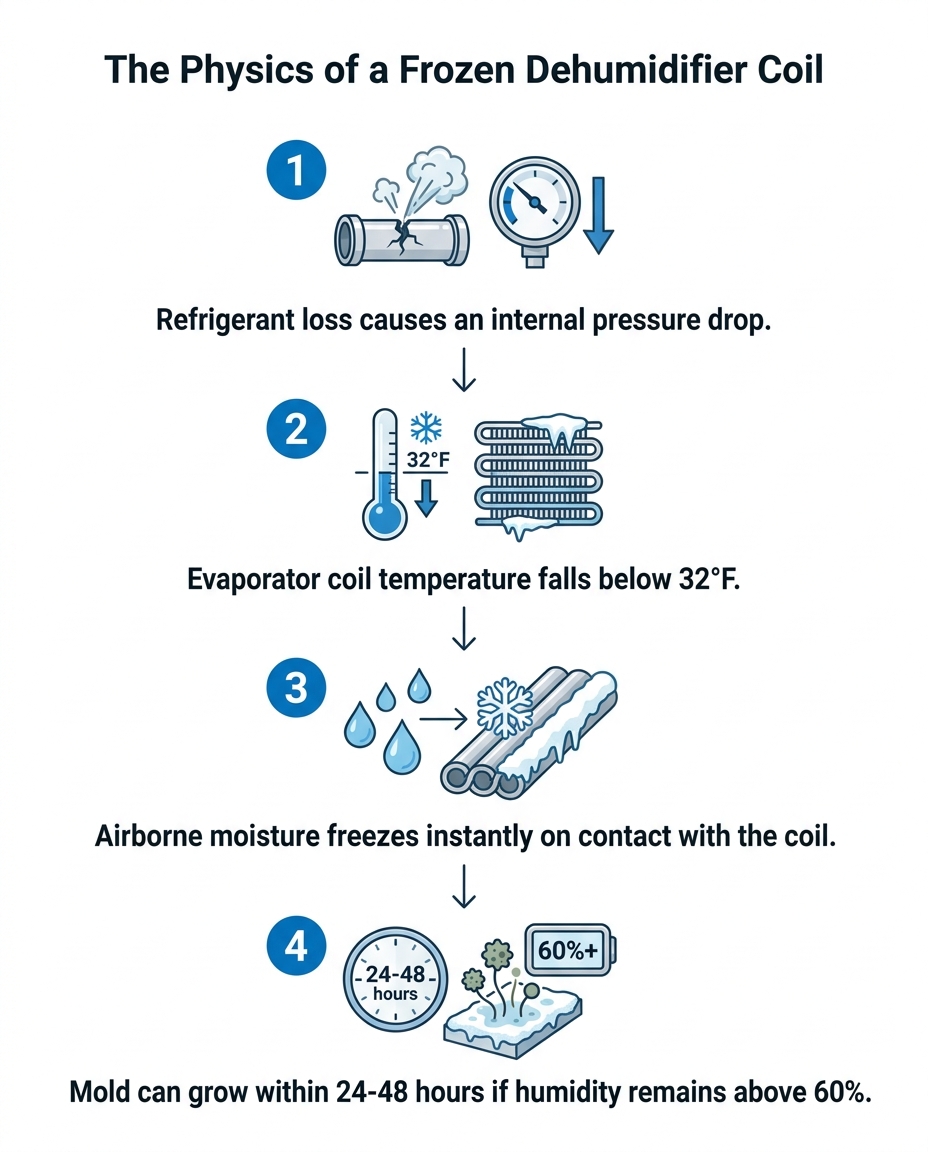
Inside the casing, your dehumidifier contains a compressor, a condenser coil, a metering device, and an evaporator coil. The compressor pumps chemical refrigerant through this closed loop. When the refrigerant reaches the metering device, it undergoes a rapid expansion, which causes a massive drop in pressure. According to ASHRAE fundamentals, the pressure and temperature of a refrigerant are directly linked. When the pressure drops, the temperature drops alongside it, making the evaporator coil cold enough to extract moisture from the air.
• The Compressor: Acts as the heart of the system, pumping refrigerant and maintaining the necessary pressure differentials.
• The Condenser: Releases the heat extracted from the air back into the room.
• The Evaporator Coil: Drops in temperature to create condensation, pulling humidity out of the air.
When the Physics Break Down
During the heavy humidity of August and late summer, the system works overtime. If the internal pressure of the refrigerant drops lower than the manufacturer intended, the temperature of the evaporator coil will fall below 32 degrees Fahrenheit. Working with NATE-certified technicians ensures that these complex refrigerant pressure drops are accurately diagnosed, as the relationship between pressure, temperature, and airflow requires specialized gauges and training to measure correctly. When this delicate balance is thrown off, airborne moisture instantly freezes on contact with the abnormally cold coil, rendering the unit useless.

Culprit 1: Low Refrigerant and Sealed System Leaks
If your filter is clean and the unit is still freezing, a refrigerant leak is one of the most common culprits. The sealed system inside your dehumidifier is under constant pressure. Over years of operation, vibration and chemical wear can create microscopic pinhole leaks in the copper tubing or at the brazed joints.
The Reality of Refrigerant Loss
A common misconception is that mechanical systems "use up" refrigerant over time. This is false. The refrigerant loop is entirely sealed. If the system is low on refrigerant, it means there is a physical leak that must be located and repaired. As the refrigerant slowly escapes, the overall pressure inside the system drops. As we discussed in the physics section, lower pressure equals lower temperatures, causing the coil to freeze over rapidly in damp Wichita basements.
The Professional Repair Process
Because refrigerants are environmentally sensitive chemicals, handling them is strictly regulated by the EPA. This is not a project that can be legally or safely handled with a DIY approach. When a sealed system fails, a specific professional process must be followed:
1. Leak Detection: A technician uses electronic sniffers or ultrasonic tools to pinpoint the exact location of the micro-leak.
2. Recovery: Any remaining refrigerant must be safely recovered into a sealed cylinder to prevent environmental venting.
3. Brazing and Repair: The damaged section of copper is repaired or replaced using high-temperature brazing.
4. Pressure Testing: The system is pressurized with nitrogen to ensure the new weld holds perfectly.
5. Vacuum and Recharge: A vacuum pump removes all non-condensable gases before the system is recharged with the exact factory weight of new refrigerant.
We frequently help local homeowners who experience severe system freeze-overs during the late summer. In one recent case, a Midwest Mechanical technician arrived on a Friday evening, diagnosed a loss of refrigerant in the sealed system, recharged the unit safely, and advised on a future replacement timeline to prevent the issue from recurring. Keeping your equipment monitored through our regular Maintenance Plan can help catch these micro-leaks before they lead to a complete system freeze.
Culprit 2: Failing Blower Motors and Mechanical Airflow Loss
While a dirty filter is a passive barrier to airflow, a failing blower motor is an active mechanical failure that produces the exact same result. The blower motor is responsible for pulling the damp ambient air across the evaporator coil and exhausting the dry air back into the room.
How Motor Failure Mimics a Dirty Filter
If the blower motor dies, struggles to reach its full RPM, or suffers from a failed start capacitor, the fan blades will stop spinning efficiently. When this happens, the cold remains trapped right on the surface of the evaporator coil. Without the constant wash of warm room air to temper the cold, the coil drops below freezing almost immediately.
A pattern we see often during late-summer maintenance calls is a failing blower motor. Recently, a local customer noticed their home was simply not getting cool or dry despite the system running constantly. A Midwest Mechanical technician diagnosed a failed mechanical airflow component, fixed the underlying issue, and explained the mechanical process so the homeowner understood exactly why the air had stopped moving. The same principle applies to your dehumidifier during August and the late-summer transition: if the fan stops moving air, the cooling energy has nowhere to go, resulting in a solid block of ice.
Signs Your Motor is Failing
Listen for the hum: If you turn the unit on and hear the low, steady vibration of the compressor running, but you do not hear the rush of air or feel any exhaust coming from the top or sides of the unit, the blower motor has likely failed.
Feel for excess heat: A struggling motor that is trying to turn but cannot (often due to seized bearings) will draw excessive electrical current and become unusually hot to the touch before the coils eventually freeze over. Both of these symptoms indicate that the motor or its electrical components require professional replacement.
The Myth of "Cold Room Temperatures" During Late Summer
If you consult a generic owner's manual or a basic online troubleshooting guide, you will almost certainly find a warning about ambient room temperatures. Many guides state that running a dehumidifier in a room colder than 65 degrees Fahrenheit will cause the coils to freeze. While this is scientifically true, it is often completely irrelevant to the actual problem at hand.
Why the Ambient Temperature Rule Fails in Summer
The 65-degree rule applies to unheated spaces during the late fall or winter. However, based on our years of experience servicing Wichita homes, this generic advice does not apply during warm transitional seasons. We know firsthand that late-summer basements are notoriously warm and humid. The ambient temperature in these spaces during August rarely, if ever, drops below 65 degrees.
Confirming the Mechanical Failure
If your basement is 70 degrees and feels heavy with humidity, ambient cold is definitively not the cause of your frozen coil. Blaming the room temperature in this scenario only delays the necessary repairs. When you have a warm room, a clean filter, and a coil that repeatedly turns into a block of ice, you have successfully isolated the problem. The persistent ice in warm conditions is the ultimate confirmation of a mechanical airflow failure or a sealed-system refrigerant leak.
Why Simply Thawing the Unit Isn't a Safe Long-Term Strategy
When faced with a frozen unit, the immediate reaction is usually to unplug it, let the ice melt into the drain pan, and turn it back on. While this thaws the coil, it does absolutely nothing to address the root cause of the mechanical failure.
The Dangers of the Freeze-Thaw Cycle
Thawing the unit only resets the clock. If the unit is low on refrigerant or the motor is failing, it will simply freeze again the next time it runs for an extended period. This constant freeze-thaw cycle forces the compressor to work incredibly hard under immense strain, which can eventually cause the compressor itself to burn out—turning a repairable issue into a total system replacement.
Protecting Your Home's Structure
More importantly, a dehumidifier trapped in a freeze-thaw cycle is not doing its job. It fails to extract moisture from the air. According to EPA guidelines, mold can begin to grow within 24 to 48 hours on damp surfaces when indoor humidity levels are not controlled. If your unit is spending half its time frozen and the other half thawing out, the humidity in your home will easily creep above the crucial 60 percent threshold.
• Structural damage: High humidity softens drywall and warps wooden floorboards above the basement.
• Biological growth: Unchecked moisture creates the perfect breeding ground for mold and mildew.
• Pest attraction: Damp environments attract insects and pests seeking water sources.
Protecting your home requires a permanent, professional fix to ensure continuous operation. For more insights on optimizing your basement's moisture control, read our guide on connecting your basement dehumidifier to the sump pump.
Frequently Asked Questions About Frozen Dehumidifiers
Why does my dehumidifier keep freezing after I cleaned the filter?
A clean filter ensures proper airflow, so persistent freezing indicates a deeper mechanical issue. Once you have ruled out a dirty filter, the most common causes are a sealed-system refrigerant leak or a failing blower motor. Because the airflow is unobstructed, the freezing is caused by an internal pressure drop or a mechanical failure to push the air across the coils, both of which require professional diagnostics.
Can you fix a dehumidifier that leaks refrigerant?
Yes, but it requires a licensed professional to locate the leak, patch it, and recharge the system safely. EPA regulations strictly prohibit the DIY handling, venting, or purchasing of professional-grade refrigerants. A certified technician will use specialized equipment to find the micro-leak, braze the copper tubing, and weigh in the exact factory charge needed to restore proper pressure.
Is a dehumidifier ruined if it freezes into a block of ice?
Not necessarily. If caught early, thawing the unit prevents immediate compressor damage and allows for a proper repair. However, running it continuously while it is frozen solid forces the compressor to work under severe strain. If left running in this state for days during August or late summer, the compressor can overheat and burn out, which usually leads to total system failure.
How long does it take to unfreeze a dehumidifier safely?
It typically takes 12 to 24 hours for a heavily iced unit to thaw completely when unplugged and left at room temperature. You should place towels around the base, as the melting ice may overflow the internal drain pan. Never use sharp objects, hair dryers, or heat guns to chip away the ice, as this can easily puncture the delicate refrigerant coils and destroy the unit.
How do you know if the blower motor on a dehumidifier is broken?
The compressor will run (you will hear a low humming noise), but no air will be exhausted from the top or sides of the machine. The unit may also feel unusually hot to the touch before the coils freeze over because the heat extracted from the air is not being properly vented. If the fan blades are completely stationary while the machine hums, the motor or its starting capacitor has failed.
Getting Your Basement Humidity Back Under Control
While cleaning the filter was absolutely the correct first step, persistent freezing requires expert attention. You have successfully ruled out basic maintenance issues, and the remaining culprits—refrigerant leaks and failing blower motors—are mechanical problems that demand specialized tools and training.
Maintaining proper humidity in Wichita basements is not just about comfort; it is about protecting the structural integrity of your home from mold, wood rot, and unchecked moisture. Don't let a failing unit leave your home vulnerable during the most humid parts of the year. Consult with the team at Midwest Mechanical to diagnose your sealed-system or motor issues safely, ensuring your equipment runs efficiently and your home stays perfectly dry.
Customer Testimonials
Hear from satisfied customers who trust us for reliable HVAC and plumbing service across Wichita.





Plus, the technician, Lee was very professional, knowledgeable and informative.
We will definitely be doing business with them sometime again in the past.
I'm prompt to my appointment. Thank you Midwest Mechanical.
I'm prompt to my appointment. Thank you Midwest Mechanical.

We have partnered with GoodLeap to offer flexible payment options for your project. GoodLeap uses a soft credit check until funding and the highest score from all 3 bureaus to see if you qualify. It also takes just a few minutes to get started.




Service Areas
.svg)