


The Hidden Complexities of Below-Grade Plumbing in Wichita
You have the perfect layout in mind for your new downstairs bathroom, but navigating Wichita plumbing codes for basement bathroom additions can quickly turn a dream project into a nightmare if you pour concrete too soon. Homeowners often focus entirely on the aesthetic details—picking out the perfect subway tile, the right vanity, and the ideal lighting fixtures. However, the true success of a below-grade addition lies beneath the surface. Pouring a concrete slab before fully understanding and complying with local below-grade plumbing codes is one of the most common, and costly, mistakes our team at Midwest Mechanical sees during the early fall basement finishing season.
Understanding the specific local triggers for venting and backwater valves is essential for passing inspections on the first try. If an inspector spots a missing vent or an improperly sloped drainage line after the cement has cured, the only solution is breaking up that brand-new floor. By relying on our professional plumbing services, you ensure your project meets all municipal requirements safely, legally, and without expensive rework.
Understanding the 'Why' Behind Wichita's Local Plumbing Codes
It is easy to view municipal building codes as arbitrary bureaucratic hurdles designed to slow down your renovation. In reality, plumbing codes are rigorous life-safety standards designed to protect your home's sanitation, structural integrity, and overall value. When dealing with below-grade additions, the stakes are significantly higher. A mistake on a main floor bathroom might cause a localized leak; a mistake in a basement rough-in can lead to catastrophic sewer gas accumulation or raw sewage flooding your newly finished living space.
The International Plumbing Code (IPC) sets the baseline for these safety standards across the country. However, local municipalities often adopt specific amendments to address regional infrastructure challenges, soil conditions, and weather patterns. Wichita is no exception. Wichita local plumbing inspections are notoriously thorough regarding below-grade additions because the city's infrastructure demands strict adherence to prevent cross-contamination and municipal sewer backups.
We often remind homeowners that local inspectors are not your adversaries; they are allies in protecting your property value. They ensure that your new addition does not compromise the existing plumbing network of your home or the city's broader infrastructure. Our team's deep familiarity with Wichita's specific municipal plumbing codes and inspector expectations ensures projects are compliant from the start, saving homeowners from the stress of failed inspections.
The Role of the MABCD in Residential Remodeling
In our daily work, we interface directly with the Wichita Metropolitan Area Building and Construction Department (MABCD), which holds jurisdiction over residential basement finishes and plumbing additions. Their mandate is to enforce the adopted codes strictly and uniformly.
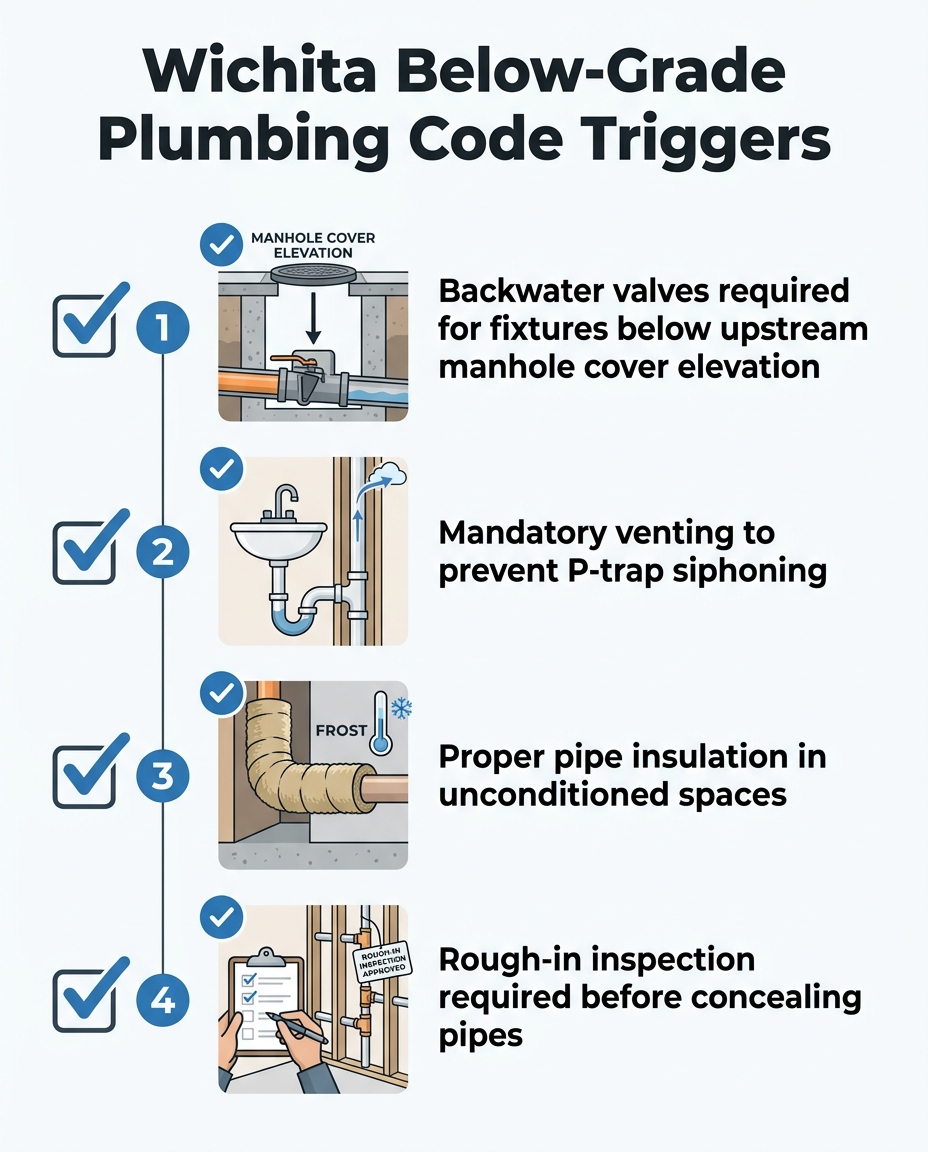
• Mandatory Rough-In Inspections: Before any pipes are concealed by drywall, flooring, or concrete, an MABCD inspector must physically examine the work. This is known as the rough-in inspection.
• Pressure Testing: Inspectors require the new plumbing lines to be pressure-tested with water or air to prove there are no leaks in the newly joined pipes.
• Slope and Grade Verification: Drainage pipes must maintain a specific slope (typically 1/4 inch per foot) to ensure gravity can effectively carry waste away without clogging.
• Material Approval: The MABCD verifies that all pipes, fittings, and adhesives used meet the specific standards required for below-grade residential applications.

Backwater Valves: Essential Defense Against Sewer Surcharges
One of the most critical, yet frequently misunderstood, code requirements for Wichita residential basements is the backwater valve. A backwater valve is a specialized one-way mechanical device installed in the main sewer line or the specific branch line serving the basement fixtures. Its sole purpose is to allow wastewater to flow out of your home while automatically blocking municipal sewage from flowing backward into your basement.
The code trigger for a backwater valve is highly specific: they are required where plumbing fixtures are installed below the elevation of the next upstream manhole cover of the public sewer. If the municipal sewer main becomes overwhelmed and backs up, the sewage will rise to the level of the nearest manhole cover before spilling out onto the street. If your basement floor drain, shower, or toilet sits lower in elevation than that manhole cover, your basement becomes the path of least resistance for the rising sewage.
Wichita's variable climate and heavy spring rains create a very real risk for these municipal sewer surcharges. When our plumbers are called out to flooded basements after torrential downpours overwhelm the city's combined or aging sewer infrastructure, the culprit is often a missing or improperly installed backwater valve. Without it, that pressurized mix of stormwater and raw sewage is forced directly into your home. Incorporating the inspection and cleaning of this valve into your preventative plumbing maintenance strategy is the best way to protect your entire basement investment from devastating water damage.
How Backwater Valves Operate During Heavy Rains
The mechanics of a backwater valve are relatively straightforward, but as our team knows firsthand, their installation requires absolute precision.
• The One-Way Flapper: Inside the valve body is a hinged flapper. Under normal conditions, the flapper hangs slightly open or is pushed open by the outbound flow of wastewater from your home.
• The Sealing Mechanism: If water begins to flow backward from the city sewer, the reverse pressure catches the flapper, slamming it shut against a watertight gasket.
• Installation Angle: In our experience, inspectors strictly scrutinize the installation angle of these valves. If the valve is not perfectly leveled according to the manufacturer's specifications, the flapper may not close completely during a backup, rendering it useless.
• Accessibility Requirements: Codes dictate that backwater valves cannot be permanently buried under concrete. They must have an access box or cleanout cover flush with the floor so the flapper can be inspected, cleaned, and replaced as needed.
• Municipal Sewer Surcharge — Without a Backwater Valve: Raw sewage backs up through basement floor drains and showers. — With a Code-Compliant Valve: Flapper closes, blocking sewage from entering the home.
• Heavy Localized Flooding — Without a Backwater Valve: Basement fixtures become the relief point for city street flooding. — With a Code-Compliant Valve: Home remains isolated from the municipal pressure surge.
• Post-Storm Cleanup — Without a Backwater Valve: Extensive biohazard mitigation and drywall replacement required. — With a Code-Compliant Valve: Normal operation resumes once municipal water levels recede.
Strict Venting Requirements for Basement Bathrooms
Drainage is only half of the plumbing equation. The other half—often the source of failed rough-in inspections that we see—is the venting system. Every plumbing fixture requires a vent to equalize air pressure within the drainage pipes. Without proper air pressure, the wastewater rushing down the pipe creates a vacuum behind it.
This vacuum effect is incredibly powerful. If a basement bathroom sink or shower is not properly vented, the draining water will siphon the standing water right out of the fixture's P-trap. The P-trap is the curved piece of pipe beneath the drain that holds a small amount of water to create a physical barrier against sewer gases. Once that trap is siphoned dry, highly toxic and combustible sewer gases have a direct, open pathway into your basement.
Below-grade fixtures face unique air-pressure challenges because they are located at the lowest point of the home's plumbing system, where positive pressure from upper floors often accumulates. Navigating the codes for tying new basement vents into the home's existing atmospheric vent stack requires a deep understanding of pipe sizing and distance limitations. For example, if you are connecting your basement dehumidifier to the sump pump or a nearby drain, ensuring the surrounding fixtures maintain proper trap seals is critical for maintaining healthy indoor air quality.
Preventing Trap Siphoning in Below-Grade Systems
To pass inspection, our professional plumbers meticulously calculate the distance between the fixture's trap and its vent connection.
• Atmospheric Venting: The most reliable and universally code-approved method is routing a new PVC vent pipe up through the walls, tying it into the home's main vent stack that exits through the roof. This provides uninterrupted, passive air equalization.
• Air Admittance Valves (AAVs): In situations where routing a pipe to the roof is structurally impossible, codes may allow the use of an Air Admittance Valve. An AAV is a mechanical, gravity-operated device that opens to let air into the pipe when water drains, but closes tightly to prevent sewer gases from escaping.
• AAV Restrictions: Wichita inspectors heavily scrutinize AAV usage, and we never recommend them as a blanket solution for poor planning. Codes require AAVs to be installed in accessible locations with plenty of free airflow—they cannot be sealed behind drywall without a louvered access panel.
Pipe Routing and Climate Considerations in Unconditioned Spaces
When planning a basement bathroom addition, it is easy to assume the entire lower level will be a warm, comfortable living space. However, the reality of routing plumbing often involves running water supply lines through areas that remain unconditioned, such as unfinished utility rooms, crawlspaces, or along exterior concrete foundation walls.
As we transition into the cooler early fall months, our technicians always emphasize careful pipe routing in unconditioned basement spaces to prepare for Wichita's freezing winter temperatures. Plumbing codes dictate specific insulation requirements for water lines exposed to cold air drafts. A pipe freezing and bursting behind a newly finished basement wall can cause extensive damage before the main water supply is finally shut off.
Structural integrity during routing: Beyond temperature control, inspectors closely examine how pipes are routed through the home's wooden framework. Running new drainage lines across a basement ceiling often requires passing through floor joists. The building code has strict mathematical rules regarding where and how large a hole can be bored into a structural joist.
Generally, holes must be drilled strictly within the middle third of the joist's depth to avoid compromising its load-bearing capacity. Notching the bottom edge of a joist to fit a pipe is heavily restricted and often outright prohibited by modern codes. A licensed professional knows exactly how to map out the plumbing runs to avoid structural damage, ensuring the home remains safe and the project passes the framing and rough-in plumbing inspections simultaneously.
Evaluating Hot Water Capacity for Your New Addition
Adding a bathroom to your basement does more than just require new drainage and venting; it fundamentally changes the overall hot water demand of your home. Every new fixture—whether it is a simple vanity sink, a standard shower, or a high-capacity soaking tub—adds to the home's total fixture unit count.
During the permitting and planning phase, we typically evaluate whether your existing water heater can safely and effectively support this new load. A standard 40-gallon tank that perfectly supported a two-bathroom house may struggle to keep up once a third basement bathroom is added, especially if multiple showers run concurrently during the morning rush.
Signs your current system may be undersized for the addition:
• The existing unit is over ten years old and already exhibits slow recovery times.
• The new bathroom design includes high-demand fixtures like multi-head showers or large soaking tubs.
• The household size is expanding, leading to more frequent, back-to-back hot water usage.
If our calculations show your current system will fall short, planning for water heater upgrades becomes a necessary step in the remodeling process. Upgrading to a larger capacity tank or transitioning to a high-efficiency tankless water heater ensures that your new basement bathroom provides the comfort you expect without leaving the rest of the house shivering in cold water.
Frequently Asked Questions About Wichita Basement Plumbing Codes
Do I need a permit to add a bathroom in my basement in Wichita?
Yes, a plumbing permit is strictly required for adding a bathroom to a basement in Wichita. The MABCD requires permits to ensure that all new drainage, venting, and water supply lines meet current life-safety and sanitation codes. Proceeding without a permit can result in stop-work orders, fines, and complications when trying to sell the home in the future.
Why is a backwater valve required for basement plumbing?
A backwater valve is required to protect your home from municipal sewer surcharges. If your basement plumbing fixtures are located below the elevation of the nearest upstream street manhole cover, a heavy rainstorm could cause the city sewer to back up directly into your basement. The valve features a one-way flapper that automatically closes to block raw sewage from entering your home.
What are the venting requirements for a basement bathroom?
Every below-grade fixture must be properly vented to prevent the siphoning of water out of the P-traps. Venting equalizes air pressure in the drainage pipes. Without it, draining water creates a vacuum that pulls the protective water barrier out of the trap, allowing dangerous and foul-smelling sewer gases to enter the basement living space.
How do I pass a plumbing rough-in inspection in Wichita?
Passing a rough-in inspection requires strict adherence to the International Plumbing Code and local Wichita amendments. An inspector will verify that proper pipe materials were used, drainage slopes are correct, structural joists were not improperly cut, and all required vents and backwater valves are in place. The pipes must also hold pressure during a mandatory leak test before any drywall is installed.
Can I use an Air Admittance Valve (AAV) for a basement bathroom?
Air Admittance Valves (AAVs) are permitted in specific scenarios where routing a traditional atmospheric vent to the roof is structurally impossible. However, local codes heavily regulate their use. They must be installed in an accessible location with adequate airflow and can never be permanently sealed behind a solid wall without an access panel.
What happens if I finish my basement without a plumbing permit?
Finishing a basement without the required plumbing permits carries significant risks. If the city discovers the unpermitted work, they can force you to tear out finished walls and concrete to expose the plumbing for inspection. Additionally, unpermitted work can void your homeowner's insurance coverage in the event of a flood or leak, and it frequently causes major legal hurdles during real estate transactions.
Partner with a Local Authority for Your Basement Addition
Successfully adding a bathroom to your lower level requires far more than just picking out the perfect tile; it demands a rigorous understanding of the codes that keep your home safe. Navigating the requirements for backwater valves, proper venting, and structural pipe routing ensures that your new space remains comfortable, sanitary, and protected from municipal sewer backups.
Understanding these rules ahead of time prevents the nightmare of failed inspections and the costly reality of tearing up freshly poured concrete. Because these codes involve complex pressure testing, precise drainage slopes, and life-safety sanitation standards, this is not a project for guesswork. Reach out to the Midwest Mechanical team to schedule a consultation to discuss your specific basement layout, evaluate your current plumbing infrastructure, and ensure your addition is built correctly from the ground up.
Customer Testimonials
Hear from satisfied customers who trust us for reliable HVAC and plumbing service across Wichita.





Plus, the technician, Lee was very professional, knowledgeable and informative.
We will definitely be doing business with them sometime again in the past.
I'm prompt to my appointment. Thank you Midwest Mechanical.
I'm prompt to my appointment. Thank you Midwest Mechanical.

We have partnered with GoodLeap to offer flexible payment options for your project. GoodLeap uses a soft credit check until funding and the highest score from all 3 bureaus to see if you qualify. It also takes just a few minutes to get started.




Service Areas
.svg)