


Are Standard Garbage Disposals Sabotaging Your Daily Meal Prep?
Are you constantly battling a jammed sink during meal prep, wondering if upgrading to a 3/4 HP garbage disposal for heavy-duty cooking is the exact solution you need? For homeowners who prepare meals from scratch daily, the kitchen sink is the command center. Yet, in our years of serving Wichita homes, our team at Midwest Mechanical frequently sees that command center handicapped by a builder-grade disposal that simply cannot keep up with the volume of organic waste generated by active cooking. You might hear a humming sound, experience slow draining, or find yourself frequently reaching for the reset button under the sink. These are all signs that your current unit is outmatched by your culinary habits.
Standard 1/3 or 1/2 horsepower units are typically designed for light, occasional cleanup—think clearing a few stray peas or cereal milk off a plate. They are not engineered to handle the rigorous demands of processing tough vegetable scraps day in and day out. When you decide to replace a failing standard unit, the decision point becomes clear: you need a robust model designed specifically for serious home chefs. If you are tired of resetting a tripped motor and want to explore long-lasting solutions, consulting with experts in professional plumbing services is the best first step to take.
True reliability in kitchen plumbing comes down to two primary factors: motor torque and the materials used inside the grinding chamber. A heavy-duty 3/4 HP stainless steel grinding chamber provides the necessary brute force to pulverize tough food waste, preventing the clogs and backups that bring your evening routine to a grinding halt. Understanding the mechanics behind this upgrade will help you make an informed decision for the long-term health of your home's plumbing system.
Why Fibrous Scraps Defeat Builder-Grade Disposals
The core problem with standard disposals becomes obvious the moment you start preparing a large, vegetable-heavy meal. In the kitchens we service across the Wichita area, we consistently find that fibrous foods are the natural enemy of low-horsepower, single-stage grinding units. When you scrape cutting boards full of tough organic matter into the sink, you are testing the absolute limits of builder-grade plumbing technology.
The Worst Offenders for Standard Disposals:
• Celery stalks and rhubarb: These contain long, stringy fibers that act like wet twine inside a standard disposal.
• Onion skins and corn husks: Their thin, flexible nature allows them to slip past blunt impellers without being chopped.
• Potato and carrot peels: Starchy peels can turn into a thick paste when combined with water, bogging down a weak motor.
• Artichoke leaves and asparagus ends: Extremely tough and woody, requiring high torque to shear effectively.
When these fibrous materials enter a standard 1/3 or 1/2 HP disposal, the lower torque motor lacks the rotational force to power through them. Instead of shearing the material, the spinning impellers simply toss the scraps around the chamber. Over time, these strings wrap tightly around the moving parts, binding the motor. This leads to the all-too-familiar humming sound of a jammed unit, followed quickly by an overheated motor that trips its internal breaker.
The frustration of interrupted meal prep is only the immediate symptom. The long-term consequence is a heightened risk of severe drain clogs. When improperly ground food manages to bypass the jammed impellers, it enters your home's plumbing system as large, stringy chunks. These chunks catch on the bends of your P-trap and the walls of your lateral drain lines, creating stubborn blockages. Transitioning to a higher horsepower unit provides the brute force required to slice through these tough fibers instantly, protecting both your appliance and your pipes.
Galvanized vs. Stainless Steel: The Hard Water Factor
While motor power is a critical part of the equation, the material composition of the grinding chamber is the true deciding factor for long-term reliability. Most standard 1/2 HP disposals utilize galvanized steel for their internal grinding components. While cost-effective to manufacture, galvanized steel is highly susceptible to rust, corrosion, and mineral scaling over time.
Our technicians deal with our regional water quality every day, and we've seen firsthand how Wichita's municipal water supply—which contains moderate to high levels of dissolved minerals—wreaks havoc on plumbing. This elevated mineral content, commonly referred to as hard water, accelerates corrosion and scaling on non-stainless plumbing components. When hard water dries inside a galvanized steel grinding chamber, it leaves behind calcium and magnesium deposits. These deposits create a rough surface that catches food particles, accelerating bacterial growth and awful sink odors. More importantly, the constant exposure to moisture and minerals causes galvanized impellers to pit and rust, turning sharp grinding edges into blunt, ineffective hammers.
In contrast, premium 3/4 HP models almost exclusively feature a 3/4 HP stainless steel grinding chamber. Stainless steel is inherently resistant to the corrosive effects of hard water. It does not rust, and mineral deposits have a much harder time adhering to its smooth surface. This means the impellers remain sharp and balanced for years, rather than dulling within the first few seasons of use. For homeowners dealing with hard water, upgrading to stainless steel internal components is a vital necessity for appliance longevity, rather than just a luxury feature.
Side-by-Side: 1/2 HP Standard vs. 3/4 HP Heavy-Duty Disposals
To fully grasp the operational differences between these two tiers of kitchen appliances, it helps to look at their specifications side-by-side. The jump from a half-horsepower to a three-quarter-horsepower unit involves significant upgrades in almost every category of performance and durability.
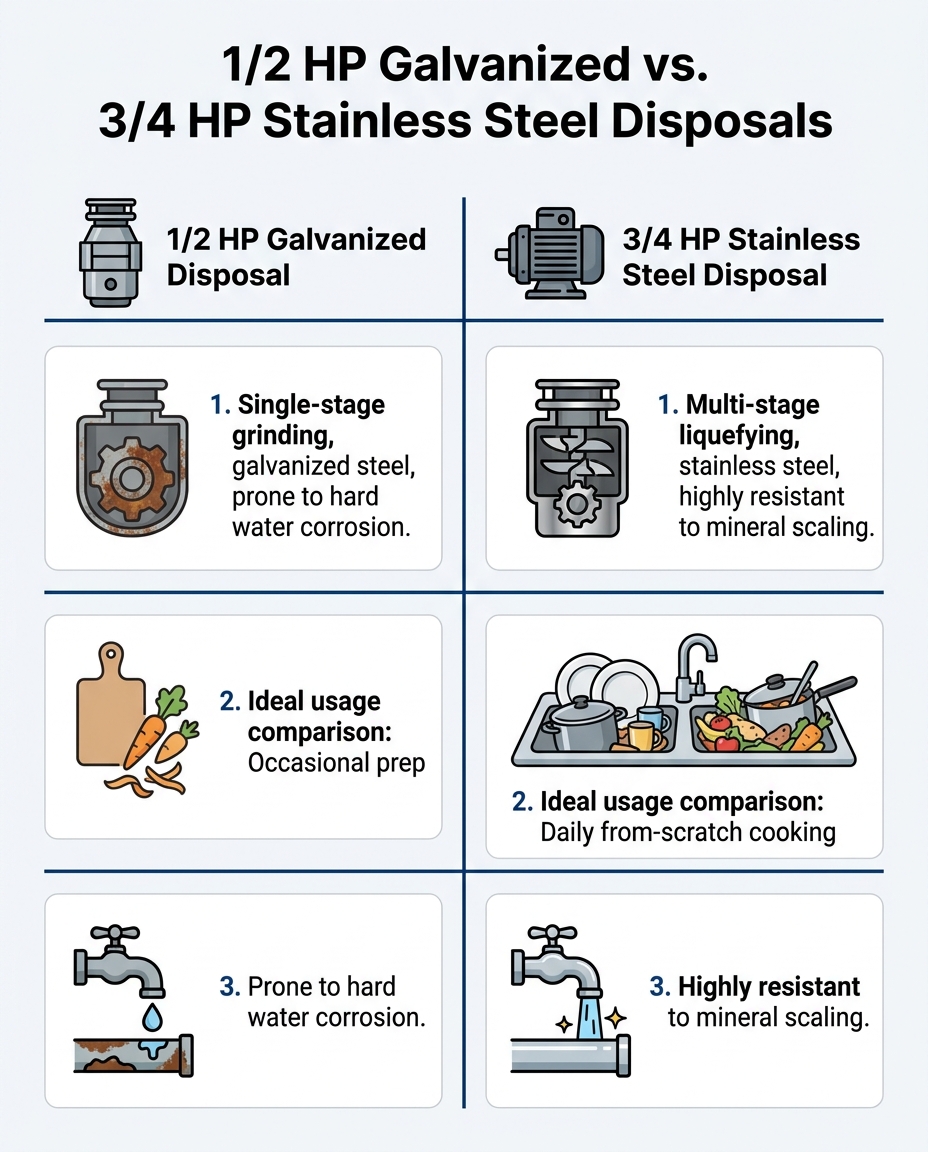
• Motor Power — 1/2 HP Standard Disposal: Light to moderate use; struggles with tough scraps. — 3/4 HP Heavy-Duty Disposal: Daily, heavy-duty cooking; high torque for fibrous foods.
• Grinding Material — 1/2 HP Standard Disposal: Galvanized steel (prone to rust and dulling). — 3/4 HP Heavy-Duty Disposal: Stainless steel (corrosion-resistant and durable).
• Grinding Stages — 1/2 HP Standard Disposal: Single-stage chopping (basic breakdown). — 3/4 HP Heavy-Duty Disposal: Multi-stage liquefying technology (ultra-fine grind).
• Noise Levels — 1/2 HP Standard Disposal: Minimal insulation; loud, rattling operation. — 3/4 HP Heavy-Duty Disposal: Advanced sound baffles and anti-vibration mounts; quiet.
• Ideal User Profile — 1/2 HP Standard Disposal: Occasional cooks, takeout enthusiasts, light cleanup. — 3/4 HP Heavy-Duty Disposal: Daily from-scratch home chefs, large households.
As the comparison table illustrates, the 3/4 HP model is engineered for a completely different level of kitchen activity. We often recommend this upgrade for open-concept homes, where the inclusion of advanced sound insulation is a particularly welcome feature. By investing in heavier-duty materials and superior sound dampening, you transform a noisy, temperamental appliance into a quiet, reliable workhorse.

How Multi-Stage Grinding Prevents Kitchen Plumbing Jams
One of the most significant technological advantages of upgrading to a 3/4 HP stainless steel grinding chamber is the introduction of multi-stage grinding. Standard disposals rely on a single-stage process: food waste is pushed against a stationary grind ring, chopped once, and flushed down the drain. If the food is tough or fibrous, this single pass is rarely enough to break it down safely.
The Mechanics of Liquefying Food Waste
Multi-stage grinding technology takes a far more aggressive approach. Instead of a single chopping action, the waste passes through two or three distinct stages of processing. First, the primary impellers break the large chunks into smaller pieces. Next, a secondary shear ring slices those pieces into even finer fragments. Finally, the high-torque motor forces the remaining particles through a specialized grinding plate that effectively liquefies the organic matter.
This ultra-fine grind is critical for maintaining healthy drain lines. When food waste is reduced to a liquid state, it suspends easily in the flow of water, washing cleanly through the P-trap and out to the home's main sewer line. This drastically reduces the likelihood of sludgy buildups that cause slow drains and require professional augering. Furthermore, this advanced technology safely processes hard organic materials—like small fruit pits, tough melon rinds, and small bones—that would instantly jam a standard 1/2 HP unit and potentially damage its weaker motor.
Securing the Torque: The Risks of DIY Disposal Installation
With the added power and advanced materials of a 3/4 HP disposal comes a significant increase in physical weight and operational torque. These heavy-duty units are substantially heavier than standard builder-grade models. We've responded to countless calls where attempting to install one of these robust machines as a weekend DIY project resulted in unexpected leaks and damage that homeowners often overlook until it is too late.
The Danger of Improper Mounting
Because a 3/4 HP motor generates intense rotational force when it powers on, the mounting hardware must be perfectly secured to the sink flange. If the locking ring is even slightly misaligned or under-tightened, the torque will cause the entire unit to twist and vibrate violently. Over time, these damaging vibrations will loosen the PVC or brass connections on your drain pipes, leading to severe under-sink leaks that can warp your cabinetry and cause hidden water damage.
Electrical Hazards Under the Sink
Beyond the plumbing connections, high-capacity disposals require secure electrical integration. Navigating the wiring in a wet environment directly beneath a water source is inherently dangerous. Understanding the specific electrical requirements, such as the difference between hardwired vs plug-in garbage disposals, is critical for safety and code compliance. An improperly grounded unit or a loose wire nut can result in a short circuit or a serious shock hazard.
This is where professional expertise becomes invaluable. Relying on Midwest Mechanical's licensed plumbing professionals ensures a flawless, leak-free installation. Our technicians understand exactly how to secure heavy-duty units to prevent vibration damage, and they ensure all electrical connections are safe, secure, and up to code. Choosing professional installation actively prevents the common pitfalls and expensive water damage associated with DIY disposal upgrades.
Timing Your Upgrade for the Fall Cooking Rush
Kitchen appliances rarely fail at convenient times. A struggling garbage disposal is most likely to give out completely when it is under the maximum amount of stress. As September rolls around and the weather cools, our dispatch board always fills up with disposal emergencies because families begin preparing heavier, more complex meals, and the demand on the kitchen sink increases exponentially.
Early fall is the prime time to assess your kitchen plumbing reliability. Waiting for a disposal to fail during a heavy cooking day—like Thanksgiving or a large family gathering—leads to emergency service calls, massive inconvenience, and a kitchen that is effectively out of commission. Proactive replacement of an aging, jammed-up unit ensures that your kitchen workflow remains smooth and uninterrupted when you need it most.
Assessing Your Surrounding Plumbing Infrastructure
While evaluating your disposal, it is wise to check the adjacent systems that endure heavy use during the fall and winter holidays. Your disposal relies on a steady stream of water to flush away waste, and proper hot water supply is essential for breaking down residual grease before it solidifies in your pipes. Upgrading a failing disposal is an excellent opportunity to evaluate the overall health of your kitchen sink setup. Enrolling in a comprehensive plumbing maintenance plan allows a professional to inspect your entire system, ensuring every component is ready to handle the upcoming seasonal demands.
Frequently Asked Questions About High-Capacity Disposals
Before diving into specific questions, remember that your disposal works in tandem with your sink and hot water supply; if you are considering other kitchen improvements like water heater upgrades alongside your disposal replacement, coordinating those projects can save time and ensure optimal performance across your plumbing system.
Why choose a 3/4 HP garbage disposal over a 1/2 HP?
A 3/4 HP disposal offers significantly more motor torque, allowing it to power through tough, fibrous food waste without jamming. While a 1/2 HP model is only suitable for light, occasional cleanup, the heavier-duty unit is designed for daily from-scratch cooking. This extra power prevents motor burnout and ensures a much longer lifespan for the appliance.
Are stainless steel garbage disposals better for hard water?
Yes, stainless steel is vastly superior for homes with hard water. The dissolved minerals in hard water quickly cause standard galvanized steel components to pit, scale, and rust. Stainless steel resists this corrosion, meaning the internal grinding impellers stay sharp, balanced, and odor-free for many years.
Can I replace a 1/2 HP disposal with a 3/4 HP unit?
In almost all cases, yes, you can upgrade to a larger unit. The sink flange connection is universally sized for standard kitchen sinks. However, because the 3/4 HP unit is physically larger and heavier, a professional should verify that your under-sink plumbing can accommodate the new dimensions and weight without stressing the existing pipe connections.
What size garbage disposal do I need for a family of 4?
For a family of four that cooks at home regularly, a 3/4 HP disposal is the recommended baseline. It provides the necessary capacity and multi-stage grinding technology to handle the daily volume of vegetable scraps, plate scrapings, and general food waste generated by a busy household.
Do 3/4 HP garbage disposals require special plumbing?
They do not require entirely new plumbing lines, but they do require precise, secure connections. Because they generate more torque and vibration, the drain tailpiece and P-trap must be perfectly aligned and tightly secured to prevent leaks. A licensed plumber will ensure the existing PVC or brass fittings are robust enough to handle the upgraded appliance.
How much under-sink space does a 3/4 HP disposal need?
A 3/4 HP unit is generally wider and taller than a standard 1/2 HP model, often requiring an additional 2 to 4 inches of vertical clearance. It also features a wider girth due to the added sound insulation. Before upgrading, a professional will measure the distance between your sink drain and the cabinet floor to ensure proper fitment and adequate slope for the drain lines.
Ensure a Flawless Kitchen Workflow This Season
Upgrading to a 3/4 HP garbage disposal for heavy-duty cooking is one of the most impactful investments you can make for your kitchen's daily functionality. By moving away from weak, builder-grade units and embracing the power of a 3/4 HP stainless steel grinding chamber, you eliminate the frustration of frequent jams, protect your home's plumbing from stubborn clogs, and ensure your appliance can withstand the corrosive effects of hard water.
As the September pre-holiday cooking prep season approaches, taking proactive steps to secure your kitchen's reliability will save you from unnecessary stress and untimely breakdowns. A clear, fluff-free comparison shows exactly why these robust units handle daily from-scratch cooking better than standard models. When you are ready to evaluate your current sink setup and schedule a disposal installation, consulting with local experts guarantees a seamless, leak-free upgrade that will serve your home for years to come.
Customer Testimonials
Hear from satisfied customers who trust us for reliable HVAC and plumbing service across Wichita.





Plus, the technician, Lee was very professional, knowledgeable and informative.
We will definitely be doing business with them sometime again in the past.
I'm prompt to my appointment. Thank you Midwest Mechanical.
I'm prompt to my appointment. Thank you Midwest Mechanical.

We have partnered with GoodLeap to offer flexible payment options for your project. GoodLeap uses a soft credit check until funding and the highest score from all 3 bureaus to see if you qualify. It also takes just a few minutes to get started.




Service Areas
.svg)