
Why Does Your Sewer Keep Backing Up After Being Cleared?
Why are you dealing with another messy drain issue just weeks after paying to have the line cleared? When evaluating camera inspection vs blind snaking for recurring sewer backups, our team at Midwest Mechanical frequently sees homeowners and business owners stuck deciding between treating a temporary symptom and diagnosing an underlying structural disease. It is incredibly frustrating to experience a second or third sewer backup right in the middle of late summer (August), especially when you are busy with back-to-school transitions and thought the problem was already handled. The reality is that clearing a pipe and fixing a pipe are two entirely different processes. A clogged sewer line is merely a symptom of a larger mechanical failure happening out of sight.
Navigating this decision means relying on professional plumbing services that prioritize long-term fixes, so you can confidently schedule a sewer camera inspection and permanently stop the cycle. In our experience serving Wichita, homeowners and business owners eventually face a pivotal decision point: continue authorizing another routine cable snaking every few months, or demand visual confirmation of the pipe's interior. Choosing visual confirmation is the only way to transition from reactive panic to proactive repair.
The Mechanical Limitations of Blind Drain Snaking
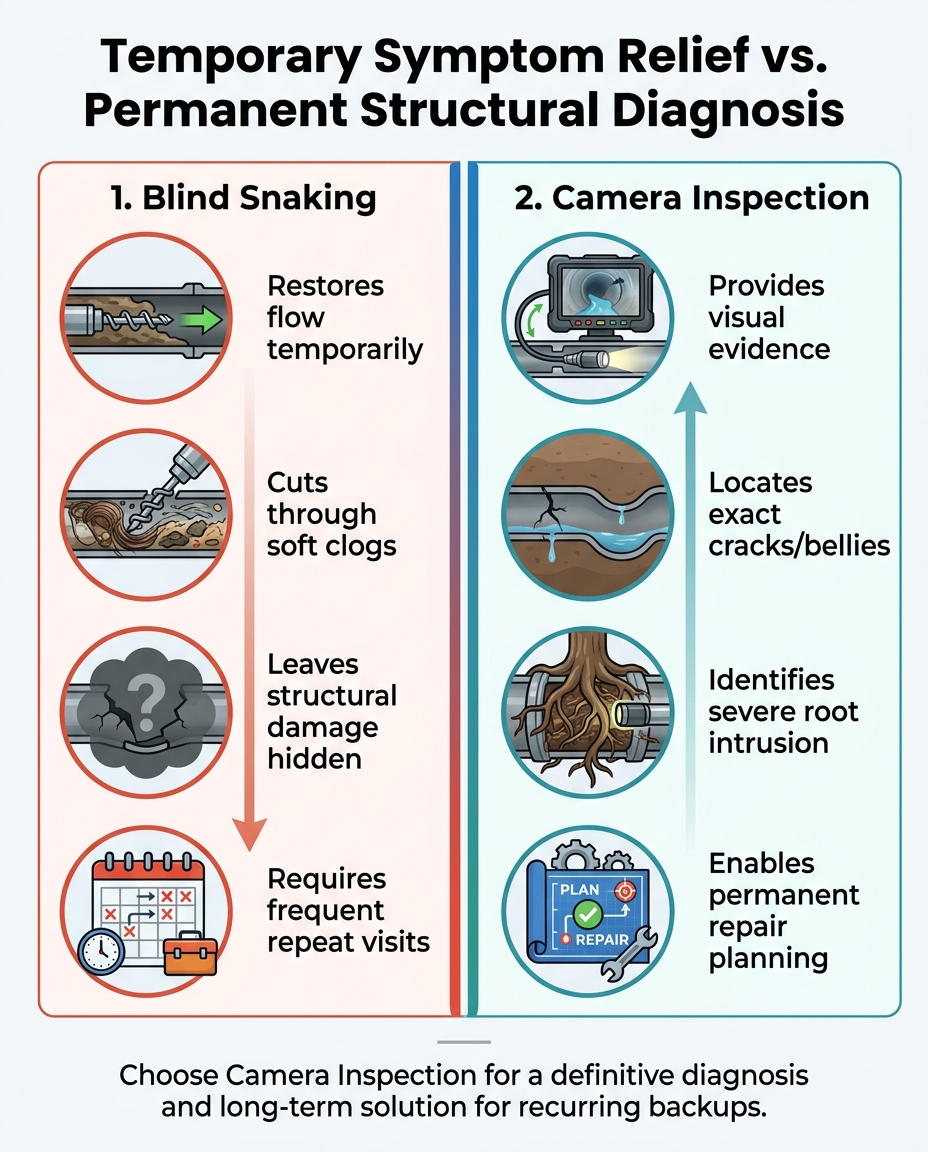
Mechanical drain snaking, often referred to as cabling or rodding, is a standard plumbing procedure where a flexible steel cable with an attached cutting blade is fed down a drain. The rotating blade is designed to break apart soft clogs, such as accumulated grease, toilet paper wads, or minor debris. For a simple, localized blockage inside the home's interior piping, a drain snake is highly effective. However, when dealing with severe, recurring blockages in the main sewer lateral—especially in older Wichita neighborhoods with mature tree canopies—our plumbers regularly see blind snaking quickly reach its mechanical limitations.
When a technician feeds a cable into a buried sewer line without a camera, they are working completely blind. They rely entirely on the tactile feedback of the cable to guess what they are hitting. Here is exactly what happens when that blind cable meets a dense obstruction like a mature tree root mass:
1. The initial contact: The cutting blade reaches the dense root intrusion and begins to spin against the blockage.
2. The temporary puncture: The blade cuts a small, narrow pathway through the center of the root mass, allowing trapped wastewater to finally drain.
3. The false resolution: Because the water drains, the technician pulls the cable back, assuming the job is complete. The homeowner or business owner pays for the service, believing the pipe is clear.
4. The biological retaliation: The roots that were sliced by the blade react biologically. Just like pruning a garden hedge, cutting the roots stimulates rapid, aggressive new growth. The roots grow back thicker and faster, guaranteeing another severe blockage in the near future.
This cycle traps homeowners and business owners in a frustrating and expensive loop. The hidden costs of renting a drain snake or paying for repeated professional snaking visits quickly add up, all without ever revealing the true condition of the underground pipe.
Treating the Symptom, Hiding the Disease
The core issue with blind snaking is that it restores flow temporarily, giving the homeowner or business owner a false sense of security. The water goes down, so the problem appears solved. In reality, the structural defect that allowed the roots or dirt to enter the pipe in the first place remains completely unaddressed. Furthermore, repeatedly scraping the interior walls of an older clay or cast-iron sewer pipe with a heavy steel cable can exacerbate existing structural weaknesses, potentially turning a small crack into a complete pipe collapse.
How Late-Summer Soil Shifts Destroy Underground Sewer Lines
To understand why sewer lines fail repeatedly, you have to look at the environment surrounding the pipe. The ground beneath your lawn is not static; it is a dynamic, shifting environment. This is particularly true given the expansive clay soils our technicians encounter daily across the Wichita area. During the wet spring months, these clay soils absorb massive amounts of moisture, causing the ground to swell and expand. This expansion exerts immense physical pressure on rigid underground sewer pipes.
As the seasons change and we enter the prolonged dry spells of late summer (August), the opposite reaction occurs. The expansive clay rapidly dehydrates, shrinks, and pulls away from the pipes. This dramatic seasonal shifting causes the ground to settle unevenly. Rigid sewer lines—especially older clay tile or cast-iron pipes—cannot flex with the shifting earth. As a result, the pipes sag, the joints offset, or the pipe bellies crack under the strain.
Once a crack forms, the pipe is compromised. During late summer (August), mature trees are desperate for moisture. Their extensive root systems can sense the nutrient-rich water escaping from the tiny cracks in your compromised sewer line. The trees send aggressive, hair-like taproots directly into the pipe joints. Once inside the pipe, where water is plentiful, these roots explode in growth, forming a dense, impenetrable net that catches solid waste and causes a complete backup. Environmental factors make recurring backups inevitable until the structural breach is identified and repaired.
The Camera Inspection Advantage: Seeing the Structural Reality
If blind snaking is a guessing game, a sewer camera inspection is absolute certainty. Instead of sending a destructive cutting blade into the dark, our technicians utilize advanced diagnostic technology to map the exact condition of your plumbing system. This process fundamentally changes how you approach a recurring backup.
The inspection process involves feeding a high-definition, waterproof video camera attached to a flexible fiber-optic pushrod directly into the sewer lateral. High-powered LED lights illuminate the dark pipe, sending a crisp, real-time video feed back to a monitor above ground. This allows the technician to visually navigate the entire length of the pipe, from the house all the way to the municipal sewer main.
A thorough camera inspection reveals specific structural issues that a blind snake could never identify:
1. Offset joints: Sections of pipe that have disconnected and shifted out of alignment, creating a lip that catches debris.
2. Bellies and sagging: Areas where the ground has settled, causing the pipe to dip and hold standing water, which inevitably leads to clogs.
3. Severe root intrusion: Visual confirmation of exactly where and how aggressively tree roots have breached the pipe walls in Wichita neighborhoods with mature tree canopies.
4. Collapsed sections: Areas where the structural integrity of the pipe has completely failed, crushing inward under the weight of the soil.
Beyond just seeing the damage, camera systems feature a built-in sonde—a radio transmitter located right behind the camera head. When the camera locates a severe defect, the technician uses a locator wand above ground to pinpoint the exact depth and location of the problem. This precision tracking prevents unnecessary, destructive digging. Instead of trenching your entire yard to find a leak, repairs can be targeted to a single, specific spot.
Most importantly, our team at Midwest Mechanical believes in total transparency. We don't just tell you what we found; we show you the actual camera footage on the monitor. You can see the root cause for yourself, empowering you to make an informed decision about your home. We view it as our ethical responsibility to accurately diagnose a failing system rather than blindly treating the symptoms over and over.
Head-to-Head Comparison: Blind Snaking vs. Camera Inspection
When you are staring at a backed-up drain in late summer (August), you need to know exactly what you are paying for. Understanding the distinct differences between these two approaches is the key to breaking the cycle of plumbing frustration. The table below breaks down how each method functions and what it ultimately provides for your home.
• Primary Function — Blind Drain Snaking: Clearing soft, localized clogs to restore immediate water flow. — Sewer Camera Inspection: Diagnosing the structural integrity and exact condition of the pipe.
• Longevity of Results — Blind Drain Snaking: Temporary symptom relief; obstructions like roots will aggressively regrow. — Sewer Camera Inspection: Enables permanent repair planning by identifying the root cause.
• Visual Evidence — Blind Drain Snaking: None. Relies entirely on the technician's tactile feel of the cable. — Sewer Camera Inspection: High-definition, real-time video footage of the pipe's interior walls.
• Risk to Old Pipes — Blind Drain Snaking: High. Heavy scraping can damage fragile, aging clay or cast-iron lines. — Sewer Camera Inspection: Zero. Non-destructive visual navigation poses no risk to the pipe.
• Long-Term ROI — Blind Drain Snaking: Poor. Cumulative costs of repeated cabling quickly exceed permanent repairs. — Sewer Camera Inspection: Excellent. A one-time definitive diagnosis prevents wasted future visits.
Relying solely on blind snaking for a recurring issue is a fundamentally flawed strategy. It forces you to pay repeatedly for a service that is biologically and mechanically incapable of providing a permanent solution.

Breaking the Cycle: When to Stop Cabling and Start Diagnosing
Knowing when to transition from standard drain clearing to diagnostic investigation can save you immense frustration. You should not have to cross your fingers every time you run the washing machine or flush a toilet. If you live in older Wichita neighborhoods with mature tree canopies, you need actionable criteria for when to refuse another snaking and insist on a camera inspection.
Watch for these definitive warning signs that indicate a structural failure rather than a simple clog:
• The single-season rule of thumb: If your main sewer line backs up more than once in a single season, a structural issue is highly likely. Soft clogs do not reform that quickly; only aggressive root growth or a collapsed pipe causes rapid repeat failures.
• Dense root extraction: If the technician pulls the drain cable back and the blade is wrapped in large, thick, dense root masses, the pipe is heavily compromised. A tiny hairline crack does not produce thick roots; only a major breach does.
• Mud or clay on the blade: If the drain snake pulls back thick mud or clay, it means the bottom of your pipe has completely rotted out or broken away, and the cable is scraping the raw earth beneath the pipe.
• Unusual gurgling sounds: If your toilets gurgle aggressively when the shower is draining, the main line is holding standing water due to a belly or sag in the pipe, restricting proper airflow.
An ethical, trustworthy contractor—like our experienced crew at Midwest Mechanical—will actively advise against wasting your money on another snaking if a camera inspection is the only way to solve the problem permanently. We will refuse to repeatedly cable a compromised line without visual confirmation, because doing so only hides the real damage. Once the line is properly diagnosed and structurally repaired, you can confidently rely on routine preventative plumbing maintenance to keep the system flowing smoothly for years to come.
Frequently Asked Questions About Sewer Line Diagnostics
Why does my sewer keep backing up after snaking?
Snaking only clears a narrow, temporary path through solid obstructions like roots or scale, which quickly close back up. Because the cutting blade is much smaller than the diameter of your main sewer line, it leaves the majority of the blockage attached to the pipe walls. Within a few weeks or months, normal waste and paper catch on the remaining debris, causing the pipe to back up all over again. Until the structural defect allowing the intrusion is fixed, backups will continue.
Can a snake permanently clear tree roots?
No, mechanical blades cut roots back temporarily, but the remaining roots will aggressively regrow into the pipe. When a drain snake slices through a tree root, it triggers a biological response that causes the root to heal by sending out multiple new, thicker shoots. In late summer (August), when trees are actively seeking water, this regrowth happens incredibly fast. Permanent removal requires fixing the broken pipe so roots can no longer enter.
Is a sewer camera inspection necessary for recurring clogs?
Yes, it is the only non-destructive way to confirm if a pipe is cracked, sagging, or collapsed. Without visual evidence, a plumber is simply guessing at the cause of the blockage based on the feel of the cable. A camera inspection removes the guesswork, showing you exactly what is wrong, where the damage is located, and how deep it is buried, which prevents unnecessary digging.
How do you fix a recurring sewer backup permanently?
By performing a camera inspection to locate the exact defect, followed by targeted repair or replacement of the damaged pipe section. Once the structural breach—such as an offset joint or a cracked belly—is identified, the damaged segment can be excavated and replaced with modern, root-resistant piping. This cures the underlying disease rather than just treating the symptom.
Will a camera inspection show if my pipe has collapsed?
Absolutely. A camera inspection provides a clear, high-definition view of the entire interior of the pipe, making a collapse immediately obvious. If the pipe has crushed inward under the weight of the soil, the camera will encounter an impassable wall of dirt, jagged pipe fragments, or standing water. This visual proof allows the technician to pinpoint the exact location of the collapse for a precise repair.
Take Control of Your Plumbing with a Clear Diagnosis
You deserve to know exactly what is happening under your lawn, especially in older Wichita neighborhoods with mature tree canopies where root intrusion is a constant threat. Continuing to pay for temporary band-aids only hides the real damage, allowing underground leaks to wash away supporting soil and make eventual repairs more extensive. Stop crossing your fingers and hoping the drain stays clear.
It is time to transition from reactive panic to proactive solutions. By choosing to schedule a sewer camera inspection with Midwest Mechanical, you gain a clear understanding of why blind snaking is only a temporary fix. Seeing the pipe's interior via high-definition camera is the necessary next step to stop the cycle, giving you definitive answers and a permanent, long-term plan for your home's plumbing.


We have partnered with GoodLeap to offer flexible payment options for your project. GoodLeap uses a soft credit check until funding and the highest score from all 3 bureaus to see if you qualify. It also takes just a few minutes to get started.






.svg)