


Preparing for Fall: Is Your Water Heater Expansion Tank Ready?
The September pre-heating season is officially upon us, meaning cooler mornings are settling in and it is time to evaluate your home's utilities before winter demand spikes. In our over two decades of serving Wichita homes, our team at Midwest Mechanical has found that if you have noticed a strange dripping near your utility closet or a heavy, solid sound coming from your plumbing equipment, you might be looking at the signs your water heater expansion tank bladder has ruptured. Catching this specific problem early is one of the smartest moves you can make to protect your home from unexpected water damage and premature equipment failure.
When navigating these symptoms, securing professional plumbing services ensures your home remains safe and fully operational. Many homeowners misunderstand what an expansion tank actually does, assuming it is just an optional accessory rather than a critical safety component. As we transition into colder weather, your water heater works harder to overcome dropping incoming municipal water temperatures. This increased workload places extra stress on the internal components of your plumbing system, particularly the expansion tank.
This diagnostic guide will help you safely observe the symptoms of a waterlogged tank without resorting to risky DIY disassembly. We will walk through the visual and auditory cues that our plumbers use to indicate an internal failure, helping you make an informed decision about when to call in a licensed professional. By understanding exactly what is happening inside that small metal tank, you can prevent minor pressure issues from turning into major household leaks.
Understanding the Role of the Expansion Tank Bladder
To understand why a failure is so problematic, you first need to understand how a closed plumbing system operates. When our technicians are out on fall tune-up calls, we often explain that when your water heater turns on to heat a fresh batch of cold water, that water physically expands in volume. In the plumbing industry, this is known as thermal expansion. Because modern homes are built as "closed systems"—meaning backflow preventers stop water from pushing back out into the city water main—that newly expanded water has nowhere to go. Without a pressure relief mechanism, this expanding water would exert tremendous force on your pipes, fixtures, and the water heater itself.
That is exactly where the expansion tank comes in. Inside this small, dome-shaped tank sitting above your water heater is a flexible rubber bladder. This bladder divides the tank into two distinct sections: one half is connected to your plumbing and fills with water, while the other half is pre-charged with pressurized air. Because air can be compressed and water cannot, the air side acts as a shock absorber.
The internal mechanics:
• Normal operation: As water heats up and expands, it pushes against the rubber bladder. The bladder flexes, compressing the air on the other side and safely absorbing the excess pressure.
• The cooling cycle: When you use hot water and the system cools down, the compressed air pushes the bladder back to its neutral resting position.
• When failure occurs: If the rubber bladder tears or degrades over time, water floods the air chamber. The tank loses its ability to compress, leaving your plumbing system entirely unprotected from thermal expansion.
During the September pre-heating season, your system undergoes more frequent and intense heating cycles. A functioning bladder is absolutely critical during this time to manage the constant pressure fluctuations safely.
The Tap Test: Safely Listening for a Waterlogged Tank
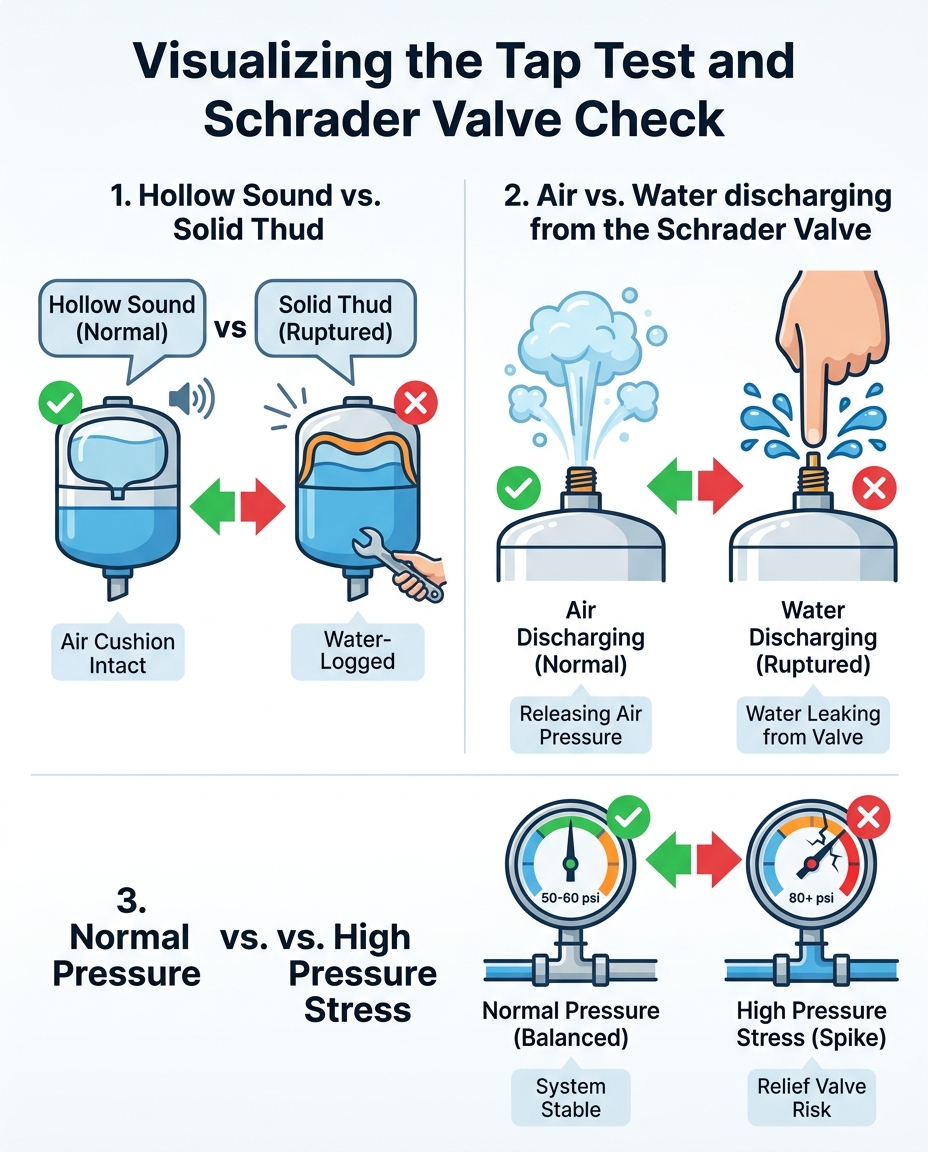
One of the most effective ways to check the health of your expansion tank requires zero tools and absolutely no plumbing disassembly. We frequently walk homeowners through this method—it is called the tap test, and it relies entirely on sound. Because a healthy expansion tank is half-full of pressurized air, it should sound distinctly hollow when you strike it lightly. If the internal bladder has failed and the tank has filled completely with water, the sound changes dramatically.
Here is how we recommend you perform this safe, preliminary diagnostic test:
1. Locate the tank: Find the small, usually blue or gray tank mounted on the cold water line directly above or adjacent to your water heater.
2. Tap the top half: Using your knuckles or a light metal object like a coin, gently tap the upper section of the tank (the side connected to the water pipe). This section always contains water, so it will produce a dull, solid sound.
3. Tap the bottom half: Move your hand to the lower half of the tank (the side with the small air valve) and tap it with the same amount of force.
4. Compare the sounds: In a healthy tank, the bottom half will produce a resonant, hollow, metallic ring because it is filled with air. If you hear the exact same solid, heavy "thud" on the bottom as you did on the top, the tank is waterlogged.
Hearing a solid thud on the bottom half is a strong indicator that the rubber bladder has given way. While this test is highly reliable, it is always a good idea to test the air pressure in your water heater expansion tank using safe observation methods to confirm your suspicions before calling a professional. The tap test is completely safe because you are simply listening to the exterior of the tank without altering the system's pressure or water flow.
The Definitive Sign: Inspecting the Schrader Valve
While the tap test provides an excellent auditory clue, our plumbers rely on one visual check that confirms a total internal failure with absolute certainty. This involves locating and observing the air valve on the expansion tank. Known as a Schrader valve, this component looks exactly like the small air valve found on a standard bicycle or car tire. It is typically located on the bottom or the side of the tank, sometimes protected by a small twist-off plastic cap.
The normal function of the Schrader valve is to allow a technician to check the air pressure inside the tank and add or release air to match your home's incoming water pressure. Under normal circumstances, the only thing behind this valve is pressurized air. The rubber bladder sits between this air chamber and your household water supply, keeping the two elements strictly separated.
The definitive failure sign occurs when you observe water discharging from the Schrader valve. If you remove the plastic cap and see a slow drip of water, or if a technician lightly depresses the center pin and water shoots out instead of a hiss of air, the diagnosis is final. The only physical way for water to reach that valve is if the internal rubber bladder has suffered a complete rupture, allowing the system's water to breach the protective air chamber.
Once water breaches this chamber, the tank is completely dead. It can no longer absorb thermal expansion, and the heavy, water-filled tank places immense physical strain on the piping holding it in place. If you see water at this valve, safe observation is over—it is time to schedule a professional replacement.

Secondary Symptoms of Expansion Tank Failure
Sometimes, the expansion tank itself is tucked away in an awkward spot, making it difficult to perform the tap test or check the air valve. In these cases, you can look for secondary symptoms throughout your home. A pattern we see often in Wichita homes is that when the bladder fails and thermal expansion is left unchecked, that excess pressure has to go somewhere. Your plumbing system will start showing signs of stress in various ways.
Here is a checklist of secondary symptoms that corroborate a failed expansion tank bladder:
• A weeping Temperature & Pressure (T&P) relief valve: This is a critical safety valve located on the side or top of your water heater. If the expansion tank cannot absorb the pressure, the T&P valve is forced to open slightly and drip water onto the floor to prevent the tank from bursting. A weeping T&P valve is the most common secondary sign of a waterlogged expansion tank.
• Unexplained spikes in household water pressure: You might notice that when you turn on a faucet first thing in the morning, the water blasts out with intense force for a split second before returning to normal flow. This happens because the pressure built up overnight during a heating cycle and had nowhere to go.
• Premature wear on plumbing fixtures: Constant high-pressure cycles take a toll on the rubber gaskets and seals inside your home. If you are constantly replacing toilet fill valves, fixing dripping faucets, or noticing minor leaks under sinks, unchecked thermal expansion is a likely culprit.
• Banging pipes (water hammer): While usually associated with fast-closing valves, a system under extreme pressure is more prone to loud banging noises when water flow abruptly stops.
If you notice these household issues alongside water discharging from the Schrader valve, you have a complete diagnostic picture. The secondary signs confirm that the primary failure is actively damaging your broader plumbing system.
The Impact of Local Climate on Plumbing Stress
Plumbing systems do not exist in a vacuum; they are heavily influenced by the environment around them. Here in Wichita, our rapid autumn temperature drops increase the delta between incoming cold municipal water and the heated tank water, amplifying thermal expansion pressure in residential plumbing systems. As we move out of summer, the ground temperature cools, and the water traveling through city mains drops significantly in temperature before it reaches your home.
When this colder water enters your water heater, the burner or heating elements have to run longer and work harder to raise that water to your set temperature of 120°F. Heating water from 50°F to 120°F causes a much larger volume expansion than heating water from 75°F to 120°F. This larger temperature delta creates more intense thermal expansion cycles within your closed plumbing system.
Our team prepares for this every September, as an aging expansion tank bladder faces its most severe test during the pre-heating season. The rubber, which may already be brittle from years of constant flexing and exposure to chlorinated water, is suddenly forced to absorb much larger pressure swings. This seasonal stress is exactly why so many expansion tanks fail during the transition into fall and winter. Recognizing the impact of the local climate helps explain why proactive observation during this time of year is so vital for preventing unexpected breakdowns.
Safe Diagnostics vs. Risky DIY Replacement
There is a distinct line between safely observing your plumbing system and attempting a dangerous repair. Tapping the side of a tank or looking at a valve for moisture are excellent homeowner maintenance habits. However, actually replacing a ruptured expansion tank is a complex job that requires specialized knowledge, specific tools, and adherence to local building codes.
Attempting to remove a waterlogged tank yourself poses significant physical risks. A standard 2-gallon expansion tank weighs only a few pounds when empty, but a failed, water-filled tank can weigh upwards of 20 to 30 pounds. Because they are often suspended above the water heater on a threaded pipe, unscrewing a heavy, pressurized tank can easily result in snapped pipes, severe water damage, or personal injury.
• Method — Safe Homeowner Diagnostics: Listening for a hollow ring vs. a solid thud during the tap test. — Risky DIY Replacement: Attempting to unscrew a pressurized, water-filled tank from the water line.
• Tools Required — Safe Homeowner Diagnostics: None (just your knuckles or a light coin). — Risky DIY Replacement: Pipe wrenches, thread sealant, pressure gauges, air compressors.
• Code Compliance — Safe Homeowner Diagnostics: Observation does not affect plumbing codes. — Risky DIY Replacement: Must meet Uniform Plumbing Code (UPC) requirements for proper sizing and support.
• Risk Level — Safe Homeowner Diagnostics: Zero risk to the plumbing system. — Risky DIY Replacement: High risk of snapping pipes, flooding, or improper pressure calibration.
Furthermore, installing a new tank is not a simple "plug and play" operation. A licensed professional must use a pressure gauge to measure your home's specific incoming water pressure and then use a compressor to pre-charge the new expansion tank to match that exact PSI before installation. If the pressure is not matched perfectly, the new bladder will fail prematurely. By leveraging our team's deep local experience at Midwest Mechanical (we have been serving Wichita since 2004), you ensure that you receive professional, accurate diagnostics and a code-compliant replacement that is vastly superior to risky DIY guesswork. Enrolling in a routine plumbing maintenance plan ensures these pressure calibrations are handled safely by our experts year after year.
Frequently Asked Questions About Expansion Tank Failures
How do I know if my expansion tank is bad?
The easiest way to know if your expansion tank is bad is to perform the tap test on the lower half of the tank. If you hear a solid, heavy thud instead of a hollow metallic ring, the tank is likely waterlogged. Additionally, you should check for water at the air valve and look for a weeping T&P valve on your water heater. Our team finds that these symptoms combined provide a clear indication of internal failure.
What happens when an expansion tank bladder fails?
When an expansion tank bladder fails, the tank becomes completely filled with water, eliminating the air cushion needed to absorb thermal expansion. Because water cannot be compressed, the excess pressure created during the heating cycle has nowhere to go. This unchecked pressure forces its way back into your plumbing system, which can damage the water heater, rupture pipe fittings, and destroy household plumbing fixtures over time.
Can you fix a ruptured expansion tank?
No, the internal rubber bladder cannot be repaired or replaced once it has torn. The tank is a sealed, pressurized unit, meaning the entire expansion tank assembly must be replaced when a failure occurs. Because this involves dealing with pressurized water lines and matching the home's exact PSI, replacement requires the expertise of a licensed plumber.
Why is water coming out of my expansion tank air valve?
If water is coming out of your expansion tank air valve, the rubber bladder separating the air and water chambers has torn. System water has breached the pressurized air chamber, filling the space where only air should exist. This is the most definitive sign of total failure, confirming that the tank must be replaced immediately.
How long does a water heater expansion tank typically last?
In our experience, a water heater expansion tank generally lasts between 5 to 10 years, depending heavily on your local water quality and your home's baseline water pressure. Homes with exceptionally high municipal water pressure will wear out a bladder faster due to constant over-flexing. Regular maintenance and annual pressure checks can help optimize the lifespan of the tank.
Does a weeping T&P valve always mean the expansion tank is broken?
Not always, but we consider it a primary suspect in closed plumbing systems. The T&P (Temperature and Pressure) valve is designed to open if the pressure or temperature inside the water heater reaches dangerous levels. While the valve itself could simply be faulty or blocked by sediment, a waterlogged expansion tank is frequently the root cause of the excess pressure forcing it open. Professional diagnostics are required to pinpoint the exact cause safely.
Next Steps: Securing Your Plumbing Before Winter
Addressing a waterlogged expansion tank quickly is essential for protecting your home's broader plumbing infrastructure. Unchecked thermal expansion acts like a slow, silent stressor on every pipe, joint, and fixture in your house. By taking the time to perform the tap test and visually inspecting the Schrader valve during the September pre-heating season, you give yourself the proactive advantage of fixing the issue before the deep winter freeze sets in.
If your observations confirm the signs your water heater expansion tank bladder has ruptured, it is crucial to rely on local experts for a safe, code-compliant replacement. Our licensed plumbers at Midwest Mechanical will ensure the new tank is properly sized, perfectly pressurized to match your home's incoming water supply, and securely mounted. Do not let a small, affordable component failure turn into a major water heater disaster. Reach out to our team for professional water heater repair and replacement to restore your system's safety. (If a full unit replacement ends up being necessary, we can also help you navigate whether general federal tax credits or local utility incentive programs may apply to qualifying high-efficiency installations!)
Customer Testimonials
Hear from satisfied customers who trust us for reliable HVAC and plumbing service across Wichita.





Plus, the technician, Lee was very professional, knowledgeable and informative.
We will definitely be doing business with them sometime again in the past.
I'm prompt to my appointment. Thank you Midwest Mechanical.
I'm prompt to my appointment. Thank you Midwest Mechanical.

We have partnered with GoodLeap to offer flexible payment options for your project. GoodLeap uses a soft credit check until funding and the highest score from all 3 bureaus to see if you qualify. It also takes just a few minutes to get started.




Service Areas
.svg)