


Why Clean Air Starts With Professional Installation
Residential indoor air quality installation in Haysville, KS addresses a problem many homeowners don't realize they have: the air inside your home is likely 2-5 times more polluted than the air outside. Between seasonal pollen from Kansas fields, agricultural dust, pet dander, mold spores, and everyday household chemicals, your HVAC system is constantly recirculating contaminants throughout every room. The result? Persistent allergies, respiratory irritation, excessive dust buildup, and lingering odors that make your home less comfortable and potentially compromise your family's health.
If you're looking for residential indoor air quality installation in Haysville, KS:
- Whole-house air purifiers integrate directly with your HVAC system to filter pollutants before they circulate
- UV light systems neutralize bacteria, viruses, and mold spores in your ductwork
- Humidity control solutions prevent mold growth and protect your respiratory comfort year-round
- Professional installation ensures proper sizing, ductwork integration, and optimal performance
- Local experts like Midwest Mechanical understand Haysville's unique air quality challenges
Improving your home's air quality isn't about buying a portable unit for one room—it's about installing a comprehensive system that works with your existing HVAC to clean every breath your family takes. Learn more about how understanding indoor air quality impacts your home comfort, or explore Midwest Mechanical's Indoor Air Quality services to get started with a professional assessment.
Why Your Haysville Home's Air Quality Matters
Living in Haysville means enjoying wide-open Kansas skies and friendly neighbors—but it also means dealing with some unique challenges when it comes to the air inside your home. Seasonal pollen from surrounding fields can be intense, especially during spring and fall when grass and tree pollen counts spike. Agricultural dust from nearby farming operations doesn't just settle on your porch; it finds its way indoors through windows, doors, and even tiny cracks in your home's envelope.
Beyond what blows in from outside, your home creates its own collection of airborne irritants. Pet dander from your furry family members, household dust that seems to reappear minutes after you've cleaned, and mold spores that thrive in Kansas humidity all circulate through your HVAC system. Add in VOCs (Volatile Organic Compounds) from everyday items like cleaning products, paints, air fresheners, and new furniture, and you've got a surprisingly complex mix of contaminants floating through every room.
Here's the part that catches most homeowners off guard: the EPA has found that indoor air can be 2-5 times more polluted than outdoor air, even on high-pollen days. That means while you're closing windows to keep allergens out, you might actually be trapping worse air inside. Understanding what's really in your home's air is the first step toward breathing easier—learn more in our guide on Understanding Indoor Air Quality.
Signs Your Home Needs an Air Quality Upgrade
Your home (and your body) will tell you when something's off with your indoor air—you just need to know what to listen for. If you or your family deal with persistent allergies that seem worse indoors than out, that's a red flag. Respiratory irritation—like coughing, sneezing, or that scratchy throat feeling that never quite goes away—often points to airborne irritants your current system isn't catching.
Lingering odors are another telltale sign. Whether it's cooking smells that hang around for days, pet odors that won't budge, or just a general stuffiness, these suggest your air isn't circulating and filtering properly. Do you dust your furniture only to find it covered again by the next day? That excessive dust buildup means particulates are constantly recirculating through your home instead of being captured.
Visible mold growth around windows, in bathrooms, or in your basement is a clear indicator of humidity problems that directly impact air quality. If you're noticing high humidity in summer or uncomfortably dry air in winter, your home needs help balancing moisture levels. These aren't just annoyances—they're opportunities to create a healthier living environment. Taking action now can lead to Better Health with Enhanced Indoor Air Quality.
Beyond Filtration: The Role of Humidity Control
Most people think about air quality in terms of filters catching dust and pollen—and that's definitely important. But there's another piece of the puzzle that often gets overlooked: humidity control. In Haysville's climate, where we swing from bone-dry winters to muggy summers, managing moisture levels is just as crucial as filtration.
Dry winter air isn't just uncomfortable—it can crack your lips, irritate your sinuses, create annoying static electricity, and even damage your wood floors and furniture. When indoor humidity drops too low, your respiratory system has to work harder, and you're more susceptible to colds and infections. Whole-house humidifiers integrate with your HVAC system to add the right amount of moisture throughout your entire home, not just one room.
On the flip side, high summer humidity creates the perfect breeding ground for mold and mildew. That musty smell in your basement? It's mold releasing spores into your air. Beyond the odor, these spores trigger allergies and can cause serious respiratory issues. Whole-house dehumidifiers work through your existing ductwork to remove excess moisture, preventing mold growth before it starts and protecting both your home and your health.
The sweet spot for indoor humidity is typically between 30-50%—comfortable for breathing, safe for your home's structure, and inhospitable to mold. When you integrate humidity control with your HVAC system, you get precise, whole-home comfort that changes with the seasons. It's not just about respiratory comfort; it's about protecting wood furnishings, preventing mold, and creating an environment where your family can truly breathe easy.
Exploring Whole-House Air Quality Solutions
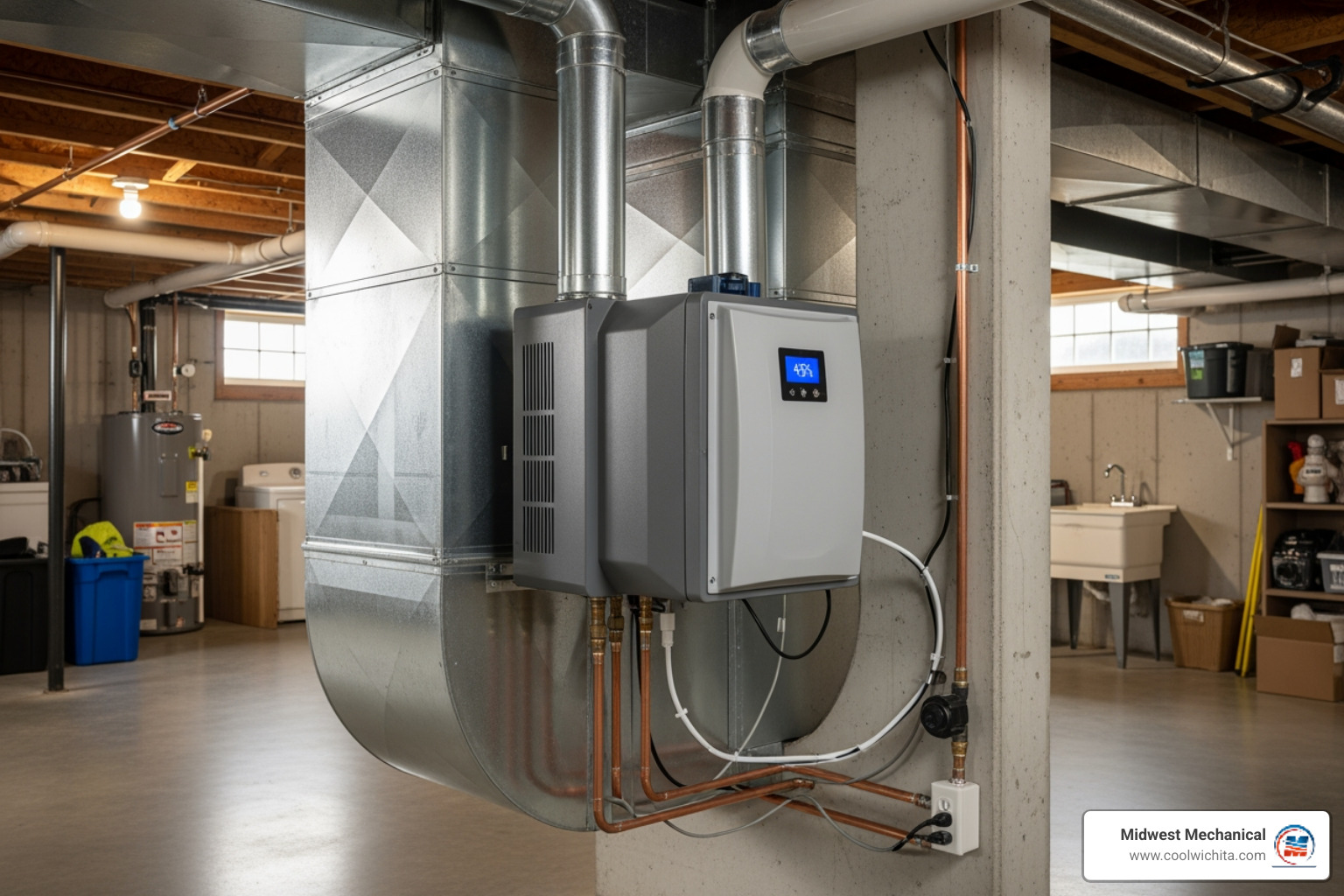
When you're ready to take control of your home's air quality, the most effective path forward isn't a collection of portable units scattered throughout your house. It's a whole-house air quality solution that works hand-in-hand with your existing HVAC system. These integrated systems treat every breath of air circulating through your home, not just the air in one bedroom or living room.
Think about it: your HVAC system already moves air through every room in your house multiple times each hour. A whole-house solution simply adds a powerful cleaning step to that process. Instead of your heating and cooling system just moving air around, it actively purifies it as it circulates. The result is consistent, reliable air quality in every corner of your home—from your basement to your upstairs bedrooms. This comprehensive approach to Enhancing Indoor Air Quality goes far beyond what any standalone unit can achieve. To learn more about the various technologies available, explore our guide on Indoor Air Cleaners & Quality.
How Whole-House Systems Work
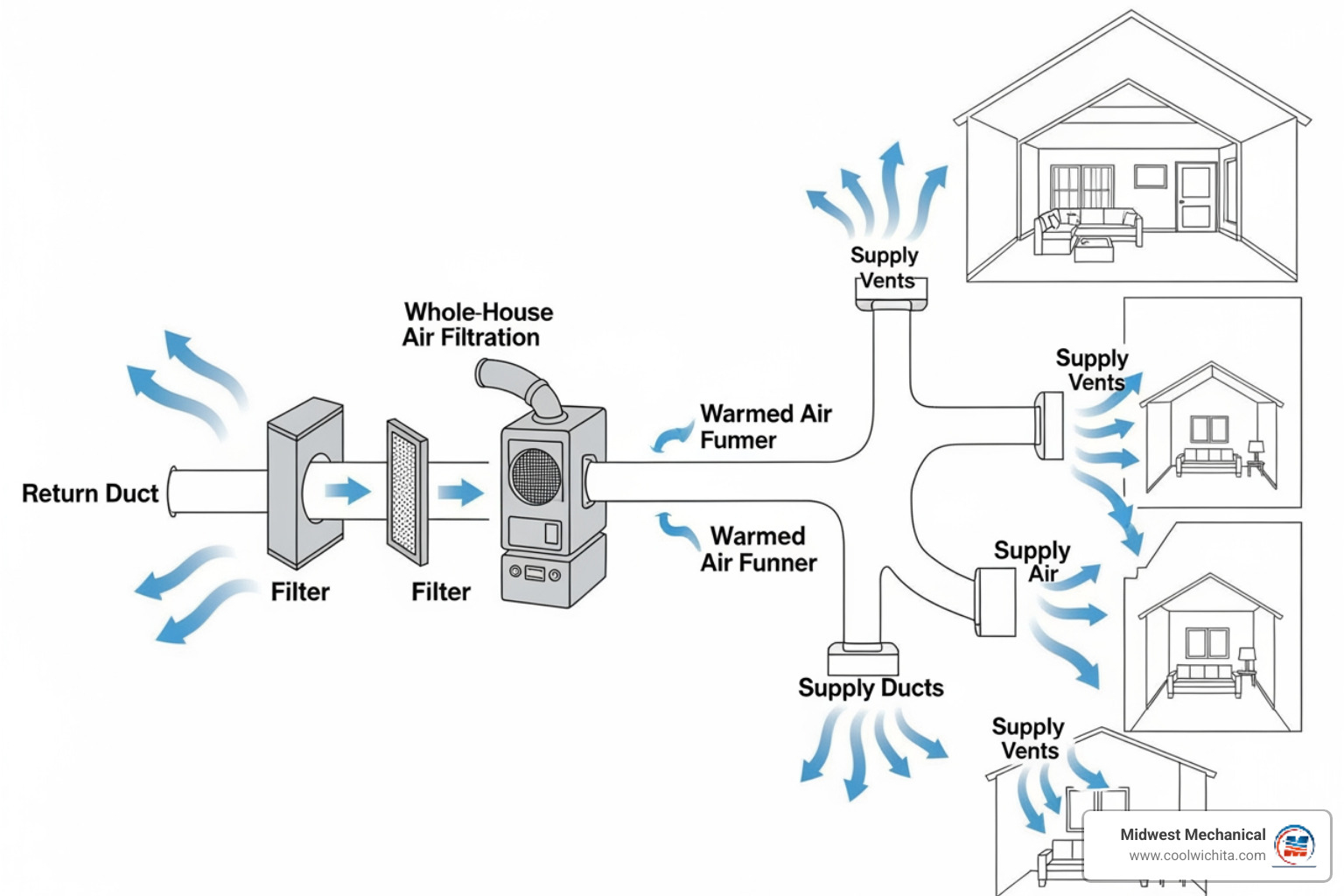
The beauty of whole-house systems is their simplicity. Your HVAC system is already doing the heavy lifting, circulating air throughout your entire home. A residential indoor air quality installation in Haysville, KS simply adds a purification component to this existing process.
Here's how it works: Air from your living spaces gets pulled into the return ducts. Before that air reaches your furnace or air handler, it passes through your installed air quality device. This could be a high-efficiency filter, an electronic air cleaner, a UV light system, or a combination of technologies. As the air moves through, the system captures particles, neutralizes pathogens, or absorbs odors—depending on which type you've chosen.
Once cleaned, the air continues through your HVAC unit, where it's heated or cooled as needed, then distributed back into your home through the supply vents. This continuous cycle means that all the air in your home gets treated multiple times throughout the day. You're not just cleaning one room's air—you're creating a healthier environment for your entire family.
Types of Air Purification and Filtration Systems
At Midwest Mechanical, we offer several types of air purification and filtration systems, each designed to tackle specific air quality challenges in your Haysville home.
Mechanical filters are the workhorses of air filtration. They physically trap particles as air passes through them. The effectiveness of these filters is measured by their MERV rating—that's Minimum Efficiency Reporting Value. A basic filter might be rated MERV 5-8, which handles visible dust, lint, and larger pollen particles. Step up to MERV 9-12, and you're capturing finer dust and most pet dander. High-efficiency filters rated MERV 13-16 catch the majority of allergens, smoke particles, and fine dust. True HEPA filters represent the gold standard, removing 99.97% of particles down to 0.3 microns—including most bacteria and viruses. Because HEPA filters are so dense, they often require a dedicated bypass system to maintain proper airflow through your HVAC. Our guide on Understanding MERV Ratings for Cleaner Air can help you understand which rating makes sense for your home.
Electronic air cleaners take a different approach. Instead of physically blocking particles, these systems use electrical charges to trap them. They charge incoming particles, which are then attracted to oppositely charged collection plates inside the unit. They're particularly effective at removing very small particles that might slip through standard filters.
UV light purifiers are your defense against biological contaminants. Installed in your ductwork (typically near the evaporator coil), these systems use ultraviolet-C light to sterilize airborne pathogens. UV-C light destroys the DNA of bacteria, viruses, and mold spores, preventing them from reproducing. It's a chemical-free way to neutralize biological threats in your air.
Activated carbon filters specialize in something mechanical filters can't handle: gases, odors, and volatile organic compounds (VOCs). These filters absorb the chemical compounds that cause smells from cooking, pets, cleaning products, and smoke. They're often paired with mechanical filters to provide comprehensive air treatment—one catches particles, the other handles odors and chemicals.
Whole-house air purifiers often combine multiple technologies into one integrated system. You might get high-efficiency filtration paired with UV-C light and activated carbon. These multi-layered systems provide the most comprehensive protection, treating all the air that circulates through your home.
Benefits of Whole-House Systems
The advantages of whole-house air quality systems extend far beyond just cleaner air. The most significant benefit is consistent air quality throughout your entire home. While a portable unit might clean the air in your bedroom, a whole-house system treats every room equally. Your kitchen, bathrooms, basement, and bedrooms all receive the same level of air purification.
These systems are also remarkably low maintenance. Instead of managing filters for multiple portable units scattered throughout your house, you typically just need to change one filter or replace a UV bulb on a set schedule. Many homeowners incorporate these simple tasks into their regular HVAC maintenance routine, making it easy to remember.
The seamless integration with your existing HVAC means no bulky equipment taking up floor space in your rooms. The system works quietly in the background, and most guests won't even know it's there. No cords to trip over, no units to move when you vacuum, and no noise from multiple fans running.
Perhaps most importantly, whole-house systems deliver improved comfort and health for everyone in your home. By continuously reducing allergens, dust, odors, and pathogens, you'll likely notice fewer allergy symptoms, easier breathing, and better sleep. Your home will smell fresher, you'll spend less time dusting, and you'll have peace of mind knowing that the air your family breathes is being actively cleaned—all day, every day.
The Professional Residential Indoor Air Quality Installation Process in Haysville, KS
When you're ready to transform your home's air quality, choosing a professional residential indoor air quality installation in Haysville, KS makes all the difference between a system that truly works and one that underperforms. At Midwest Mechanical, we've refined our installation process to be thorough, efficient, and custom to your specific needs.
Everything starts with a comprehensive system assessment. Our technicians don't just show up and start drilling holes—we take time to understand your home. We'll examine your existing HVAC system, including your furnace or air handler, ductwork condition, and current filtration setup. More importantly, we'll sit down with you to discuss what's actually bothering you. Is it allergies that flare up indoors? Pet dander that never seems to settle? Lingering cooking odors? Excessive dust no matter how often you clean? Understanding your specific concerns helps us recommend the right solution rather than a one-size-fits-all approach.
This conversation leads naturally into sizing and selection. We calculate your home's square footage, assess your HVAC system's capacity, and match you with an air quality system that won't restrict airflow or strain your equipment. Installing a filter that's too restrictive can actually reduce your HVAC's efficiency and shorten its lifespan—something we're careful to avoid.
Once we've determined the perfect system for your home, we handle the ductwork modification with precision. Most whole-house systems integrate at the return air plenum or directly into your air handler. This requires careful cutting, proper sealing, and secure mounting to ensure no air bypasses the filtration system. For advanced systems that require dedicated power, our certified electricians handle all electrical connections safely and up to code—no shortcuts, no concerns.
After the physical installation, we move into system testing—arguably the most critical phase. We verify proper airflow throughout your home, check static pressure to confirm the new system isn't hindering your HVAC's performance, and calibrate all settings for optimal operation. Before we leave, we walk you through your new system, explaining how it works and what simple maintenance you'll need to do. Our Haysville Duct Cleaning & Air Quality Guide offers additional insights into how clean ductwork improves your new air quality system's performance.
Key Benefits of a Residential Indoor Air Quality Installation in Haysville, KS
Investing in a professional residential indoor air quality installation in Haysville, KS delivers benefits that extend far beyond just "cleaner air." The changes you'll notice touch every aspect of daily life in your home.
Allergen reduction often provides the most immediate relief. High-efficiency filters and purifiers capture pollen, pet dander, and dust mites before they circulate through your home, offering genuine relief for family members who suffer from allergies or asthma. Many of our customers report fewer allergy symptoms within just a few days of installation.
Odor elimination transforms how your home feels. Activated carbon filters and advanced purifiers neutralize unpleasant smells from cooking, pets, smoke, and household chemicals. Instead of masking odors with candles or air fresheners, you're actually removing the source particles from the air.
You'll also experience dramatic dust control. That frustrating cycle of dusting furniture only to see it covered again two days later? A quality air filtration system captures those particles before they settle, meaning less cleaning and a noticeably cleaner home.
Here's something many homeowners don't consider: HVAC protection. By removing particulates before they reach your heating and cooling equipment, your air quality system protects evaporator coils and other internal components from dirt accumulation. This translates to improved efficiency and a longer lifespan for your entire HVAC system—your air quality investment actually protects another major investment.
Most importantly, you'll see improved respiratory health across your household. Cleaner air means fewer irritants entering lungs, which is especially beneficial for children, elderly family members, and anyone with respiratory sensitivities. And there's the invaluable peace of mind that comes from knowing every breath your family takes is filtered and purified. For even more comprehensive results, consider pairing your installation with Air Duct Cleaning for Quality Air.
What to Expect During Your Residential Indoor Air Quality Installation in Haysville, KS
When our Midwest Mechanical team arrives for your residential indoor air quality installation in Haysville, KS, we treat your home with the same respect we'd want for our own. Our technicians start with a thorough inspection to confirm the installation plan and answer any last-minute questions. We're not here to rush through the job—we're here to do it right.
Before any work begins, we protect your home. Drop cloths go down, shoe covers go on, and we identify the cleanest path to our work area. We believe maintaining a clean work environment isn't optional—it's basic respect for your space.
The actual installation involves integrating your chosen air purification unit into your existing HVAC ductwork, typically near the furnace or air handler. This requires precision cutting into the ductwork to create the proper opening, then securing the unit and sealing all connections to prevent air leaks. If your system needs dedicated electrical power, our certified technicians handle the wiring safely, following all local codes without exception.
Once everything is physically installed, we move to system calibration—the fine-tuning that ensures your new air quality system works in perfect harmony with your HVAC. We adjust settings, verify proper operation, and test for any issues. The final step is post-installation verification, where we run the system through its paces to confirm everything is functioning as designed.
Before we pack up, we take time to explain your new system. How does it work? What maintenance will you need to perform? What improvements should you expect to notice? We want you to feel confident and informed, not confused by new technology in your home. Our goal is simple: leave you with a fully functional system and the knowledge to enjoy cleaner, healthier air starting today.
Maintaining Your System for Peak Performance
Think of your whole-house air quality system like a car—it's a valuable investment that needs regular attention to keep performing at its best. The good news? Maintenance is straightforward and manageable. Your system's effectiveness depends on a few key factors: filter replacement schedule, routine system checks, and understanding what influences performance factors like how often your HVAC fan runtime cycles air through your home and what indoor pollutant sources you're dealing with (pets, cooking, or other activities that generate particles and odors).
The reality is that filters can only hold so much before they become saturated. When filters get too clogged, they can't capture new pollutants effectively, and they may even restrict airflow, forcing your HVAC system to work harder than it should. That's why staying on top of maintenance is essential—not just for air quality, but for protecting your heating and cooling equipment too. Our guide on Essential Air Filter Maintenance offers practical tips to help you stay ahead of the curve.
Recommended Maintenance Schedule
Keeping your air quality system running smoothly doesn't require a complicated routine. Here's what we recommend:
Start with routine checks every 1-3 months, especially during spring and fall when allergens are at their worst, or when you're running your HVAC system heavily. A quick visual inspection lets you see how much debris your filter is capturing and whether it's time for a change.
For standard filter replacement, most media filters (those rated MERV 8-12) need changing every 3 to 12 months. The exact timing depends on your household—homes with pets, smokers, or a lot of cooking will need more frequent changes. If you notice reduced airflow from your vents or an increase in dust around your home, it's likely time for a new filter.
HEPA filter service is typically needed every 1 to 3 years, as these high-efficiency filters have a longer lifespan due to their robust construction. Always follow the manufacturer's recommendations for your specific model.
If your system includes a UV light purifier, plan on annual UV bulb replacement. Even though the light may still appear to glow, its germicidal power diminishes over time, making yearly replacement essential for continued protection against bacteria, viruses, and mold spores.
Finally, we strongly encourage an annual professional inspection of your entire indoor air quality system. Our technicians can clean components, verify electrical connections, check for proper airflow, and make adjustments to keep everything running optimally. This inspection pairs perfectly with your regular HVAC tune-up, making it convenient to address both at once.
Skipping these maintenance tasks isn't worth the risk. Clogged filters don't just reduce air quality—they can strain your HVAC system, increase energy bills, and lead to costly repairs down the line. For more insight into why this matters so much, check out our article on the Importance of Air Filter Replacement.
Expected Improvements After Installation
After your residential indoor air quality installation in Haysville, KS, you'll likely notice improvements almost immediately—and they just keep getting better as your system continues working. Many homeowners tell us they experience reduced allergy symptoms within the first few weeks, with less sneezing, fewer itchy eyes, and easier breathing, especially during pollen season when Kansas air can be particularly challenging.
You'll also find yourself doing less dusting. When your system is actively capturing particles before they settle, your furniture, shelves, and electronics stay cleaner longer. It's a small change that makes a big difference in your daily routine.
One of the most pleasant surprises for many families is fresher smelling air throughout the home. Whether it's cooking odors, pet smells, or that musty basement scent, a quality air purification system neutralizes these odors at the source, leaving your home consistently pleasant.
Better sleep is another benefit our clients frequently mention. When you're not breathing in irritants all night, your body can truly rest, leading to deeper, more restorative sleep. And ultimately, all these improvements combine to create improved overall comfort—that intangible but very real feeling that your home is a healthier, more enjoyable place to be.
These aren't just nice-to-haves; they're measurable improvements that improve your quality of life every single day. The key to maintaining these benefits? Keeping up with those filter changes we talked about. Learn more about how to Improve Indoor Air with Filter Replacement and keep your system performing at its peak.
Conclusion
Your home should be your sanctuary—a place where every breath you take supports your health rather than compromises it. Throughout this guide, we've explored how the air inside your Haysville home faces unique challenges, from Kansas agricultural dust and seasonal pollen to everyday pollutants like pet dander, mold spores, and household chemicals. The reality that indoor air can be 2-5 times more polluted than outdoor air isn't just a statistic; it's a daily reality affecting your family's comfort and well-being.
A professional residential indoor air quality installation in Haysville, KS addresses these challenges at their source. Unlike portable units that only treat one room, whole-house systems work seamlessly with your existing HVAC to purify every cubic foot of air circulating through your home. The result? Fewer allergy symptoms, less dust settling on your furniture, fresher smelling rooms, and the peace of mind that comes from knowing your family is breathing cleaner air with every breath.
This isn't just about feeling better today—it's a long-term investment in your family's health and your home's comfort. Properly installed systems protect your HVAC equipment, reduce maintenance headaches, and create a living environment where respiratory issues, lingering odors, and excessive dust become problems of the past.
At Midwest Mechanical, we've built our reputation on professional expertise, transparent service, and genuine care for our neighbors in Haysville and the surrounding Wichita area. We understand your local air quality challenges because we live here too. Our team ensures your air quality solution is properly sized, expertly installed, and maintained for peak performance year after year.
Ready to take control of your home's air? Learn more about our Indoor Air Quality services and find how we can help your family breathe easier, starting today.
Customer Testimonials
Hear from satisfied customers who trust us for reliable HVAC and plumbing service across Wichita.




Plus, the technician, Lee was very professional, knowledgeable and informative.
We will definitely be doing business with them sometime again in the past.
I'm prompt to my appointment. Thank you Midwest Mechanical.
I'm prompt to my appointment. Thank you Midwest Mechanical.

We have partnered with GoodLeap to offer flexible payment options for your project. GoodLeap uses a soft credit check until funding and the highest score from all 3 bureaus to see if you qualify. It also takes just a few minutes to get started.




Service Areas
.svg)