


The Chilly Morning Surprise: When Your Furnace Quits After 30 Seconds
You turn your thermostat to "heat" for the first time this season, expecting the comforting rush of warm air. Instead, you hear a faint click, a small motor ramps up, runs for about half a minute, and then the entire system abruptly shuts down. The house stays cold, and you are left wondering what went wrong. Researching Draft Inducer Motor Failures: Why Your Furnace Shuts Down Immediately is often the first step homeowners take when confronted with this frustrating, yet highly common, early-season breakdown.
If you are dealing with a sudden shutdown, reaching out for professional heating services is the safest route, and you can easily schedule a furnace repair to get your system safely back online.
This sudden halt is actually a built-in safety mechanism working exactly as intended. Before your furnace is allowed to burn fuel, it must prove that it can safely vent the toxic exhaust gases outdoors. When the system detects a failure in this venting process, it aborts the ignition sequence entirely. Here in Wichita, where rapid autumn temperature drops are the norm, our team at Midwest Mechanical always stresses that performing early fall pre-heating test runs is critical. Discovering that your furnace shuts down immediately in September gives you time to resolve the issue before freezing conditions and high wind chills arrive.
Meet the Draft Inducer Motor: Your Furnace's First Line of Defense
To understand why your heating system refuses to run, you first need to understand the component acting as its safety gatekeeper: the draft inducer motor. Located inside the furnace cabinet, usually near the top where the exhaust flue connects, this small but mighty motor plays a massive role in your home's safety.
In our years of servicing furnaces across the Wichita area, we find that many homeowners confuse the inducer motor with the main blower motor, but they serve two very different functions. While the main blower is responsible for pushing warm, conditioned air through your home's ductwork, the draft inducer motor handles the toxic byproducts of combustion. Its primary job is to sweep the heat exchanger clean of any lingering, unburned gases from the previous heating cycle before the new ignition sequence is allowed to begin. By establishing a clear, one-way path for exhaust to exit your home, the inducer motor ensures a safe, breathable environment inside your living spaces.
More Than Just a Fan
The draft inducer is not merely blowing air around; it is engineered to create a very specific physical condition inside the furnace.
• Creating negative pressure: As the inducer motor spins, it pulls air through the heat exchanger, creating a precise negative pressure drop.
• Activating the fail-safe: This negative pressure physically pulls on a small diaphragm inside a component called the pressure switch.
• Granting clearance: Only when the pressure switch closes does the control board receive the electrical signal that it is safe to proceed.
• Location — Draft Inducer Motor: Near the exhaust flue assembly — Main Blower Motor: At the base of the furnace cabinet
• Primary Function — Draft Inducer Motor: Vents toxic combustion exhaust outdoors — Main Blower Motor: Pushes warm air into the home's ductwork
• Timing — Draft Inducer Motor: Activates first, before any gas is ignited — Main Blower Motor: Activates last, after the heat exchanger is warm
• Safety Role — Draft Inducer Motor: Prevents carbon monoxide buildup — Main Blower Motor: Prevents the furnace from overheating
Understanding this relationship makes it clear why early fall pre-heating test runs are so valuable. If this small motor fails to spin at the correct RPM, the required pressure drop never happens, and the entire heating process stops in its tracks.
The Ignition Sequence: Why the Burners Won't Light
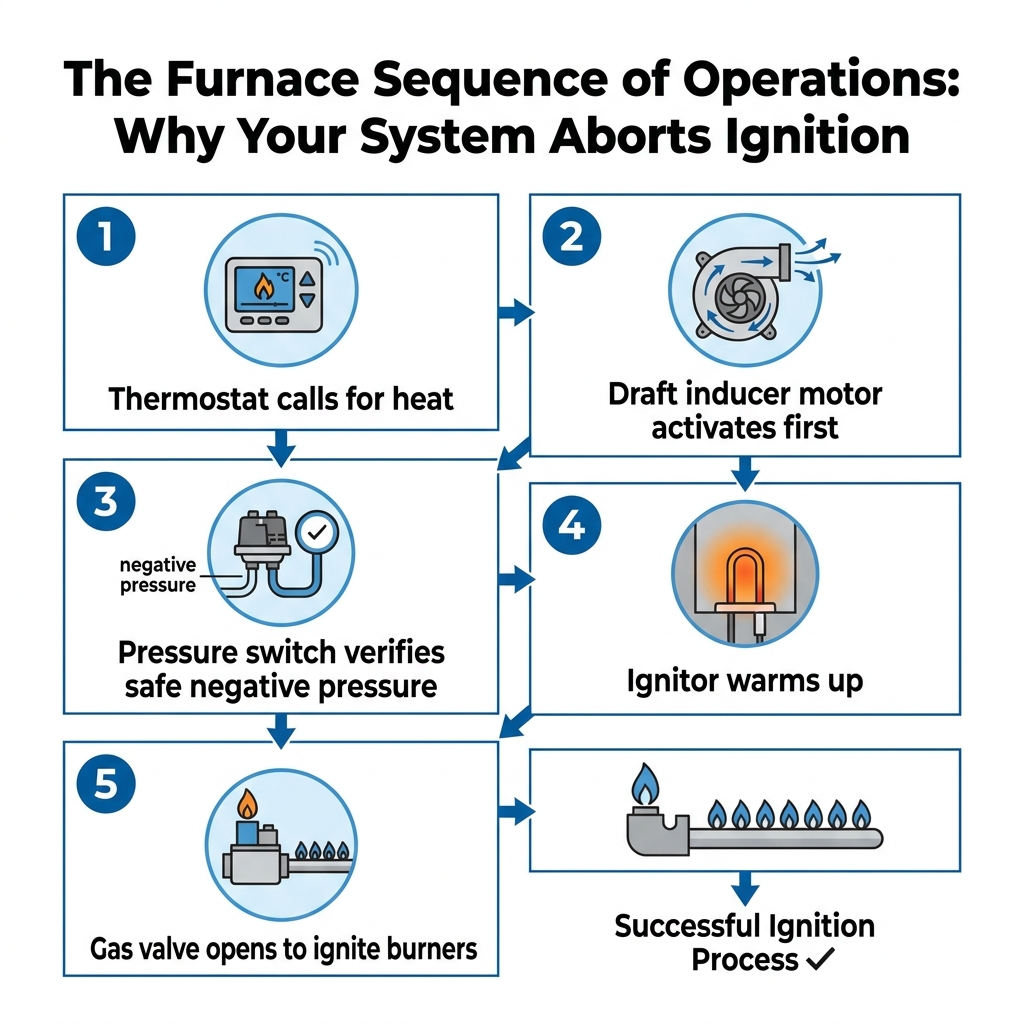
When a furnace shuts down immediately, it is following a strict, non-negotiable set of rules programmed into its control board. This sequence of operations is designed to ensure that every step of the combustion process happens in the correct order, with zero room for error.
1. The Call for Heat: You adjust your thermostat, sending a low-voltage signal to the furnace control board requesting heat.
2. The Inducer Motor Powers Up: The control board immediately sends 120 volts to the draft inducer motor. You will hear a small fan ramp up. This is the motor attempting to clear the combustion chamber.
3. The Pressure Switch Verifies Draft: As the inducer runs, the pressure switch monitors the draft. If the draft is sufficient, the switch closes. If the motor is failing, spinning too slowly, or if the flue is blocked, the switch stays open.
4. The Safety Shutdown: The control board waits a predetermined number of seconds for that switch to close. If it doesn't, the board cuts power, halting the sequence. The gas valve remains locked shut, and diagnosing a bad furnace ignitor becomes a moot point because the system never even reached the ignition phase.
This rigid sequence is the exact reason your system quits after 30 seconds. The brain of the furnace realized the venting conditions were unsafe and pulled the plug.
The Summer Dormancy Effect: What Happens While Your Furnace Sits Idle
Why do these failures happen so frequently in September and October? The answer lies in what happens to your heating system during the long, hot summer months when it isn't running at all. Our team refers to this as the "summer dormancy effect."
The Problem: When mechanical components sit unused for six to eight months, they degrade. The draft inducer motor operates in a harsh environment, dealing with heat, moisture, and acidic exhaust gases during the winter. When it suddenly stops running in the spring, the lubrication inside its bearings can dry out and harden. Additionally, the exhaust flue pipe that runs to the outside of your house becomes an attractive nesting spot for pests.
The Cause: By the time you turn the system on in the fall, those dried-out bearings can cause the motor to seize completely. Even if the motor tries to spin, it simply cannot overcome the physical resistance. Alternatively, mud daubers, wasps, or birds may have built nests inside the PVC exhaust pipe over the summer. Even if the inducer motor works perfectly, that nest blocks the airflow, preventing the pressure switch from closing.
The Solution: This is exactly why scheduling routine heating maintenance before the cold weather hits is so vital. Every September, our technicians at Midwest Mechanical field calls from Wichita homeowners dealing with this exact issue. Recently, we responded to a call during the early fall when a heating system needed service after sitting dormant all summer. We provided professional, courteous post-sale service, clearing out the summer debris and ensuring the inducer motor was spinning freely, which kept the system functioning well for the winter ahead. Catching these dormancy issues during early fall pre-heating test runs saves you from a freezing night later on.
Electrical Degradation vs. Mechanical Failure
It is important to distinguish between a motor that has failed mechanically and one that is suffering from an electrical issue. A mechanical failure usually means the bearings have seized or the plastic inducer wheel has cracked. An electrical failure might mean the motor itself is fine, but the capacitor that gives it a starting jolt has died, or the relay on the control board is burnt out. Both scenarios result in the exact same symptom: the furnace shuts down immediately.
A Successful Safety Intervention: Preventing Carbon Monoxide Hazards
It is incredibly frustrating when you want a warm house and your system refuses to cooperate. However, it helps to reframe this breakdown: your furnace isn't just broken; it is actively protecting you from a severe hazard.
If the control board allowed the furnace to ignite without the draft inducer motor running, the results would be dangerous. First, you could experience delayed ignition. Without the inducer pulling the gas steadily into the burners, gas can pool inside the combustion chamber. When it finally catches a spark, it creates a small explosion that can crack the heat exchanger or damage the furnace cabinet.
More importantly, without the inducer motor pushing the exhaust outdoors, those toxic combustion byproducts—including deadly carbon monoxide—have nowhere to go. They would eventually spill backward out of the furnace and mix into the air circulating through your ductwork, severely compromising your indoor air quality and threatening your family's health.
When your furnace shuts down immediately after 30 seconds, take a deep breath. That sudden silence means your safety sensors are doing their job perfectly. The system recognized a threat and neutralized it before any gas was ever released.
Listening for Clues: Symptoms of a Failing Draft Inducer
Before you call for a professional diagnostic, you can gather valuable information just by standing next to your furnace and listening closely during those first few seconds of the heating cycle. Identifying the specific sounds can help point directly to the inducer motor.
• Humming but not spinning: If you hear a low, vibrating electrical hum (often a 60Hz hum) but no sound of rushing air, the motor is receiving power from the control board but is mechanically seized and cannot turn.
• Clicking sounds: A distinct "click" followed by nothing usually indicates the relays on the control board are trying to engage the motor, but the electrical connection is failing.
• Grinding, squealing, or rattling noises: If the motor runs but sounds like metal scraping on metal, the bearings are severely worn. A loud plastic rattling sound usually means the blower wheel inside the inducer housing has cracked or come loose from the motor shaft.
• The timeline: Pay attention to the clock. All of these sounds, and the subsequent failure, will happen within the first 10 to 60 seconds of the cycle. If the furnace shuts down immediately in this window, the inducer or pressure switch circuit is almost certainly the culprit.
Why Bypassing Safety Switches is Dangerous (And Why You Need a Pro)
When faced with a cold house, some homeowners turn to the internet for quick fixes. One of the most dangerous DIY myths found online involves bypassing the pressure switch with a jumper wire to "trick" the furnace into running even when the inducer motor is failing.
You must never attempt this. Bypassing safety switches removes the only barrier preventing carbon monoxide poisoning or a catastrophic fire hazard in your home. The pressure switch is not an optional accessory; it is a life-saving device. If the switch is open, it is open for a reason.
Diagnosing the root cause of an immediate shutdown requires specialized training. A technician must use a manometer to measure the exact negative pressure draft in inches of water column. They must use a multimeter to test the microfarad reading of the capacitor, check the voltage coming from the control board, and verify the continuity of the pressure switch itself. This level of intricate troubleshooting is exactly why you need NATE-certified professionals who understand the sequence of operations inside and out.
During an early fall cold snap last year, our Midwest Mechanical technicians assisted a customer who wasn't particularly handy and experienced severe issues with their heating system shutting down abruptly. Our team quickly diagnosed and repaired the furnace, explaining the intricate safety mechanisms along the way. Because they trusted our professionals rather than attempting a dangerous DIY bypass, their furnace was restored safely, providing reliable comfort without risking their household.
Ensuring Safe and Reliable Heat for the Winter Ahead
An early-season furnace failure is a nuisance, but it is also a vital warning sign. When your furnace shuts down immediately, it is a clear signal that your built-in safety systems are protecting you from improper combustion and dangerous exhaust leaks.
Taking advantage of early fall pre-heating test runs allows you to catch these seized motors, failing capacitors, and blocked flues on your own terms. Here in Wichita, where freezing winter temperatures and high wind chills make reliable heating an absolute necessity, we highly recommend addressing these issues now so you do not wait until a blizzard hits to find out your inducer motor is locked up.
If your system is aborting its ignition sequence, do not repeatedly reset the thermostat in hopes that it will magically fix itself. Trust the safety sensors, leave the cabinet closed, and schedule a furnace repair to have a certified professional assess the situation and restore your heat safely.
Frequently Asked Questions
Why does my furnace shut off after 30 seconds?
Your furnace shuts off after 30 seconds because a safety sensor, usually the pressure switch, detected an unsafe condition. During the first half-minute of the cycle, the system tests the draft inducer motor to ensure exhaust gases can vent safely. If the motor fails or the exhaust flue is blocked, the control board aborts the ignition sequence to prevent carbon monoxide buildup.
What happens when a draft inducer motor goes bad?
When a draft inducer motor goes bad, it stops generating the negative pressure required to pull exhaust gases out of the heat exchanger. You may hear a loud humming, grinding, or squealing noise from the furnace cabinet. Ultimately, a bad inducer motor triggers a safety lockout, preventing the furnace from producing any heat.
Will a furnace ignite if the inducer motor is bad?
No, a modern furnace will not ignite if the inducer motor is bad. The system's control board requires confirmation from the pressure switch that the inducer is moving enough air before it will send power to the ignitor or open the gas valve. This sequence prevents dangerous delayed ignition and gas leaks.
Why does my furnace shut off immediately after turning on?
An immediate shutdown is almost always tied to a failure in the initial venting sequence. The thermostat sends the signal to start, the inducer motor tries to spin, but if it is seized or electrically compromised, the pressure switch remains open. The furnace immediately cuts power to protect the household from combustion hazards.
What is the exact role of the draft inducer motor?
The exact role of the draft inducer motor is to clear the heat exchanger of residual gases and establish a one-way draft for toxic exhaust to exit the home. It activates before the burners light to ensure that carbon monoxide and other combustion byproducts are safely vented outdoors rather than spilling into your living space.
Can I safely bypass the furnace pressure switch to get heat?
No, you can never safely bypass a furnace pressure switch. Bypassing this switch forces the furnace to burn gas without verifying that the toxic exhaust can escape, creating a severe risk of carbon monoxide poisoning and fire. If the switch is preventing the furnace from running, you need a licensed professional to diagnose and fix the underlying venting problem.
Customer Testimonials
Hear from satisfied customers who trust us for reliable HVAC and plumbing service across Wichita.





Plus, the technician, Lee was very professional, knowledgeable and informative.
We will definitely be doing business with them sometime again in the past.
I'm prompt to my appointment. Thank you Midwest Mechanical.
I'm prompt to my appointment. Thank you Midwest Mechanical.

We have partnered with GoodLeap to offer flexible payment options for your project. GoodLeap uses a soft credit check until funding and the highest score from all 3 bureaus to see if you qualify. It also takes just a few minutes to get started.




Service Areas
.svg)