


Why Ice Forming on Your AC Unit Is a Warning You Shouldn't Ignore
Ice forming on your ac unit causes and what to do is one of the most searched AC problems homeowners in Wichita, KS face — especially during the hot, humid Kansas summers when your cooling system is working hardest. Here is a quick overview to address the issue right away:
Common causes of AC unit freezing:
- Dirty or clogged air filter (the #1 cause)
- Blocked or closed supply/return vents
- Low refrigerant levels due to a leak
- Malfunctioning blower motor or fan
- Running the AC when outdoor temps drop below 60°F
- Dirty evaporator coils
- Thermostat issues
What to do immediately:
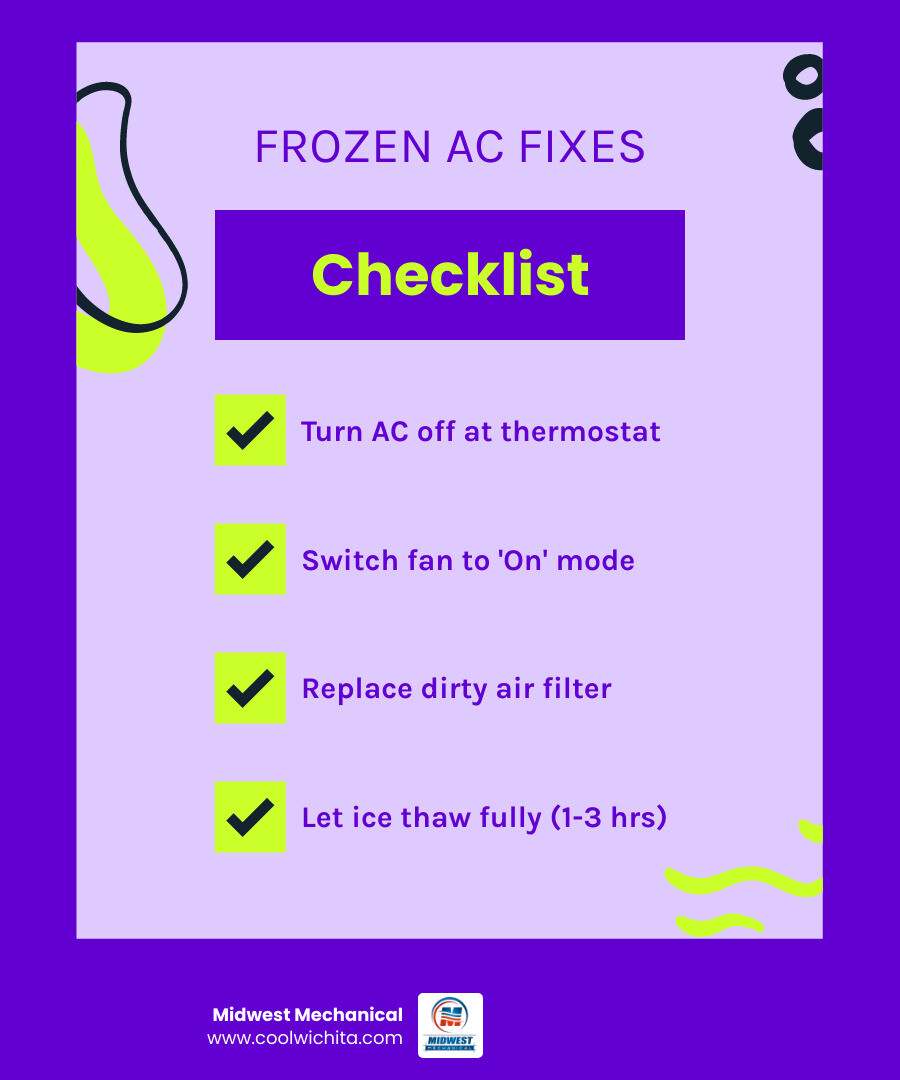
- Turn the AC system off at the thermostat
- Switch the fan setting from "Auto" to "On" to help thaw the coils
- Check and replace your air filter if it is dirty
- Let the ice melt fully before restarting — this can take 1 to 3 hours or longer
- Do not scrape or chip the ice off the coils
- Call a professional if ice keeps coming back
Here is the thing: ice on your air conditioner during a scorching Wichita summer might look oddly out of place — and that is because it is. A frozen AC unit is not a sign that your system is cooling extra hard. It is a warning that something has gone wrong inside the system, and running it that way can cause serious — and expensive — damage to the compressor.
Most homeowners do not notice the problem until warm air starts blowing from the vents or water begins pooling near the indoor air handler. By that point, the evaporator coil may already be encased in ice, starving the system of the airflow it needs to function.
The good news is that many causes of a frozen AC are preventable, and some can be resolved with basic DIY steps. But knowing which steps to take — and when to call in a professional — makes all the difference in protecting your home's cooling system.
Ice forming on your ac unit causes and what to do
To understand why your air conditioner is turning into a block of ice in April 2026, we have to look at the science of the refrigeration cycle. Your AC doesn't actually "create" cold; it removes heat. This happens at the evaporator coil, where refrigerant evaporates and absorbs heat from your indoor air.
When things are working correctly, the coil stays cold but above freezing. However, if the balance of pressure and airflow is disrupted, the temperature of that coil can plummet. This is often due to the Joule-Thomson effect—a physics principle where a rapid pressure drop in the refrigerant leads to a significant temperature drop. If the coil surface falls below 32°F, the humidity in our Kansas air hits that metal and instantly turns to frost.
Once a thin layer of frost forms, it acts as an insulator. This makes it even harder for the refrigerant to absorb heat, causing the temperature to drop further and more ice to accumulate. It’s a self-perpetuating cycle that eventually results in the AC's Evaporator Coil Freezes in Hot Weather.
| Issue Type | Primary Symptoms | Common Fix |
|---|---|---|
| Airflow Restriction | Weak air coming from vents, dusty registers | Change filter, open all vents |
| Refrigerant Issue | Hissing sounds, ice on outdoor lines, constant running | Professional leak repair |
| Mechanical Failure | Blower fan not spinning, no sound from indoor unit | Motor or capacitor replacement |
Common ice forming on your ac unit causes and what to do
The most frequent culprit we see in homes from Maize to Derby is restricted airflow. If warm air isn't blowing over the evaporator coil, the refrigerant inside stays too cold.
- Dirty Air Filters: This is the #1 cause. A thick layer of dust on your filter acts like a wall, stopping the air from reaching the coils.
- Blocked Return Vents: Sometimes a new piece of furniture or a heavy curtain accidentally covers the large return air grille, starving the system.
- Closed Supply Registers: We often find homeowners close vents in unused rooms to save energy. However, this increases pressure and reduces airflow, often leading to Common AC Problems and Solutions like frozen coils.
- Dust Accumulation: Over time, dust can bypass the filter and coat the evaporator coil itself. This grimy layer prevents the heat exchange process, making the coil stay icy. Solving Weak Airflow in Your AC System starts with ensuring every part of the path is clear.
Mechanical and environmental triggers
Sometimes the weather or the hardware is to blame. In the spring or fall, Wichita temperatures can fluctuate wildly. If you run your AC when it’s below 60°F outside, the system pressures won't balance correctly, and the unit is highly likely to freeze up.
Mechanical failures are also common triggers. A malfunctioning blower motor might not spin fast enough to move air, or a faulty fan relay might cause the compressor to keep running even when the fan has stopped. If your AC Fan Is Running But Not Cooling Your Home, it could be a sign that the mechanical timing of your system is off, leading to ice buildup. Additionally, damaged or collapsed ductwork can restrict air so severely that the system can't "breathe," causing the temperature at the coil to dive below freezing.
Immediate Steps: How to Safely Defrost Your System
If you see ice, the very first thing you must do is turn the system off. We know it’s tempting to keep it running in hopes it will eventually cool the house, but operating a frozen unit can destroy the compressor—the most expensive part of your AC.

Switch your thermostat from "Cool" to "Off." Then, switch the fan setting from "Auto" to "On." This keeps the indoor blower running without the cooling cycle, pushing warm indoor air over the ice to melt it naturally. This is a key part of what to do What to Do When Your HVAC Breaks Down Unexpectedly.
While the system is thawing, keep an eye on the drain pan. As that block of ice melts, it can produce a lot of water. If your condensate drain is partially clogged, you might end up with AC Not Cooling and a puddle on your floor.
What to avoid during the defrosting process
It can be frustrating to wait hours for ice to melt, but patience is your best friend here. Never use a knife, screwdriver, or any sharp object to chip away at the ice. The aluminum fins and copper tubes of the evaporator coil are incredibly delicate. One slip can puncture a line, causing a major refrigerant leak and a much more expensive repair.
Avoid using high-heat hair dryers or heat guns directly on the coils, as extreme temperature changes can cause the metal to stress or crack. Instead, let the air do the work. If you are worried about water damage, lay down towels around the base of the air handler and check the Air Conditioner Repair Wichita Guide for tips on managing moisture.
Restoring airflow after the thaw
Once the ice has completely vanished—and we mean completely—you can begin troubleshooting the airflow. Start by replacing your air filter. We recommend a 30-90 day schedule, but if you have pets or live in a dustier part of Sedgwick County, every 30 days is safer.
Check every room in the house to ensure that at least 80% of your supply registers are open and that no furniture is blocking the return vents. If you've recently rearranged a room, you might have inadvertently created one of the Reasons Your AC Is Not Cooling Your Home. Finally, ensure the condensate line is clear so the system can properly dehumidify your home once it’s back up and running.
Identifying Symptoms of a Frozen AC Unit
You don't always have to look inside the air handler to know there's a problem. Often, the signs are visible or audible if you know what to look for.
- Weak Airflow: If you feel very little air coming out of the vents even though the fan is blowing, ice is likely blocking the passage.
- Warm Air: If the air coming out isn't cold, the ice is acting as a barrier, preventing the system from cooling the air.
- Hissing or Bubbling Sounds: This can indicate a refrigerant leak, which is a primary cause of freezing.
- Excessive Moisture: If you see Signs That Your AC Needs Repair, like water dripping from the unit or a full drain pan, it’s a major red flag.
- Visible Ice: You might see frost on the copper refrigerant lines leading into the outdoor unit or even on the outdoor cabinet itself.
Because High Humidity Affects Your AC Performance, Kansas homes are particularly susceptible to these symptoms. When the air is thick with moisture, a cold coil will freeze much faster than in a dry climate.
Refrigerant leaks and low pressure
Your AC uses a chemical refrigerant in a "closed-loop" system. This means it should never "run out" of refrigerant. If the levels are low, you have a leak.
When refrigerant levels drop, the pressure inside the evaporator coil also drops. According to the laws of physics, lower pressure leads to lower temperatures. This is why AC Refrigerant Issues at Home often lead to ice; the remaining refrigerant gets so cold that it freezes the condensation on the coil. If you suspect a leak, it requires professional tools for Detecting HVAC Refrigerant Leaks in Derby to find and seal the hole before recharging the system.
Long-Term Solutions and Professional Maintenance
While changing a filter is a great DIY step, many causes of ice forming on your ac unit causes and what to do require a professional touch. Annual inspections are the best way to catch small issues before they turn into a frozen disaster.
During a professional visit, we perform several critical tasks:
- Coil Cleaning: We remove the deep-seated grime that air filters miss.
- Blower Motor Lubrication: Ensuring the fan spins at the correct RPM to maintain airflow.
- Refrigerant Check: Verifying the charge is exactly where it needs to be.
- Drain Line Flush: Preventing water backups that can damage your home.
Understanding AC Maintenance is about more than just preventing ice; it's about maximizing the lifespan of your equipment. We cannot overstate the Importance of Regular AC Maintenance for keeping your utility bills low and your home comfortable. For a deeper dive, check out our AC Tune Up Wichita KS Complete Guide.
Preventing ice forming on your ac unit causes and what to do
Beyond maintenance, there are modern upgrades that can help. A smart thermostat can be programmed to ensure the AC doesn't run during unseasonably cool nights, which is a major factor in Preventing AC Freezing in Wichita.
We also recommend professional static pressure testing. This allows us to see if your ductwork is properly sized for your AC unit. If the ducts are too small, the airflow will always be restricted, making the unit prone to icing. By Unraveling Common AC Repair Issues, we can create a custom plan to keep your system running smoothly for years to come.
When to consider system replacement
If your AC is between 10 and 15 years old and continues to freeze up despite repairs, it might be time to look at a replacement. Older units often develop multiple pinhole leaks in the coils that are difficult and expensive to patch.
Frequent breakdowns and rising energy bills are signs that your system is reaching the end of its reliable life. If you are facing a major component failure, such as a damaged compressor caused by repeated icing, the cost of AC Repair Wichita KS might be better spent on a new, high-efficiency system. Modern units use different refrigerants and are much better at managing humidity, providing significant energy savings and peace of mind.
Frequently Asked Questions about Frozen AC Units
Can I run my AC while the coils are frozen?
No. You should never run your AC with frozen coils. Doing so can cause liquid refrigerant to flood back into the compressor. Since compressors are designed to compress gas, not liquid, this can lead to catastrophic mechanical failure.
How long does it take for an AC unit to fully defrost?
It typically takes between 1 to 3 hours, but in severe cases where the entire air handler is a block of ice, it can take up to 24 hours. Running the fan on the "On" setting will speed up the process significantly.
Why does low refrigerant cause the unit to freeze instead of getting warmer?
It seems counterintuitive, but it's all about pressure. Less refrigerant means less pressure in the evaporator coil. Lower pressure naturally results in a lower temperature, often dropping the coil well below the freezing point.
Conclusion
At Midwest Mechanical, we know how stressful it is to find ice on your AC when you need it most. Whether you are in Andover, Derby, or right here in Wichita, our goal is to provide total home comfort with transparent pricing and expert diagnostics. If you've thawed your unit and changed the filter, but the ice keeps coming back, don't wait for a total system breakdown.
Schedule your professional AC maintenance today and let our team ensure your home stays cool all summer long. From simple tune-ups to complex leak repairs, we are here to keep your Wichita home running at peak efficiency.
Customer Testimonials
Hear from satisfied customers who trust us for reliable HVAC and plumbing service across Wichita.





Plus, the technician, Lee was very professional, knowledgeable and informative.
We will definitely be doing business with them sometime again in the past.
I'm prompt to my appointment. Thank you Midwest Mechanical.
I'm prompt to my appointment. Thank you Midwest Mechanical.

We have partnered with GoodLeap to offer flexible payment options for your project. GoodLeap uses a soft credit check until funding and the highest score from all 3 bureaus to see if you qualify. It also takes just a few minutes to get started.




Service Areas
.svg)