


Why Endless Hot Water in July Suddenly Disappears in January
You turn on the tap on a freezing morning, expecting a blast of steam, but the water barely gets warm. If you are researching the impact of groundwater temperature on tankless heater output, you are likely dealing with one of the most frustrating seasonal plumbing issues homeowners face. A tankless unit that performs flawlessly during a hot summer can suddenly struggle to fill a single bathtub once the winter chill sets in. Most people immediately assume their system is broken, but the reality is often much simpler: your unit is fighting the basic physics of freezing municipal water.
Tankless systems are incredibly efficient, but they do not store hot water in a reserve tank. They must heat the water on demand as it flows through the pipes. When the water entering your home is significantly colder in January than it was in July, the unit has to work exponentially harder to reach your desired temperature. This is why addressing this seasonal drop-off requires proactive September pre-heating-season prep before the deep freeze arrives. By understanding how your system responds to cold weather, you can take the necessary steps to ensure your comfort isn't interrupted.
If you wait until the first major freeze to evaluate your system's performance, you might find yourself stuck in a queue for emergency plumbing services. Taking action early in the fall allows a professional to optimize your system, descale the heat exchanger, and determine if you need water heater repair and installation upgrades to handle the upcoming winter load. The secret to endless hot water in January is simply preparing for it in September.
The Science of Temperature Rise (Delta T) in Tankless Systems
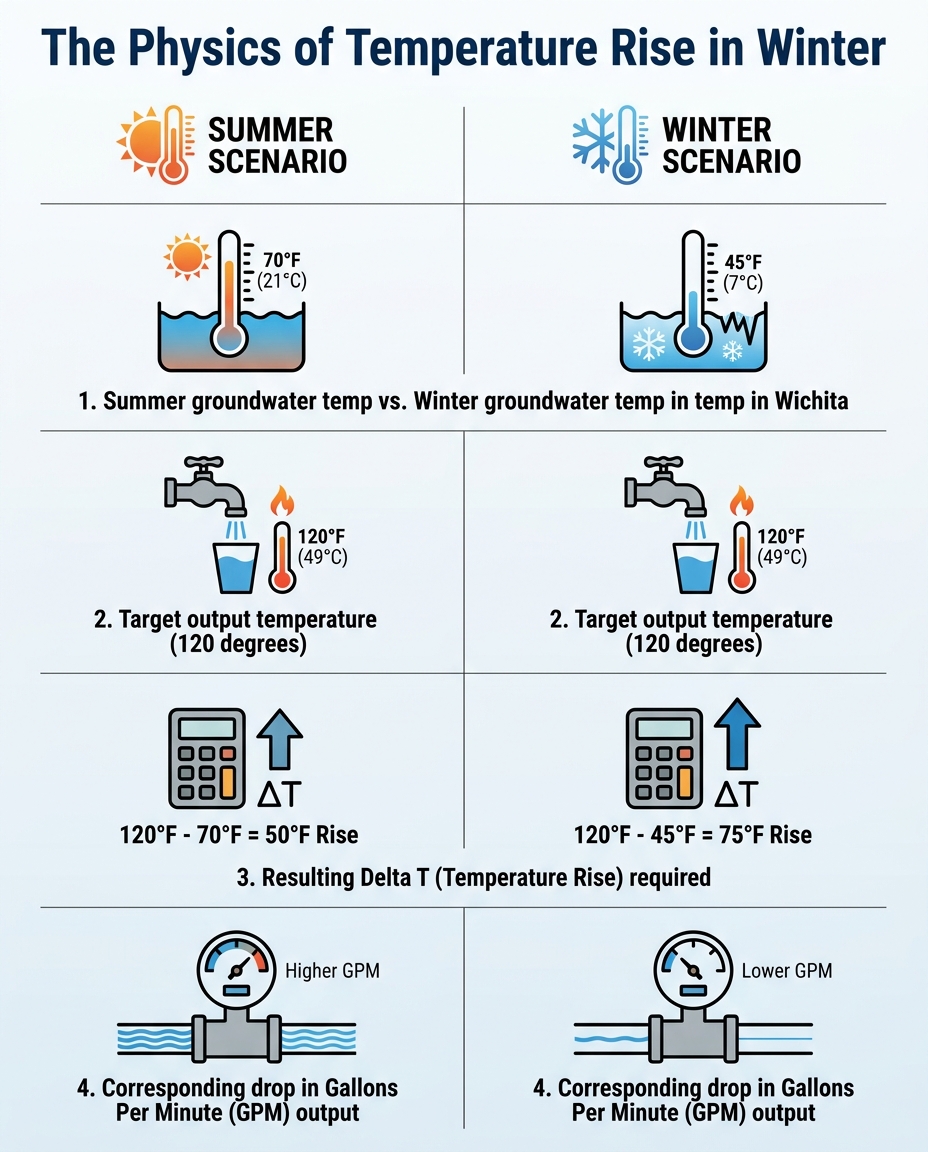
To understand why your hot water vanishes in the winter, you need to understand a core plumbing metric known as "temperature rise," often referred to in the industry as Delta T. Temperature rise is the exact difference between the incoming water temperature from your city's municipal lines and the desired output temperature at your faucet or showerhead. For most homes, the target output temperature is set to a safe and comfortable 120 degrees Fahrenheit.
Because tankless units heat water instantly as it passes through a highly engineered heat exchanger, their performance is entirely dependent on the starting temperature of that water. If the incoming groundwater temperature differential changes drastically, the workload on the unit changes just as drastically. One of the main benefits of tankless water heaters is their ability to provide continuous hot water, but this baseline efficiency relies on operating within their designed temperature parameters.
How Delta T Changes by Season:
• Summer (July) — Incoming Water Temp: 75°F — Target Output Temp: 120°F — Required Temperature Rise (Delta T): 45°F Rise
• Fall (October) — Incoming Water Temp: 60°F — Target Output Temp: 120°F — Required Temperature Rise (Delta T): 60°F Rise
• Winter (January) — Incoming Water Temp: 40°F — Target Output Temp: 120°F — Required Temperature Rise (Delta T): 80°F Rise
As the table illustrates, a unit operating in the winter has to generate nearly twice as much heat energy just to produce the exact same temperature of water it provided effortlessly during the summer months. The burner must fire at maximum capacity, and the heat exchanger must transfer thermal energy at peak efficiency to bridge that massive gap.
Why Is My Tankless Water Heater Not Heating Properly?
If you have found yourself searching for "tankless water heater not heating" or "tankless water heater not getting hot," you are not alone. These are some of the most common homeowner queries during the first cold snap of the year. When the required temperature rise becomes too steep for the unit's maximum burner capacity, the system's internal computer makes a calculated decision: it prioritizes temperature over volume.
To ensure the water exiting the unit actually reaches your set 120 degrees, the tankless heater automatically restricts the water flow, measured in Gallons Per Minute (GPM). It pinches off the incoming water supply valve slightly, slowing the water down so it spends more time inside the heat exchanger. This means the drop in hot water pressure you experience in the shower during winter is often a protective feature, not a malfunction. The system is intentionally reducing your water pressure to prevent you from being blasted with a lukewarm or freezing shower.
Flow Restriction vs. System Failure
It can be difficult to tell whether your unit is simply restricting flow due to the incoming groundwater temperature differential or if it has actually suffered a mechanical failure. Here is how you can spot the difference:
• Signs of normal flow restriction: The water reaching your shower is perfectly hot, but the water pressure is noticeably lower than it is during the summer. If you turn on a second faucet, the pressure drops even further, but the temperature remains steady.
• Signs of actual system failure: The water never reaches 120 degrees regardless of how low the flow rate drops. The water rapidly fluctuates between hot and ice cold (often called the "cold water sandwich").
• Error codes flashing: If the unit is pushed completely beyond its maximum BTU output, the system may shut down entirely to prevent overheating or venting issues, displaying an error code on the digital thermostat.
If your system is simply restricting flow, it is working exactly as designed. However, if that restricted flow is too low to meet your household's daily needs, it indicates that the unit is undersized for winter conditions.
Wichita's Extreme Groundwater Swings: A Winter Challenge
The severity of this issue depends heavily on where you live. In Wichita, the municipal groundwater temperatures can swing by tens of degrees between a scorching July afternoon and a freezing January morning. While the ground acts as a natural insulator for buried water mains, prolonged freezing temperatures eventually pull the heat right out of the soil and the water traveling through it.
During a mild season, the incoming groundwater temperature differential might only require a 40-degree rise. But in the dead of a Kansas winter, that water can drop close to 40 degrees by the time it reaches your home's inlet valve. This forces your tankless unit to achieve an 80-degree temperature rise on demand. This local reality heavily contrasts with the national averages often printed in standard manufacturer manuals, which frequently base their performance charts on a mild 50-degree temperature rise.
Because Wichita's specific municipal groundwater temperature drops so drastically in winter, creating a massive temperature rise demand, local homeowners experience this flow reduction much more acutely than someone living in a milder southern climate. What looks like a high-capacity unit on paper can quickly become a bottleneck when forced to fight against the freezing Kansas soil.

How Many GPM Do I Need for a Tankless Water Heater in Winter?
When homeowners ask, "how many GPM do I need for a tankless water heater?" they often look at their summer usage to find the answer. This is a critical mistake. Your winter needs dictate your true sizing requirements, because that is when the unit's GPM capacity will be at its absolute lowest.
A tankless unit marketed as a "7 GPM heater" can likely deliver those 7 gallons per minute when the incoming water is warm and the required temperature rise is only 35 degrees. However, that exact same unit might only be capable of delivering 3.5 GPM when fighting the extreme incoming groundwater temperature differential of a cold winter. If you do not account for this drop, you will find yourself short on hot water.
Here is how to evaluate your winter flow rate needs:
1. Identify simultaneous fixtures: Determine the maximum number of hot water fixtures you expect to run at the exact same time during a winter morning. For example, running two showers simultaneously.
2. Calculate total demand: A standard low-flow showerhead uses about 2.0 GPM. Two showers running at once require a total of 4.0 GPM of continuous hot water.
3. Check the winter Delta T chart: Look at the manufacturer's performance curve for your specific unit. Find the GPM output listed for an 80-degree temperature rise (the typical winter requirement).
4. Compare demand to winter capacity: If your unit only outputs 3.5 GPM at an 80-degree rise, but your morning routine demands 4.0 GPM, the unit will restrict flow, resulting in low shower pressure. If you are sizing a tankless water heater for multiple showers, you must size the unit based on that winter output number, not the summer maximum.
The Hidden Culprit: How Mineral Scale Worsens Winter Performance
The physics of temperature rise explain why your unit works harder in the winter, but the physical condition of the unit determines whether it can survive that workload. The hidden culprit behind severe winter performance drops is mineral scale buildup inside the heat exchanger. Hard water contains high levels of calcium and magnesium, which precipitate out of the water and cling to the metallic components of the heater.
This mineral scale acts as a stubborn layer of insulation between the gas burner and the water passing through the pipes. When a heat exchanger is coated in scale, heat transfer efficiency plummets. The burner has to fire longer and hotter just to push thermal energy through the crust of minerals before it can even begin heating the water.
During the summer, when the temperature rise demand is low, a scaled-up unit might still manage to keep up. But in January, when the unit is already pushed to its absolute limit by freezing groundwater, that insulating layer of scale becomes a massive liability. A dirty unit will be forced to restrict water flow much earlier and much more aggressively than a clean unit. This is why September pre-heating-season prep is so vital. Removing that scale before the groundwater temperatures drop ensures your unit has maximum heat transfer efficiency when it needs it most.
Taking Action: Why September is the Ideal Time for Maintenance
Understanding the physics of your tankless system is only half the battle; the other half is proactive maintenance. September is the optimal transition month for pre-heating-season tankless maintenance. The weather is still mild enough that you aren't yet relying on maximum BTU output, making it the perfect window to prepare the system for the heavy lifting ahead.
A professional pre-winter tune-up involves a thorough descaling process. A technician will isolate the unit from your home's plumbing and pump a specialized, food-safe acidic solution through the heat exchanger for nearly an hour. This dissolves the calcium buildup and restores the metal's ability to transfer heat efficiently. The technician will also clean the inlet water screen, check the gas pressure, and ensure the venting system is clear of debris. These are precise adjustments that require a licensed professional to perform safely.
Working with experts who understand the local climate makes a significant difference. Midwest Mechanical brings deep local expertise in properly sizing and maintaining tankless systems specifically for Kansas winters, ensuring homeowners aren't left shivering under a cold shower. Recently, a local homeowner reached out because a routine maintenance check was needed for their HVAC system. While our technician performed a thorough maintenance check and explained the system, the conversation naturally turned to their home's winter readiness, including their tankless water heater. That holistic, educational approach to home comfort is why proactive scheduling matters.
If you have consistently struggled with low hot water pressure every winter, this is also the ideal time to have a professional assess whether your current unit is properly sized for your home's demand. If an upgrade is necessary, choosing the right water heater for your home in September is far less stressful than trying to replace a failing unit in the middle of a January snowstorm.
Frequently Asked Questions About Winter Tankless Performance
Why is my tankless water heater not getting hot in the winter?
Your tankless water heater is likely struggling against the incoming groundwater temperature differential. In the winter, municipal water is significantly colder, forcing the heater to work much harder to achieve a standard 120-degree output. If the unit reaches its maximum heating capacity, it will automatically reduce water flow to ensure the water reaches the correct temperature, which you experience as a drop in water pressure.
Does outside temperature affect tankless water heaters?
Yes, outside temperatures indirectly affect your tankless system by chilling the ground and, consequently, the municipal water pipes buried within it. While the air temperature immediately around an indoor unit doesn't change much, the freezing water entering the unit requires a massive temperature rise. This forces the system to operate at maximum capacity during the coldest months of the year.
How many GPM do I need for a tankless water heater?
The GPM you need depends entirely on your peak winter usage, not your summer usage. You must calculate the total flow rate of all fixtures you plan to run simultaneously (like two showers at 2.0 GPM each, totaling 4.0 GPM). You then need to ensure your tankless unit can produce that specific GPM during a high-demand 80-degree temperature rise, which is typical for winter operation.
Why is my tankless water heater flow rate so low?
A low flow rate in the winter is usually a built-in protective feature rather than a mechanical failure. When the unit realizes it cannot heat the freezing incoming water fast enough, it restricts the water volume to give the heat exchanger more time to warm the water. Additionally, a clogged inlet filter or severe mineral scale buildup can artificially restrict flow, which is why annual maintenance is necessary.
Can a tankless water heater freeze in the winter?
Yes, a tankless water heater can freeze if it is installed in an unconditioned space or if power to the unit is lost during a hard freeze. Most modern units have built-in freeze protection heaters that activate automatically, but these require continuous electricity to function. If you lose power during a winter storm, the internal pipes can freeze and burst if the unit is not properly drained.
How often should a tankless water heater be flushed before winter?
A tankless water heater should be professionally flushed and descaled at least once a year, ideally during the early fall. Homes with particularly hard water may require flushing every six months to prevent severe scale buildup. Removing this mineral insulation before winter ensures the unit operates at peak efficiency when groundwater temperatures are at their lowest.
Secure Your Winter Comfort Before the Freeze
Understanding the impact of groundwater temperature on your tankless unit is the first step toward preventing seasonal frustration, but professional maintenance is the ultimate solution. Do not wait for the first deep freeze to find out your system is bogged down by mineral scale and struggling to keep up with the incoming groundwater temperature differential. Proactive September pre-heating-season prep is the best way to guarantee your system operates at peak efficiency all season long. Schedule your professional tune-up and descaling today to secure endless, reliable hot water for your home before the winter chill takes over.
Customer Testimonials
Hear from satisfied customers who trust us for reliable HVAC and plumbing service across Wichita.





Plus, the technician, Lee was very professional, knowledgeable and informative.
We will definitely be doing business with them sometime again in the past.
I'm prompt to my appointment. Thank you Midwest Mechanical.
I'm prompt to my appointment. Thank you Midwest Mechanical.

We have partnered with GoodLeap to offer flexible payment options for your project. GoodLeap uses a soft credit check until funding and the highest score from all 3 bureaus to see if you qualify. It also takes just a few minutes to get started.




Service Areas
.svg)