


Is an On-Demand Water Heater Right for Your Wichita Home?
An on demand water heater — also called a tankless water heater — heats water only when you need it, with no storage tank and no standby energy waste. Here's a quick overview of what that means for you:
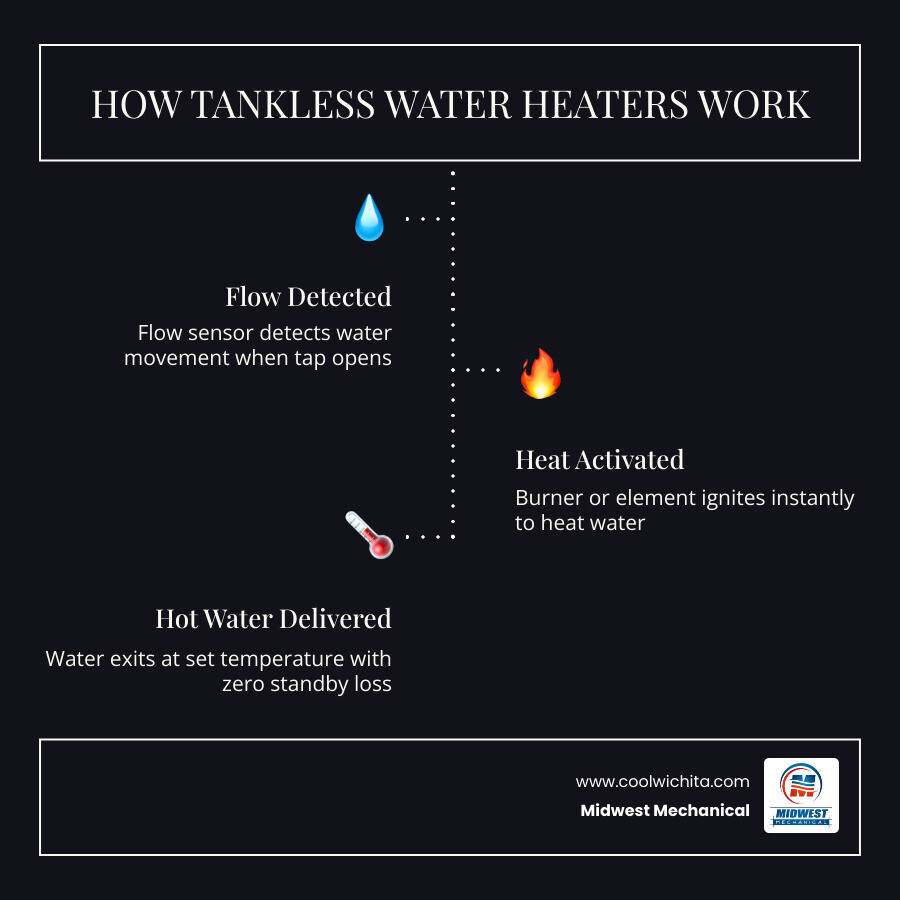
- How it works: Cold water flows through the unit, sensors detect the flow, and a burner or heating element heats the water instantly.
- Key benefit: You get a continuous supply of hot water without waiting for a tank to refill or reheat.
- Energy savings: Homes using 41 gallons or less of hot water per day can see 24%–34% greater efficiency compared to traditional tank heaters.
- Lifespan: Tankless units can last 20 years or more with proper maintenance — roughly twice as long as a standard tank heater.
- Best for: Households tired of cold showers, high energy bills, or bulky tank units taking up space.
For Kansas homeowners, especially in Wichita and the surrounding area, cold mornings make hot water reliability a real daily concern. When a traditional tank runs out mid-shower or starts showing its age, many homeowners start asking whether it's time to make the switch to on-demand heating.
This guide covers everything you need to know — how these systems work, how to size one for your home, what maintenance looks like, and what makes them a smart long-term investment.
Understanding the On-Demand Water Heater
To understand why an on demand water heater is such a game-changer, we first have to look at what it replaces. Traditional water heaters are essentially giant, insulated kettles. They keep 40 to 50 gallons of water hot 24 hours a day, whether you are using it or not. This creates "standby loss," where energy is constantly used to maintain temperature.
In contrast, a tankless design is built around a high-efficiency heat exchanger. When you turn on a hot water tap in your kitchen or bathroom, a flow sensor inside the unit detects the movement of water. This sensor sends a signal to the control board, which ignites the gas burner or activates the electric heating elements. The water travels through a series of coils (the heat exchanger) where it is instantly brought up to your desired temperature.
Because there is no tank, the hot water doesn't "run out." As long as water is flowing and the unit has power/fuel, it will keep producing heat. This provides significant Advantages of a Tankless Water Heater, including the elimination of that bulky tank that takes up valuable floor space in your basement or utility closet. For more on how these systems compare to what you might currently have, check out our guide on the Benefits of Tankless Water Heaters.

Why Kansas Homeowners Prefer Tankless Systems
Living in South Central Kansas, from the bustling streets of Wichita to the quiet neighborhoods of Derby and Maize, we deal with significant temperature swings. In April 2026, as we look at modern home trends, efficiency and reliability are at the top of every homeowner's list.
The primary reason our neighbors are switching is the promise of endless hot water. If you have a large family, you know the "shower lottery"—the person who goes last usually ends up with a lukewarm experience. With an on demand water heater, the first shower is just as hot as the fourth.
| Feature | Traditional Tank Heater | On-Demand (Tankless) Heater |
|---|---|---|
| Lifespan | 6–12 Years | 20+ Years |
| Energy Efficiency | Lower (Standby Loss) | High (Up to 96% UEF) |
| Space Required | 10–15 sq. ft. Floor Space | Small Wall-Mounted Unit |
| Hot Water Supply | Limited by Tank Size | Endless |
Beyond the luxury of long showers, these units are incredibly durable. While a standard tank might rust out in a decade, a well-maintained tankless unit can last two decades or more. This longevity makes them a sustainable choice for those looking to stay in their homes long-term. If you find yourself currently dealing with No Hot Water Tankless issues, it is often a simple sensor or power issue rather than a catastrophic failure of the unit itself. For those in the metro area, we specialize in Tankless Water Heater Wichita KS solutions that fit our local climate.
Sizing and Selection for Local Households
One of the most common mistakes homeowners make is choosing a unit that is too small for their peak demand. Sizing isn't about how much water the heater "holds" (since it holds none), but how much it can heat at once.
In Kansas, our groundwater is quite cold in the winter. This is important because the "temperature rise"—the difference between the cold water coming in and the hot water coming out—dictates how hard the unit has to work. If your groundwater is 50°F and you want a 120°F shower, your heater needs to provide a 70-degree rise. This is a key consideration in our Tankless Water Heater Repair Derby Guide when we help residents select the right equipment.
Sizing Your On-Demand Water Heater by GPM
Flow rate is measured in Gallons Per Minute (GPM). To size your home correctly, we look at your "peak demand." This is the total GPM of every fixture you might run at the same time.
- Shower: 1.5 to 2.5 GPM
- Kitchen Faucet: 1.0 to 1.5 GPM
- Dishwasher: 1.0 to 2.0 GPM
If you want to be able to run two showers and the dishwasher at once, you’ll likely need a unit capable of at least 7.0 GPM. We also look at the BTU (British Thermal Unit) rating for gas models; higher BTUs mean the unit can heat more water faster. For a deeper dive into these calculations, see our Tankless Flow Rate Guide 2025.
Gas vs. Electric On-Demand Water Heater Options
Choosing between gas and electric usually depends on what is already available in your home.
- Natural Gas/Propane: These are generally the most popular in the Wichita area. They offer higher flow rates and are better suited for whole-home applications. They do require proper venting to the outdoors.
- Electric: These are often used for "point-of-use" applications (like a single remote bathroom) or in homes where gas isn't an option. They require significant electrical capacity—often a dedicated 240V circuit with high amperage.
Modern units also feature self-modulating technology, which means they can adjust their energy consumption based on the exact amount of water flowing, ensuring you never use more fuel than necessary. This is a standard part of our Tankless Hot Water Service inspections.
Maintenance and Longevity in Hard Water Areas
If there is one "catch" to owning an on demand water heater, it is that they do require regular maintenance, especially in Kansas. Our region is known for hard water, which is full of minerals like calcium and magnesium.
When hard water is heated inside the heat exchanger, these minerals solidify and create "scale." Over time, scale acts like insulation, making the heater work harder and eventually clogging the narrow passages. To prevent this, an annual or bi-annual flush is essential. This involves circulating a descaling solution (often food-grade white vinegar) through the unit to dissolve the buildup. You can find step-by-step instructions in our Tankless Water Heater Flush Complete Guide and our Tankless Water Heater Descaling Guide.
Protecting Your Investment in Wichita
For homeowners in Andover, Derby, and Goddard, we often recommend installing a water softener alongside a tankless unit. By removing the minerals before they ever reach the heater, you significantly reduce the frequency of maintenance and protect the sensitive internal components.
Ignoring this maintenance can lead to reduced flow or "error codes" on your unit's display. If you're seeing issues, our Tankless Water Heater Repair Guide offers troubleshooting tips, and we provide specific Tankless Repair Derby KS Tips for those in the southern part of the metro area.
Frequently Asked Questions about Tankless Systems
How much energy can I save with an on-demand system?
The savings can be substantial. Because you aren't heating a tank of water while you sleep or while you're at work, you can reduce your water heating energy use by up to 34%. For a typical family, this can translate to over $100 in annual savings on utility bills. Some high-efficiency condensing models, like the Rheem Performance Platinum, are up to 52% more efficient than standard gas tanks.
What are the venting requirements for indoor installation?
Gas-fired tankless heaters require specific venting to handle the exhaust. Many modern "condensing" units use inexpensive PVC pipe for venting, which can be run through a side wall. Non-condensing units require stainless steel venting to handle higher exhaust temperatures. It is vital that this is installed by a professional to ensure no carbon monoxide enters the home.
How long do these units typically last compared to tanks?
A standard storage tank water heater is usually on its last legs by year 10 or 12 because the tank itself eventually corrodes. An on demand water heater is designed with replaceable parts and a stainless steel heat exchanger that doesn't hold water, meaning it can easily last 20 to 25 years with proper descaling and care.
Conclusion
Upgrading to an on demand water heater is one of the most effective ways to improve your home’s comfort and efficiency. Whether you are in Park City, Valley Center, or right here in Wichita, the peace of mind that comes with endless hot water and a smaller carbon footprint is hard to beat.
At Midwest Mechanical, we take pride in helping our neighbors navigate these technical choices. From calculating the perfect GPM for your household to ensuring your gas lines and venting are up to code, we provide the professional reliability you deserve. We serve the entire Greater Wichita area, including Rose Hill, Mulvane, and Bel Aire, with transparent pricing and state-of-the-art systems designed for the Kansas climate.
Ready to say goodbye to cold showers? Schedule your expert on-demand water heater service today and let us help you find the perfect fit for your home comfort.
Customer Testimonials
Hear from satisfied customers who trust us for reliable HVAC and plumbing service across Wichita.




Plus, the technician, Lee was very professional, knowledgeable and informative.
We will definitely be doing business with them sometime again in the past.
I'm prompt to my appointment. Thank you Midwest Mechanical.
I'm prompt to my appointment. Thank you Midwest Mechanical.

We have partnered with GoodLeap to offer flexible payment options for your project. GoodLeap uses a soft credit check until funding and the highest score from all 3 bureaus to see if you qualify. It also takes just a few minutes to get started.




Service Areas
.svg)