


Why Getting Water Heater Efficiency Options Explained Could Cut Your Energy Bills Significantly
If you've ever opened a utility bill and wondered where all that energy is going, your water heater is likely a major culprit. Water heating accounts for roughly 18% of a typical home's energy use — more than your refrigerator, dishwasher, clothes washer, and dryer combined.
Here's a quick look at the main water heater efficiency options available to homeowners today:
| Water Heater Type | Efficiency Level | Best For |
|---|---|---|
| Storage Tank (gas or electric) | Standard | Budget-conscious buyers, simple replacement |
| Tankless (on-demand) | 24–34% more efficient than storage | Smaller households or low daily hot water use |
| Heat Pump (hybrid) | ~3x more efficient than standard electric | Households replacing electric tank heaters |
| Solar | Highest potential savings | Sunny climates with backup heating |
Most Wichita homeowners are running older storage tank water heaters that quietly waste energy around the clock — a problem called standby loss. That's energy spent keeping 40 to 80 gallons of water hot even when nobody needs it.
The good news? Newer, more efficient systems can dramatically reduce that waste. Whether you're dealing with a unit that's on its last legs or simply looking to lower your monthly bills, understanding your options before you buy is the smartest move you can make.
This guide breaks down every major water heater type, how efficiency ratings work, what size system your home actually needs, and what financial incentives are currently available to help offset upgrade costs.
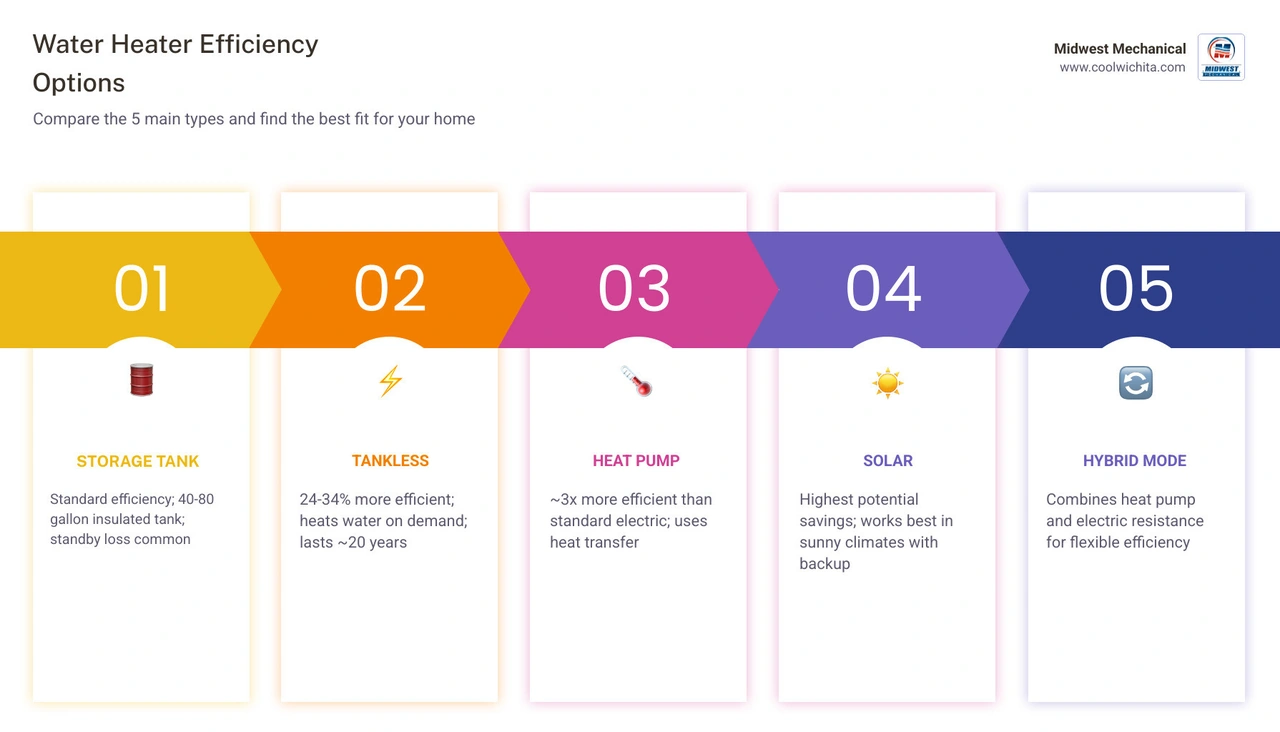
Must-know water heater efficiency options explained terms:
- how to choose the right water heater for your home
- tankless vs tank water heater comparison
- water heater buying guide for kansas homes
Water Heater Efficiency Options Explained: Comparing the Main Types
When it is time to upgrade, you aren't locked into the exact same system you bought ten or fifteen years ago. In fact, the market has evolved rapidly, introducing smart controls, hybrid technologies, and ultra-efficient combustion designs. To help you sort through the noise, we have compiled the main options below.
| Feature | Storage Tank | Tankless (On-Demand) | Heat Pump (Hybrid) |
|---|---|---|---|
| Average Lifespan | 10–15 Years | 20+ Years | 13–15 Years |
| Primary Efficiency Benefit | Lower upfront equipment cost | Zero standby heat loss | Uses 70% less electricity than standard tanks |
| Venting/Space Needs | Standard closet space | Ultra-compact (wall-mounted) | Needs 450–700 cubic feet of air space |
| Fuel Sources | Natural Gas, Propane, Electric | Natural Gas, Propane, Electric | Electricity |
To truly master the landscape of home energy savings, it helps to read up on the Different Types of Water Heaters for Home and learn How to Know Which Type of Water Heater is Best for your family's unique routine.
Traditional Storage Tank Water Heaters
The classic storage tank is still the most common system in Kansas. It operates on a simple principle: keep a large volume of water heated to a set temperature (usually 120°F to 140°F) so it is ready whenever you turn on a tap.
The drawback here is "standby loss." Because the tank is constantly heated, energy is continuously lost through the walls of the cylinder, requiring the burners or electric elements to cycle on periodically even when you're asleep or at work. While newer models feature vastly improved insulation to slow down this heat loss, traditional tanks are still fundamentally less efficient than on-demand or hybrid alternatives. Their typical lifespan is 10 to 15 years. If you are trying to decide if this classic style still makes sense for you, taking a look at Navigating Water Heater Options can clarify things.
Tankless (Demand-Type) Water Heaters
Often called "on-demand" water heaters, tankless systems discard the tank altogether. When you turn on a hot water tap, cold water travels through a pipe and into the unit. A gas burner or electric element instantly heats the water using a high-powered heat exchanger.
Because they do not store hot water, tankless systems eliminate standby energy losses completely. This can make them up to 34% more energy-efficient than traditional tanks in homes with moderate hot water needs. Better yet, they typically last more than 20 years and feature easily replaceable parts that can extend their operational life even further. To learn more about how they save space and fuel, explore the Advantages of a Tankless Water Heater and the overall Benefits of Tankless Water Heaters.
Heat Pump (Hybrid) Water Heaters
If you have an all-electric home, a heat pump (or hybrid) water heater is the gold standard of efficiency. Instead of generating heat directly through electric resistance elements, a heat pump water heater works like a refrigerator in reverse. It uses a fan and compressor to pull heat from the surrounding air and transfer it directly into a storage tank.
Because moving heat requires significantly less electricity than creating it, hybrid systems deliver around three times the efficiency of standard electric models. In fact, they use about one-quarter of the energy of a conventional electric resistance heater. To see how these hybrid powerhouses stack up against other setups, read our guide on how to Choose the Right Water Heater for Your Home.
How Tankless and Heat Pump Systems Maximize Efficiency
Understanding how these systems achieve their high efficiency ratings is the key to choosing the right one. Traditional electric water heaters are essentially giant electric kettles; they draw massive amounts of power to heat water. In contrast, advanced systems use clever mechanical design to minimize fuel consumption.
For instance, tankless systems achieve their high ratings by only firing up when water is flowing. This eliminates the endless cycle of reheating a 50-gallon tank all day. According to the U.S. Department of Energy, for homes that use 41 gallons or less of hot water daily, tankless models can be 24% to 34% more energy-efficient than conventional storage tanks. Even in high-use homes (around 86 gallons per day), they remain 8% to 14% more efficient.
Meanwhile, heat pump water heaters save energy by leveraging the ambient room temperature. If your water heater is installed in a warm basement or utility room, it captures that ambient warmth and pumps it directly into your water. This reduces your electricity consumption by up to 70%, which translates to massive annual savings on your utility bills.
To see a detailed breakdown of these two heavyweights, check out our Tankless vs Tank Water Heater Comparison and our Ultimate Tankless Water Heater Savings Guide.
Understanding Ratings: Water Heater Efficiency Options Explained
When shopping for a new water heater, you will encounter a few key performance metrics on the yellow EnergyGuide label:
- Uniform Energy Factor (UEF): This is the official standard for measuring water heater efficiency. The higher the UEF number, the more efficient the unit. Standard gas tanks usually hover around 0.60 to 0.80, gas tankless units regularly reach 0.82 to 0.97, and heat pumps achieve incredible UEF ratings between 3.3 and 4.1 (which means they are 330% to 410% efficient!).
- First-Hour Rating (FHR): For tank systems, the FHR measures how many gallons of hot water the unit can reliably deliver in its first hour of operation when starting with a fully heated tank. This is crucial for ensuring you don't run out of hot water during back-to-back morning showers.
- Gallons Per Minute (GPM): This rating is specific to tankless water heaters. It indicates how much hot water the unit can produce continuously.
To demystify these numbers before making a purchase, take a look at our detailed post on Energy Efficiency Ratings for Water Heaters.
Operating Modes of Hybrid Heat Pumps
One of the coolest features of modern hybrid heat pump water heaters is their adaptability. Most models come with user-friendly digital controls that allow you to toggle between several operating modes:
- Efficiency Mode: The system relies strictly on the heat pump mechanism, pulling heat from the air. This offers the absolute lowest operating costs but has a slower recovery time.
- Hybrid Mode: The default setting. The unit primarily uses the highly efficient heat pump, but if there is a sudden spike in demand (like three back-to-back showers), it will temporarily engage the standard electric resistance elements to heat the water faster.
- Electric Resistance Mode: The unit operates exactly like a standard electric water heater. This is helpful if the surrounding room drops below freezing, though it is the least efficient setting.
- High Demand Mode: Ideal for when you have weekend guests, this mode prioritizes fast recovery over pure energy savings.
- Vacation Mode: If you are leaving your Wichita home for a week, this setting drops the tank temperature significantly to prevent standby energy waste, then automatically warms it back up just before you return.
Sizing and Selecting the Right System for Your Household
Buying an ultra-efficient water heater won't do you much good if it is sized incorrectly. An undersized tankless unit will leave you shivering in the shower if someone runs the washing machine, while an oversized storage tank will cause you to pay for heating water you never actually use.
Sizing a tank system is all about calculating your household's peak hour demand. This isn't just about how many bedrooms you have, but how many showers, loads of laundry, and dishwasher cycles occur simultaneously. For a deeper dive into these calculations, check out What Size Water Heater Does Your Home Need and read our practical Tips Choosing Right Water Heater Size.
Sizing and Fuel: Water Heater Efficiency Options Explained for Kansas Homes
Your choice of fuel will also heavily influence your operating costs and overall system efficiency. In Kansas, natural gas has traditionally been a popular option because of its fast recovery times and lower fuel costs compared to standard electric resistance heating. However, modern electric heat pumps have flipped this equation on its head. Because heat pumps are so incredibly efficient, an electric hybrid system can actually cost less to run annually than a standard gas-fired conventional storage water heater, even in areas where natural gas rates are relatively low.
Propane is another common fuel source, particularly in rural areas surrounding Wichita. Propane storage and tankless units offer excellent heating capacity — one gallon of propane generates nearly 91,500 BTUs of heat energy — making them highly reliable, though fuel delivery logistics must be considered. For a localized breakdown of how these fuels perform in our unique Midwestern climate, consult the Water Heater Buying Guide for Kansas Homes and the Water Heater Choosing Guide 2026.
Flow Rates and GPM for Tankless Systems
If you decide to go tankless, sizing is calculated using flow rate (GPM) and temperature rise rather than tank volume. You must determine how many fixtures might draw hot water at the exact same time.
For example, a typical low-flow showerhead uses about 2.0 GPM, while a kitchen sink faucet uses around 1.5 GPM. If you want to be able to run both at once, your tankless unit must be capable of delivering at least 3.5 GPM. Furthermore, because incoming groundwater in Kansas can get quite cold during our freezing winters, your system needs enough heating capacity to raise that cold groundwater to a comfortable 120°F.
To make sure you get a unit that can handle a cold Kansas winter without dropping your shower pressure, refer to the Tankless Water Heater Flow Rate Guide for Your Home and the updated Tankless Flow Rate Guide 2025.
Installation, Maintenance, and Financial Incentives
Upgrading to a high-efficiency water heater involves unique installation considerations that differ from standard swaps. Proper placement, adequate ventilation, and routine upkeep are essential to ensuring your new system reaches its maximum efficiency and lasts for decades.
Unique Installation and Maintenance Requirements
- Space & Airflow for Heat Pumps: Because hybrid heat pump water heaters pull heat from the surrounding air, they need a continuous supply of air. Most models require at least 700 cubic feet of surrounding air space (equivalent to a 10' x 10' room with a 7' ceiling). If installed in a tight closet, a louvered door must be used to allow adequate airflow. They also produce cool, dehumidified air as a byproduct and generate a small amount of condensation, which must be routed to a floor drain or managed with a small condensate pump.
- Venting for Tankless Gas Units: Gas tankless water heaters require specialized, concentric venting that drafts directly through an exterior wall. Because they burn fuel so rapidly to heat water instantly, they cannot share standard chimney venting with an older furnace.
- Routine Maintenance: Standard tanks should be flushed every year to remove mineral scale that settles on the bottom and insulates the water from the heating elements. They also require periodic inspection of the sacrificial anode rod, which protects the steel tank from rusting. Tankless units need annual descaling, especially in hard water areas like Wichita, to prevent mineral buildup inside the narrow passages of the heat exchanger. Heat pump units feature an air filter that must be cleaned periodically to maintain optimal airflow.
To learn more about the technical details of electric and on-demand systems, read our Electric On Demand Water Heater Guide and our overview of the On Demand Water Heater.
Rebates, Tax Credits, and Long-Term Savings
While high-efficiency systems are an investment, they are heavily supported by local utility rebates and federal tax incentives that can drastically lower your net cost:
- Federal Tax Credits: Under current energy policies, homeowners can claim a federal tax credit of 30% up to $2,000 for installing an ENERGY STAR certified heat pump water heater.
- Utility Rebates: Many local electric and gas utilities in the Wichita area offer substantial cash-back rebates for upgrading to ENERGY STAR certified hybrid or tankless models.
- Operational Savings: A household of four can save approximately $600 per year on electric bills by switching from a standard electric water heater to an ENERGY STAR certified heat pump model. Over the unit's lifespan, that adds up to more than $4,500 in direct utility savings!
When to Replace Your Aging Water Heater
Waiting for your water heater to burst and flood your utility room is a recipe for a stressful, rushed decision. When you are forced to replace a unit in a hurry, you rarely have the time to research efficiency options, check for tax credits, or wait for a specialized hybrid unit to be delivered.
Keep an eye out for these common warning signs that your system is approaching the end of its life:
- Rusty Water: If red or brown water is coming out of your hot water taps, it is a sign that the inside of your tank is beginning to corrode.
- Strange Noises: Popping, rumbling, or banging noises coming from the tank indicate a heavy layer of hardened sediment has built up at the bottom, causing the tank to overheat and wear out.
- Slow Recovery Times: If it takes hours for your water to get hot again after a single shower, your heating elements or burners are failing.
- Leaking Around the Base: Any signs of water pooling around the bottom of the tank usually mean the inner steel lining has fractured, and a total tank failure is imminent.
- Age: If your storage tank is over 10 years old, or your tankless system is approaching 20 years, it is highly recommended to start planning a proactive replacement.
Frequently Asked Questions About Water Heater Efficiency
How much can I save by switching to a heat pump water heater?
The average household can expect to save between $200 and $550 annually on their electric bills, depending on their local utility rates and what kind of water heater they are replacing. For a typical family of four, an ENERGY STAR certified heat pump water heater can save more than $4,500 over its lifetime compared to a standard electric resistance model.
Do tankless water heaters provide instant hot water?
This is a common misconception! Tankless water heaters provide endless hot water, but not necessarily instant hot water. The water still has to travel from the unit through your home's pipes to reach your faucet. If your bathroom is far away from the water heater, there will still be a brief delay as the cold water in the pipes is pushed out. To get true instant hot water, many homeowners install small point-of-use tankless heaters directly under remote bathroom sinks.
What is the difference between UEF and First-Hour Rating?
Think of Uniform Energy Factor (UEF) as your water heater's "miles per gallon" — it tells you how efficiently the system converts energy into hot water. First-Hour Rating (FHR) is a measure of capacity — it tells you how many gallons of hot water a tank system can supply during a period of heavy, continuous use. Both ratings are clearly printed on the yellow EnergyGuide label to help you compare models.
Conclusion
Navigating home energy upgrades can feel overwhelming, but getting the water heater efficiency options explained is one of the most rewarding steps you can take for your home's comfort and your wallet. Whether you choose the endless supply of a tankless system or the incredible, eco-friendly savings of a hybrid heat pump, modern technology makes it easier than ever to cut down on utility waste.
At Midwest Mechanical, we are proud to provide reliable, professional plumbing services to homeowners in Wichita, Andover, Derby, Maize, Bel Aire, and surrounding communities. If you are ready to explore your options and find the perfect, high-efficiency water heater for your household, visit our Water Heaters Service Page or contact our friendly team today to schedule an expert consultation!
Customer Testimonials
Hear from satisfied customers who trust us for reliable HVAC and plumbing service across Wichita.





Plus, the technician, Lee was very professional, knowledgeable and informative.
We will definitely be doing business with them sometime again in the past.
I'm prompt to my appointment. Thank you Midwest Mechanical.
I'm prompt to my appointment. Thank you Midwest Mechanical.

We have partnered with GoodLeap to offer flexible payment options for your project. GoodLeap uses a soft credit check until funding and the highest score from all 3 bureaus to see if you qualify. It also takes just a few minutes to get started.




Service Areas
.svg)