

Why Getting Your Water Heater Size Right Matters for Wichita Homeowners and Business Owners
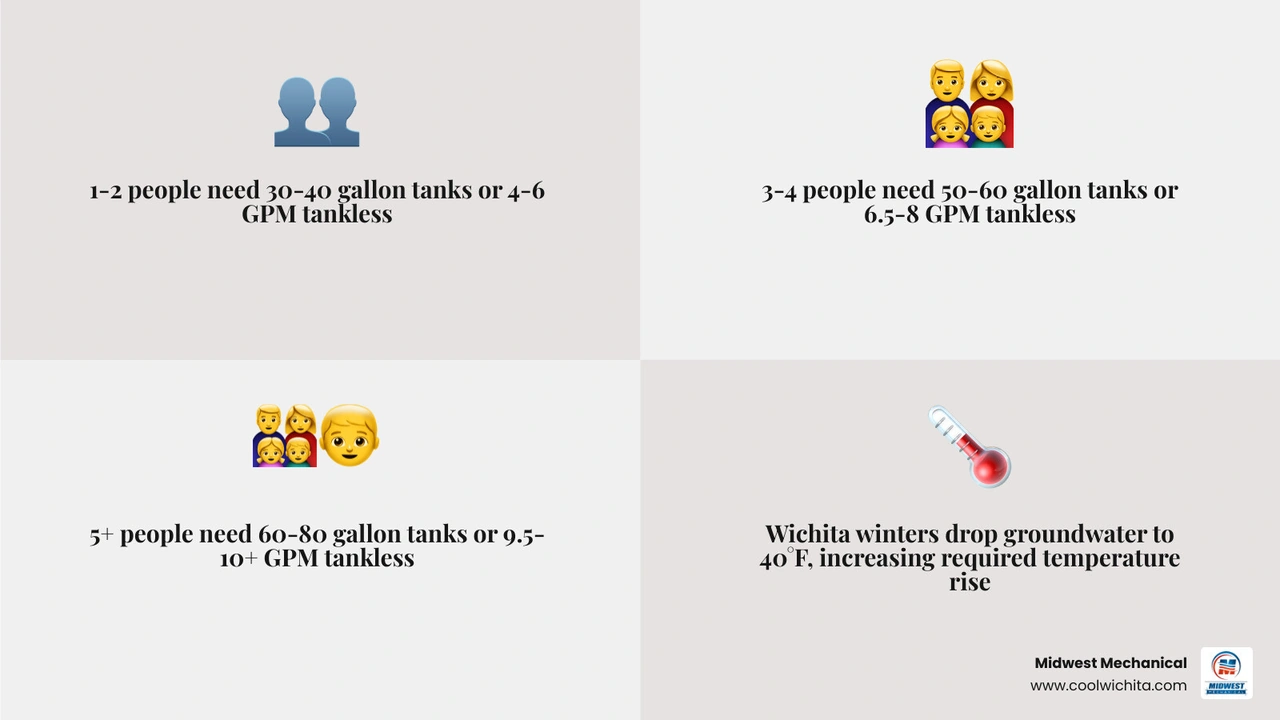
What size water heater does your home need depends on how many people live in your home, your peak hot water demand, and your fuel source. Here's a quick reference:
Household SizeStorage TankTankless (GPM)1-2 people30-40 gallons4-6 GPM3-4 people50-60 gallons6.5-8 GPM5+ people60-80 gallons9.5-10+ GPM
Water heating accounts for roughly 18% of your home's total energy use. That makes your water heater one of the biggest energy consumers under your roof — and one of the most important appliances to size correctly.
Too small, and you're fighting over who gets the last hot shower. Too large, and you're paying to keep a tank of water hot around the clock, even when no one's home. Either way, the wrong size costs you.
For Wichita homeowners and business owners, there's an added layer to consider. Kansas winters push groundwater temperatures down significantly, which means your water heater has to work harder to deliver hot water at your tap. That affects how much capacity you actually need — especially if you're looking at a tankless system.
This guide walks you through everything: storage tanks, tankless units, heat pumps, and the simple calculations that take the guesswork out of sizing.
What Size Water Heater Does Your Home Need: The Ultimate Guide
Determining what size water heater does your home need is a bit like buying a car; you don't just look at the number of seats, you look at how you plan to drive it. In places like Andover, Derby, and Maize, we see homes of all shapes and sizes, from cozy bungalows to sprawling estates. Each one has a unique "hot water profile."
When we talk about Water Heaters Wichita Ks, we look at three main variables: your household size, your peak-hour demand, and your fuel source.
- Household Size: This is the most basic starting point. A family of five naturally uses more water than a retired couple.
- Peak-Hour Demand: This is the maximum amount of hot water your household uses during its busiest hour of the day (usually the morning rush).
- Fuel Source: Whether you use natural gas, propane, or electricity changes how fast your water heater can recover after someone takes a long shower.
Determining what size water heater does your home need for storage tanks
For a traditional storage tank system, sizing is about more than just the physical gallon capacity. While most residential tanks range from 30 to 80 gallons, the number on the side of the tank only tells half the story.
We also have to look at the First-Hour Rating (FHR). This is the total amount of hot water the heater can provide in a single hour, starting with a full tank of hot water. It combines the tank capacity with the recovery rate—the speed at which the unit can heat up new cold water entering the tank.
Another factor often overlooked is standby losses. Because storage tanks keep water hot 24/7, they lose heat through the walls of the tank. In older or poorly insulated models, this can account for 20% to 30% of your water heating energy. Sizing the tank correctly ensures you aren't paying to keep 80 gallons hot when you only ever use 40.
Calculating what size water heater does your home need for tankless units
Tankless units operate on a completely different set of rules. They don't have a "capacity" in the traditional sense because they don't store water. Instead, they are sized based on Gallons Per Minute (GPM) and temperature rise.
To size a tankless unit, we look at your fixture count. If you want to run two showers and a dishwasher at the same time, we add up the GPM requirements for each. However, the "temperature rise" is the real kicker for those of us in the Wichita area. If the groundwater entering your home is 40°F in January and you want your shower at 120°F, the unit has to "rise" that water by 80 degrees instantly. This requires significantly more power than a home in a warmer climate where the groundwater might start at 70°F.
Sizing Storage Tank Systems and First-Hour Ratings
If you've decided a storage tank is the right fit for your home, you'll need to focus on Tips Choosing Right Water Heater Size to ensure you don't end up with "lukewarm shower syndrome."
As we mentioned, the First-Hour Rating (FHR) is the gold standard for tank sizing. You can find this rating on the yellow EnergyGuide label on any new water heater. When we help homeowners and business owners explore Different Types Of Water Heaters For Home, we always compare the FHR to their calculated peak-hour demand.
The recovery rate is largely determined by the BTU capacity (for gas) or wattage (for electric). Gas units generally have a much higher recovery rate than electric units. For example, a 40-gallon gas tank might have a recovery rate of 40 gallons per hour, while an electric unit of the same size might only recover 20 gallons per hour. This is why electric tanks often need to be slightly larger to provide the same level of service.
Household ProfileRecommended Tank CapacityEstimated Peak FHR Needed1-2 People30-40 Gallons45-60 Gallons3-4 People50-60 Gallons65-80 Gallons5+ People60-80 Gallons85-100+ Gallons
Sizing guidelines for Kansas households
In our local service area—including Park City, Bel Aire, and Valley Center—we generally follow these rules of thumb:
- 1-2 People: A 30 to 40-gallon tank is usually sufficient. If you have a high-flow showerhead or a large soaking tub, aim for the 40-gallon mark.
- 3-4 People: We typically recommend a 50 to 60-gallon tank. This accommodates back-to-back showers and the occasional load of laundry running at the same time.
- 5+ People: For large families, an 80-gallon tank or a high-recovery 75-gallon gas unit is almost always necessary to avoid morning conflicts.
Tankless Water Heater Sizing for Wichita Homes and Businesses
Many homeowners and business owners are moving toward tankless systems for the "endless" hot water benefit. If you're considering this, our Tankless Flow Rate Guide 2025 is a great resource. The main Advantages Of A Tankless Water Heater include space savings and energy efficiency, but only if the unit is sized to handle your peak flow.
In Wichita, we have to be very careful with the GPM ratings advertised on the box. Many manufacturers rate their units based on a 35°F or 45°F temperature rise. In Kansas, we need to size for a 70°F to 80°F rise during the winter. A unit that promises 9 GPM in Florida might only deliver 4.5 GPM in Wichita when the ground is frozen.
Sizing for simultaneous fixture use
To find your required GPM, we look at what you’ll be doing at the same time. Here is a rough breakdown of flow rates for common fixtures:
- Standard Shower: 2.5 GPM
- Low-Flow Shower: 1.5 - 2.0 GPM
- Kitchen Faucet: 1.5 - 2.2 GPM
- Bathroom Faucet: 0.5 - 1.5 GPM
- Dishwasher: 1.0 - 2.0 GPM
- Washing Machine: 2.0 GPM
If you want to run two standard showers (5.0 GPM) while the dishwasher is running (1.5 GPM), you need a unit capable of at least 6.5 GPM at an 80°F rise. If your unit is undersized, you’ll experience a "flow deficit," where the water pressure drops or the temperature fluctuates wildly when a second tap is opened.
Key Factors Influencing Peak Hot Water Demand
When you Choose The Right Water Heater For Your Home, you have to look beyond just the number of people. Your lifestyle dictates your demand. We’ve seen two-person households that use more hot water than families of four because of high-end "spa" showers or frequent guests.
Understanding How To Know Which Type Of Water Heater Is Best involves auditing your peak usage times. Is everyone showering between 6:30 AM and 7:30 AM? Do you run the dishwasher right after dinner while the kids are in the bath? These "congested" times are what determine your needed capacity.
Impact of climate and groundwater temperature
We cannot stress enough how much Kansas winters impact your water heater. Our groundwater temperature can drop to 40°F. To get that water to a comfortable 120°F, your heater has to work significantly harder than it does in the summer when the water might enter the home at 65°F.
This extra heating load means that a system that feels perfectly adequate in July might struggle to keep up in January. When we size systems for homes and businesses in Rose Hill or Mulvane, we always build in a "buffer" for these cold weather months to ensure year-round comfort.
Advanced sizing for heat pumps and high-efficiency systems
If you are looking at Energy Efficiency Ratings For Water Heaters, you may have come across Heat Pump Water Heaters (HPWH) or condensing units. These are fantastic options, but they have unique sizing requirements.
When Navigating Water Heater Options, keep these technical needs in mind:
- Heat Pump Water Heaters: These units pull heat from the surrounding air. Because they heat water more slowly than standard electric elements, we often recommend "upsizing." If a 50-gallon standard tank works for you, you might want an 80-gallon heat pump model to ensure you have a larger reservoir of hot water ready to go. They also require at least 700 to 1,000 cubic feet of unconditioned air space to operate efficiently.
- Condensing Units: These are high-efficiency gas models that capture heat from the exhaust gases. They are excellent for homes with high demand (55 gallons or more) because they comply with stricter federal efficiency standards while providing massive amounts of hot water.
Frequently Asked Questions About Water Heater Sizing
Is a 40-gallon or 50-gallon tank better for a family of four?
For a family of four, we almost always recommend a 50-gallon tank, especially if it is an electric model. If you have a gas heater with a very high recovery rate and your family staggers their showers (some in the morning, some at night), a 40-gallon tank might suffice. However, a 50-gallon tank provides that extra cushion for simultaneous showers or running the dishwasher while someone is bathing.
How does the Wichita climate affect my water heater size?
The Wichita climate requires a higher "temperature rise" capability. Because our winter groundwater is so cold, your heater has to add more energy to every gallon of water. For tankless systems, this means you need a unit with a higher BTU or kW rating than someone in a southern state. For tank systems, it means your recovery rate will be slightly slower in the winter.
Can I use multiple tankless units for a large home?
Yes, this is often called a "manifold" system or "point-of-use" installation. In very large homes in areas like McConnell AFB or Sedgwick, a single tankless unit might struggle to push hot water to a distant master suite. Installing a second, smaller unit near the kitchen or the primary bathroom can provide "instant" hot water and increase your total GPM capacity. However, this does increase installation complexity.
Choosing the Right Partner for Your Home Comfort
Sizing a water heater isn't just about math; it's about understanding how your home functions. At Midwest Mechanical, we pride ourselves on providing the Wichita area with reliable plumbing expertise. Whether you're in Towanda, Udall, or right here in Wichita, we take the time to calculate your peak demand and groundwater factors to ensure you never run out of hot water again.
We offer transparent pricing, zero-down financing, and comprehensive maintenance plans to keep your new system running efficiently for years to come. Don't leave your morning shower to chance—let us help you find the perfect fit for your home.
If you're ready to upgrade or just have more questions about Water Heaters, we are here to help. Our team serves the entire region, from Goddard to Rose Hill, ensuring every neighbor has access to total home comfort.


We have partnered with GoodLeap to offer flexible payment options for your project. GoodLeap uses a soft credit check until funding and the highest score from all 3 bureaus to see if you qualify. It also takes just a few minutes to get started.






.svg)