

Why Knowing How to Calculate Your Household Hot Water Demand Saves You From Cold Showers
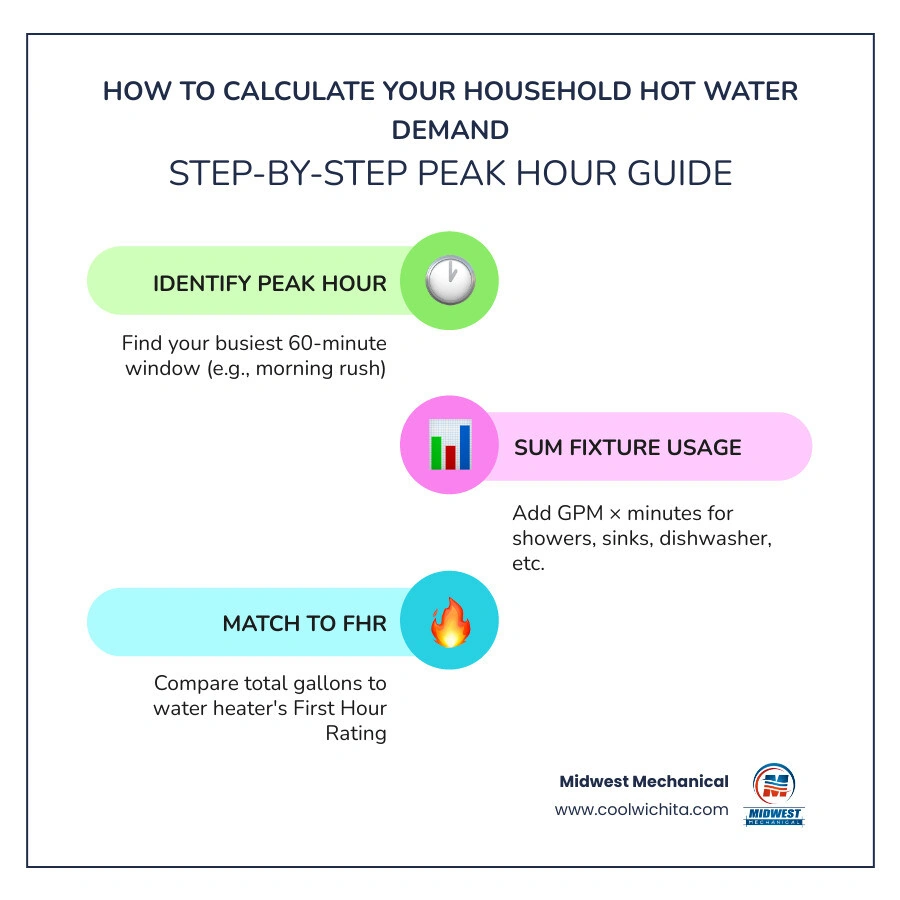
How to calculate your household hot water demand comes down to five straightforward steps:
- List every hot water fixture and appliance in your home (showers, sinks, dishwasher, washing machine)
- Estimate each fixture's hot water usage using average flow rates and typical run times
- Identify your peak hour — the single busiest 60-minute window of hot water use in your day
- Add up the gallons used during that peak hour to get your peak hour demand
- Match that number to a water heater's First Hour Rating (FHR) or flow rate (GPM for tankless)
For a quick reference, most households fall into these ranges:
Household SizeEstimated Peak Hour DemandRecommended Tank Size1-2 people30-40 gallons30-40 gallon tank2-3 people40-50 gallons40-50 gallon tank3-4 people55-65 gallons50-60 gallon tank5+ people70-90+ gallons60-80+ gallon tank
Hot water is one of those home comforts you only notice when it runs out — usually mid-shower on a cold Kansas morning. Whether you have a family of five racing through the bathroom before school or a couple running the dishwasher while someone showers, your water heater has to keep up with all of it.
The problem is that most homeowners and business owners size a water heater based on a rough guess — or just replace it with whatever size they had before. That approach leads to two expensive outcomes: a unit too small that leaves you with cold water during peak demand, or an oversized unit that quietly wastes energy every single day. Research shows oversized units can waste a significant amount in unnecessary energy costs each year.
Getting the sizing right starts with one calculation: your peak hour demand — the maximum amount of hot water your household uses in any single hour. Once you know that number, everything else falls into place.
Why You Need to Calculate Your Household Hot Water Demand
We often see homeowners and business owners in Wichita and Derby who are frustrated because their water heater "just isn't working like it used to." Sometimes the unit is failing, but often, the household has simply outgrown its capacity. Understanding how to calculate your household hot water demand is the first step toward reclaiming your morning routine.
Energy Efficiency and System Longevity
When a water heater is properly sized, it operates at peak efficiency. An undersized unit has to work overtime, constantly firing up to recover lost heat. This constant "recovery mode" puts immense strain on the tank or the heat exchanger, shortening the system's lifespan. By Choosing the Right Water Heater for Your Home, you ensure the system only works as hard as it needs to.
Consistent Supply and Comfort
Nobody likes the "polar plunge" that happens when the dishwasher starts while you're in the shower. Calculating your demand helps you avoid these conflicts. It’s about Navigating Water Heater Options to find a unit that matches your actual lifestyle, not an idealized version of it.
Avoiding Unnecessary Costs
While we don't discuss specific pricing, it’s a universal truth that wasting energy is like flushing money down the drain. An oversized unit maintains a massive volume of hot water that you might never use, leading to high standby heat loss. Using Tips Choosing Right Water Heater Size helps you find that "Goldilocks" zone — not too big, not too small, but just right.
Step 1: Inventory Your Hot Water Appliances and Fixtures
Before we get into the math, we need to know what we’re working with. Walk through your home in Maize or Bel Aire and count every single point where hot water comes out.
The Primary "Hot Spots"
- Showerheads: These are usually the biggest consumers. Standard showerheads use about 2.5 gallons per minute (GPM), though older models can use up to 5 or even 7 GPM.
- Bathroom Faucets: Think about morning shaves or face washing. These typically flow at 1.0 to 1.5 GPM.
- Kitchen Sinks: Between food prep and hand-washing dishes, the kitchen sink is a frequent user, often flowing at 1.5 to 2.2 GPM.
- Automatic Dishwashers: Modern ENERGY STAR models are remarkably efficient, but they still require a specific volume of hot water per cycle.
- Clothes Washers: A standard top-loader can use a significant amount of hot water if you’re running a warm or hot cycle.
When looking at Different Types of Water Heaters for Home, you'll see that how these fixtures draw water (all at once versus spread out) dictates whether a tank or tankless system is better for you.
Step 2: How to Calculate Your Household Hot Water Demand for Individual Fixtures
Now that you have your inventory, let's look at the numbers. To understand how to calculate your household hot water demand, we have to look at both the flow rate and the duration of use.
Average Hot Water Usage Per Task
Fixture/ApplianceAverage Total Water UsedAverage Hot Water Used (approx.)Shower20-25 gallons15-17.5 gallonsBath30 gallons18-21 gallonsShaving (faucet running)2 gallons1.5 gallonsHand Dishwashing4 gallons3 gallonsDishwasher (ENERGY STAR)3-5 gallons3-5 gallonsClothes Washer (Warm)20 gallons8-13 gallons
Understanding these figures is vital for evaluating Energy Efficiency Ratings for Water Heaters, as those ratings are based on typical usage patterns.
Estimating Usage for Showers and Sinks
A common mistake is assuming that if a showerhead is 2.5 GPM, you are using 2.5 gallons of hot water every minute. In reality, you’re mixing in cold water. Typically, a shower is a 70/30 mix (70% hot, 30% cold).
If you take a 10-minute shower with a 2.5 GPM head:
- Total Water: 25 gallons.
- Hot Water Mix (70%): 17.5 gallons.
If you have four people in your Maize home taking 10-minute showers back-to-back, that’s 70 gallons of hot water right there!
How to Calculate Your Household Hot Water Demand for Appliances
Appliances are a bit different because they usually draw water in "gulps" rather than a steady stream.
- Dishwashers: Standard ENERGY STAR certified models use between 3 and 5 gallons per cycle. Compact models might use as little as 2.7 gallons.
- Washing Machines: This varies wildly. A standard warm wash cycle uses about 8 to 13 gallons of hot water. If you have an older top-loader, that number could jump to 25 gallons.
Knowing these specifics helps you determine How to Know Which Type of Water Heater is Best for your specific appliance load.
Step 3: Determining Your Peak Hour Demand
This is the most critical step in the process. Your "Peak Hour" is the one hour during the day when your home uses the most hot water. For most families in Andover or Wichita, this is between 6:30 AM and 7:30 AM.
The 60-Minute Window
Think about your busiest morning. Does the dishwasher run while three people shower? Do you start a load of laundry before heading to work?
To find your peak hour demand:
- Identify your busiest hour.
- List every activity that uses hot water in that hour.
- Use the gallon estimates from Step 2 to add them all up.
This total is your target. When you Choose the Right Water Heater for Your Home, the unit's "First Hour Rating" (for tanks) must meet or exceed this number.
How to Calculate Your Household Hot Water Demand During Busy Mornings
Let's look at a real-world example for a family of four in a typical suburban home:
- 3 Showers (10 mins each): 17.5 gal x 3 = 52.5 gallons
- 1 Shave (faucet running): 2 gallons
- 1 Hand Dishwashing (breakfast): 3 gallons
- Total Peak Hour Demand: 57.5 gallons
In this scenario, a water heater with a First Hour Rating of 60 gallons would be perfect. If you bought a tank based solely on its size (like a 40-gallon tank), you might run out of hot water before the third person finishes their shower.
Matching Your Calculations to the Right Water Heater
Once you have your peak hour number, you can look at the equipment. There are two main ways to satisfy that demand: storage tanks and tankless systems.
Storage Tank Water Heaters and FHR
For traditional Water Heaters, you don't just look at the tank size (e.g., 50 gallons). You look at the First Hour Rating (FHR). The FHR is a combination of how much hot water is already in the tank plus how much the heater can "recover" (heat up) in one hour.
A gas water heater generally has a higher recovery rate than an electric one. For example, a 50-gallon gas unit might have an FHR of 75 gallons, while an electric unit of the same size might only have an FHR of 60 gallons.
Sizing Tankless Systems for Wichita Homes and Businesses
Tankless systems don't have an FHR because they don't store water. Instead, they are sized by flow rate and temperature rise.
- Flow Rate Requirements: If your peak hour involves two showers (2.5 GPM each) and a kitchen sink (1.5 GPM) running at the exact same time, you need a tankless unit that can provide at least 6.5 GPM.
- Temperature Rise: This is where our Kansas climate matters. In the winter, our groundwater can be as cold as 40°F. If you want your shower at 120°F, the unit has to raise the temperature by 80 degrees. This "temperature rise" can lower the GPM output of the unit.
We recommend checking out our Tankless Flow Rate Guide 2025 for a deeper dive. If you’re considering an upgrade, a Tankless Water Heater in Wichita, KS can provide an endless supply, provided it’s sized for these simultaneous uses. There are many Benefits of Tankless Water Heaters, but proper sizing is the most important one.
Frequently Asked Questions about Hot Water Sizing
What is the First Hour Rating (FHR) and why does it matter?
The FHR is the most important number on the EnergyGuide label of a storage water heater. It tells you exactly how much hot water the unit can deliver in its first hour of operation, starting with a full tank. If your peak hour demand is 60 gallons, you need an FHR of at least 60.
How do guests or teenagers impact my hot water demand?
Teenagers are notorious for taking longer showers — sometimes 20 minutes or more. This can double the hot water demand for a single shower. Similarly, if you frequently have guests staying over in your Rose Hill or Towanda home, you should add about 15-20 gallons to your peak hour demand calculation to ensure everyone stays comfortable.
Does the incoming water temperature in Kansas affect my heater size?
Absolutely. In southern states, groundwater might be 70°F, meaning the heater only has to work a little bit to reach 120°F. In Kansas, our winter groundwater is much colder. This means your water heater (especially a tankless unit) has to work harder and may produce fewer gallons per minute than the "max" rating shown on the box. We always factor in a 70°F to 80°F temperature rise for our local customers.
Conclusion
Calculating your household's hot water demand isn't just about avoiding a cold shock in the morning; it's about system efficiency, home comfort, and long-term reliability. By taking an inventory of your fixtures, estimating your usage, and identifying your peak hour, you can make an informed decision that fits your family's unique lifestyle.
At Midwest Mechanical, we’ve helped countless homeowners and business owners in Wichita, Andover, and the surrounding communities find the perfect balance for their hot water needs. Whether you’re interested in a high-efficiency storage tank or the endless supply of a tankless system, we provide transparent guidance and expert installation.
Ready to ensure your home has the hot water it needs? Explore our options for Water Heaters or give us a call to schedule a professional sizing consultation. We’re here to keep your Kansas home comfortable, one gallon at a time.


We have partnered with GoodLeap to offer flexible payment options for your project. GoodLeap uses a soft credit check until funding and the highest score from all 3 bureaus to see if you qualify. It also takes just a few minutes to get started.






.svg)