


What the 2025-2026 Refrigerant Transition Means for Your Next AC Purchase in Wichita, KS
How the refrigerant transition affects your next AC purchase is something every Wichita homeowner needs to understand before signing off on a new system in 2026. The short version: the refrigerant that has powered most home air conditioners for the past two decades — R-410A — is being phased out under federal law. Every new residential AC system manufactured today uses a different refrigerant entirely. That shift changes what you buy, how it works, and what happens when your older system needs a repair.
Here is a quick summary of what this transition means for you right now:
- New systems use A2L refrigerants (R-454B or R-32) with up to 78% lower global warming potential than R-410A
- Your existing R-410A system is still legal to service — no one is forcing you to replace it today
- R-410A is getting harder and more expensive to source, with production cut 40% in 2026 alone
- New A2L systems run 10–15% more efficiently than the R-410A units they replace
- You cannot retrofit an old R-410A system to run on the new refrigerants — a full replacement is required
- Federal incentives exist for qualifying upgrades, including up to $2,000 for heat pumps and up to $600 for central AC units
- Ask your contractor whether their technicians are trained for A2L refrigerants before you commit to any new installation
The driving force behind all of this is the American Innovation and Manufacturing (AIM) Act, signed into law in December 2020. It authorized the EPA to phase down hydrofluorocarbons (HFCs) — a class of refrigerants with an outsized impact on climate warming. R-410A has a global warming potential (GWP) of 2,088, meaning it traps significantly more heat in the atmosphere than carbon dioxide over a 100-year period. The new A2L refrigerants replacing it — primarily R-454B (GWP: 466) and R-32 (GWP: 675) — represent a major step down in environmental impact.
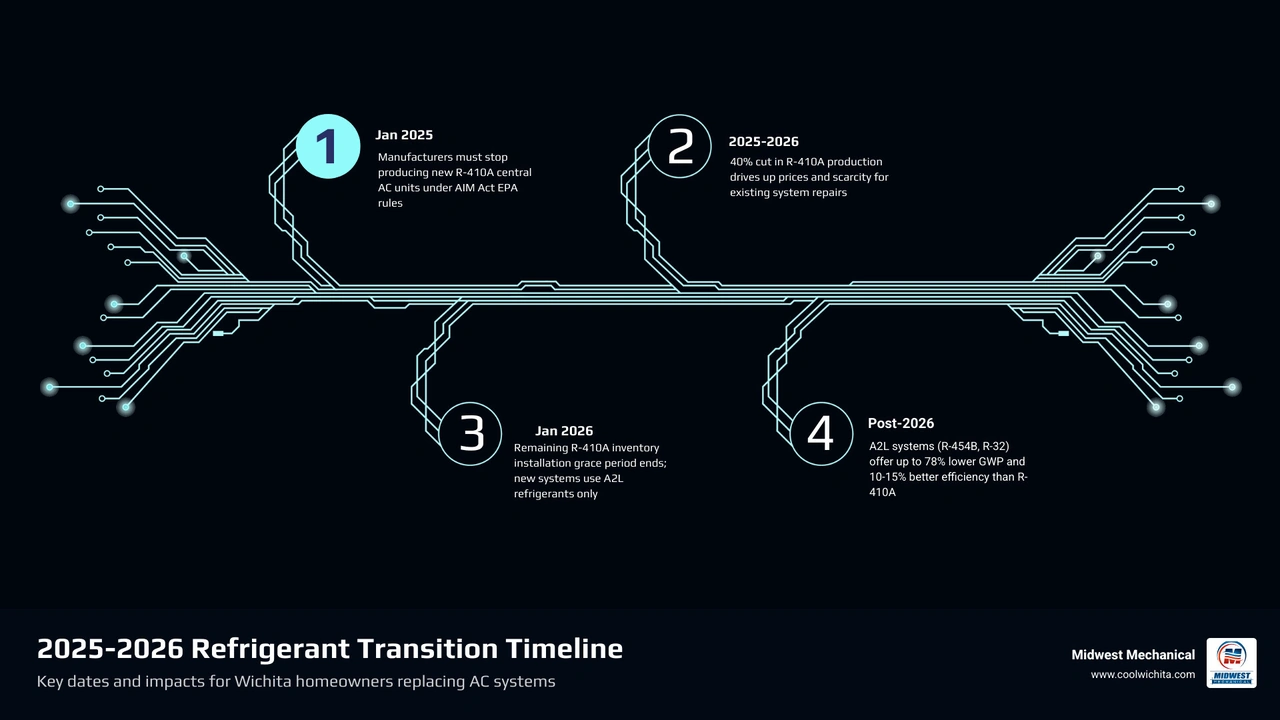
As of January 1, 2025, manufacturers can no longer produce new central air conditioning units using R-410A. And as of January 1, 2026, the grace period for installing remaining R-410A inventory has ended. If you are shopping for a new AC system in Wichita right now, the system on the truck will almost certainly contain one of these next-generation refrigerants — whether you knew that going in or not.
This guide walks you through everything you need to know: what the new refrigerants actually are, how they affect safety and efficiency, what rising R-410A service costs mean for your repair-versus-replace decision, and what questions to ask before you buy.
Understanding the 2025-2026 HVAC Refrigerant Shift
The transition away from R-410A is not the first time the heating, ventilation, and air conditioning (HVAC) industry has undergone a massive environmental upgrade. Decades ago, the industry phased out R-12, followed by the phase-out of R-22 (often known by the brand name Freon) which concluded in 2020. Each step has moved us toward compounds that do less harm to our planet.
With the AIM Act, the focus has shifted from protecting the ozone layer to reducing global warming potential. To understand how these changes trickle down to your household budget and summer comfort, it is helpful to look at How AC Refrigerant Changes Affect Homeowners and see how federal mandates reshape the manufacturing landscape.
Why R-410A is Disappearing and How the Refrigerant Transition Affects Your Next AC Purchase
R-410A has been the reliable, standard refrigerant for residential cooling systems since the early 2000s. However, because it is a powerful hydrofluorocarbon, its high GWP of 2,088 makes it a primary target for environmental regulations. Under the EPA’s technology transitions, the production baseline for HFCs has been drastically reduced.
As of January 1, 2025, the EPA prohibited the manufacturing of residential split-system air conditioners and heat pumps that utilize refrigerants with a GWP of 700 or higher. For homeowners, the finality of this transition became absolute on January 1, 2026, when the installation sell-through period for older R-410A systems officially closed.
This means that any new central cooling system you purchase today must run on an approved low-GWP alternative. This shift is closely aligned with ongoing efficiency updates, similar to the New Energy Efficiency Standards for the Start of 2023, which pushed manufacturers to redesign systems for lower electrical consumption and cleaner operation.
R-454B vs. R-32: The New Generation of A2L Refrigerants
To replace R-410A, the HVAC industry has adopted a new class of refrigerants designated as "A2L" by ASHRAE. The A2L classification means these fluids have low toxicity (A) and are mildly flammable (2L).
While the word "flammable" can sound intimidating, A2L refrigerants are incredibly stable. They are exceptionally difficult to ignite, requiring a high-energy ignition source and a highly concentrated, sealed environment to burn. In fact, many common household items, such as hairspray, aerosol cooking sprays, and cosmetics, are significantly more flammable than A2L refrigerants.
The two primary A2L options dominant in the residential market in 2026 are:
- R-454B: A blend composed of 68.9% R-32 and 31.1% R-1234yf. It features a GWP of 466, offering a 78% reduction in global warming impact compared to R-410A. It is the chosen successor for the majority of major ducted HVAC brands in North America.
- R-32: A single-component refrigerant with a GWP of 675, representing a 68% reduction in climate impact. It has been used in millions of window units and ductless mini-split systems worldwide for years and is favored by several prominent manufacturers.
| Refrigerant Property | R-410A (Legacy) | R-454B (New Standard) | R-32 (New Standard) |
|---|---|---|---|
| ASHRAE Safety Class | A1 (Non-flammable) | A2L (Mildly Flammable) | A2L (Mildly Flammable) |
| Global Warming Potential (GWP) | 2,088 | 466 | 675 |
| Ozone Depletion Potential | 0 | 0 | 0 |
| Chemical Composition | HFC Blend | HFC/HFO Blend | Pure HFC |
| Relative Efficiency Gain | Baseline | 8% to 10% Higher | 10% to 12% Higher |
How the Refrigerant Transition Affects Your Next AC Purchase and System Technology

When you shop for an air conditioner in 2026, you aren't just buying the same old machine with a different fluid inside. Because A2L refrigerants carry a mild flammability rating, safety standards require manufacturers to completely redesign their equipment. This technological leap impacts the design of the physical units, the safety components built into your home's ductwork, and the installation protocols our technicians must follow.
When upgrading to an A2L system, it is vital to replace both the outdoor condensing unit and the indoor evaporator coil at the same time. Trying to mix older R-410A indoor components with a new A2L outdoor unit will result in system failure, voided warranties, and code violations. Taking the time to understand these technical requirements is a key part of Choosing the Right Home Air Conditioner for your household's long-term comfort and safety.
Safety Features and Energy Efficiency in Modern A2L Systems
To comply with updated building codes, modern A2L air conditioners are equipped with advanced safety systems. Central ducted units now feature integrated Refrigerant Detection Systems (RDS) and specialized mitigation boards.
If a leak occurs within the indoor coil, the RDS sensor immediately detects the concentration of refrigerant. Within seconds, the mitigation board triggers a safety protocol: it shuts down the outdoor compressor to stop the flow of refrigerant and activates the indoor blower fan at 100% capacity. Running the fan dilutes the refrigerant vapor with household air, keeping the concentration far below any level that could pose a safety hazard.
Beyond safety, the thermodynamic properties of R-454B and R-32 are superior to R-410A. These new fluids transfer heat much more efficiently, allowing compressors to do less work to cool your home. As a result, new A2L systems deliver a 10% to 15% increase in energy efficiency over older models. When combined with modern SEER2 rating standards, this efficiency leap translates directly into lower monthly utility bills during our hot, humid Kansas summers.
Repair vs. Replace: Navigating Rising Service Expenses
For the owners of the roughly 80 million R-410A systems currently installed across the United States, this transition introduces a practical financial dilemma. As the supply of older refrigerants continues to shrink under federal phase-down schedules, the cost of keeping an aging system running will rise.
If your current air conditioner is approaching the end of its typical lifespan, you will have to weigh the cost of ongoing repairs against the benefits of upgrading. To help navigate this choice, consult our AC Replacement Wichita KS Complete Guide to understand how system age and local climate factors shape your options.
The Financial Impact of Maintaining Older R-410A Systems
In 2026, the EPA has enforced a 40% reduction in R-410A production allowances compared to the historical baseline. By 2036, that reduction will reach 85%. Because supply is dropping rapidly while millions of homes still rely on R-410A, the cost of this refrigerant has escalated dramatically.
If your air conditioner develops a significant refrigerant leak, simply "topping it off" is no longer a viable long-term strategy. Doing so is the mechanical equivalent of pumping air into a tire that has a massive nail in it—the expensive gas will simply escape again, leaving you with another costly service call.
Instead, homeowners must prioritize permanent leak repairs, which require recovering the remaining refrigerant, soldering the leak under a nitrogen purge, and recharging the system. Because of the rising expenses associated with R-410A, a major leak repair on an older system can quickly turn into an "obsolescence trap," where you spend a significant portion of what a new, highly efficient system would cost just to keep an old unit limping along. Investing in a timely upgrade is often the wiser path, especially since a Professional AC Installation Saves Money over time through reduced repair needs and lower energy consumption.
Retrofitting Limitations and How the Refrigerant Transition Affects Your Next AC Purchase
A common question we receive from homeowners in Wichita, Derby, and Andover is: "Can you just drain my old R-410A system and refill it with the new, eco-friendly R-454B or R-32?"
Unfortunately, the answer is a definitive no.
A2L refrigerants cannot be used as a "drop-in" replacement for several critical reasons:
- Pressure Differences: R-454B and R-32 operate at different pressures and have different mass flow rates than R-410A. Older compressors are not engineered to handle these physical differences.
- Lubricant Incompatibility: The synthetic polyolester (POE) oils used to lubricate A2L compressors are formulated differently than those used in legacy R-410A systems. Mixing them can cause compressor failure.
- Safety Compliance: Older indoor evaporator coils lack the mandatory Refrigerant Detection Systems, mitigation controls, and spark-shielded electrical components required by modern building codes for A2L operation.
Because of these limitations, transitioning to the new refrigerant requires a complete system replacement.
Frequently Asked Questions about the Refrigerant Transition
Navigating federal regulatory shifts can feel overwhelming. To help clarify your options, we have compiled answers to the most common questions Wichita area homeowners are asking in 2026.
Do I need to replace my existing R-410A system immediately?
No, there is absolutely no legal requirement to replace a properly functioning R-410A air conditioner. You are perfectly free to run your current system for the remainder of its natural operating life.
Legacy systems can still be legally repaired, and service technicians can continue to recharge them as long as R-410A supplies remain available. However, if your system is more than 12 to 15 years old and requires a major repair, you should strongly consider a replacement rather than sink money into a system running on a scarce and increasingly costly refrigerant.
What federal tax credits or incentives are available for upgrading?
To help offset the cost of transitioning to cleaner, more efficient home comfort technology, several valuable incentives are available in 2026:
- Energy Efficient Home Improvement Credit (Section 25C): Homeowners can claim a federal tax credit of up to $2,000 for qualifying high-efficiency heat pumps, or up to $600 for qualifying central air conditioning units that meet specific SEER2 efficiency thresholds.
- Local Utility Rebates: Depending on your specific location in the Wichita metro area—whether you are in Maize, Bel Aire, or Goddard—local electric utilities offer active rebate programs for installing high-efficiency cooling systems.
What should homeowners ask HVAC contractors before purchasing a new system in 2026?
When shopping for a new air conditioner, it is vital to ensure your chosen contractor is fully prepared for the modern technological standards. We recommend asking the following questions:
- "Are your installation technicians specifically certified to handle A2L refrigerants?"
- "Do your crews use specialized, spark-resistant recovery machines and vacuum pumps designed for A2L systems?"
- "Will you perform a proper nitrogen pressure test and pull a vacuum below 500 microns to ensure the new line set is completely sealed?"
- "Are the necessary local mechanical permits included in your installation agreement?"
Conclusion
The 2025-2026 refrigerant transition represents a major step forward for environmental responsibility and home energy efficiency. While it changes the technical landscape of residential cooling, it does not have to be a source of stress. By partnering with a knowledgeable, local team, you can make an informed decision that keeps your home comfortable for years to come.
At Midwest Mechanical, we are proud to provide expert heating, cooling, and plumbing services across the entire Wichita metropolitan area, including Andover, Bel Aire, Derby, Goddard, Kechi, Maize, Mulvane, Park City, Rose Hill, and Valley Center. Our team of skilled professionals is fully certified in A2L safety standards, equipped with specialized tools, and ready to help you navigate your next home comfort upgrade with transparent pricing and dependable service.
Schedule your next air conditioning service with Midwest Mechanical today to ensure your home's cooling system is reliable, efficient, and ready for the summer heat.
Customer Testimonials
Hear from satisfied customers who trust us for reliable HVAC and plumbing service across Wichita.




Plus, the technician, Lee was very professional, knowledgeable and informative.
We will definitely be doing business with them sometime again in the past.
I'm prompt to my appointment. Thank you Midwest Mechanical.
I'm prompt to my appointment. Thank you Midwest Mechanical.

We have partnered with GoodLeap to offer flexible payment options for your project. GoodLeap uses a soft credit check until funding and the highest score from all 3 bureaus to see if you qualify. It also takes just a few minutes to get started.




Service Areas
.svg)