
How a Tankless Water Heater Works Explained Simply — And Why It Matters for Wichita Homeowners and Business Owners
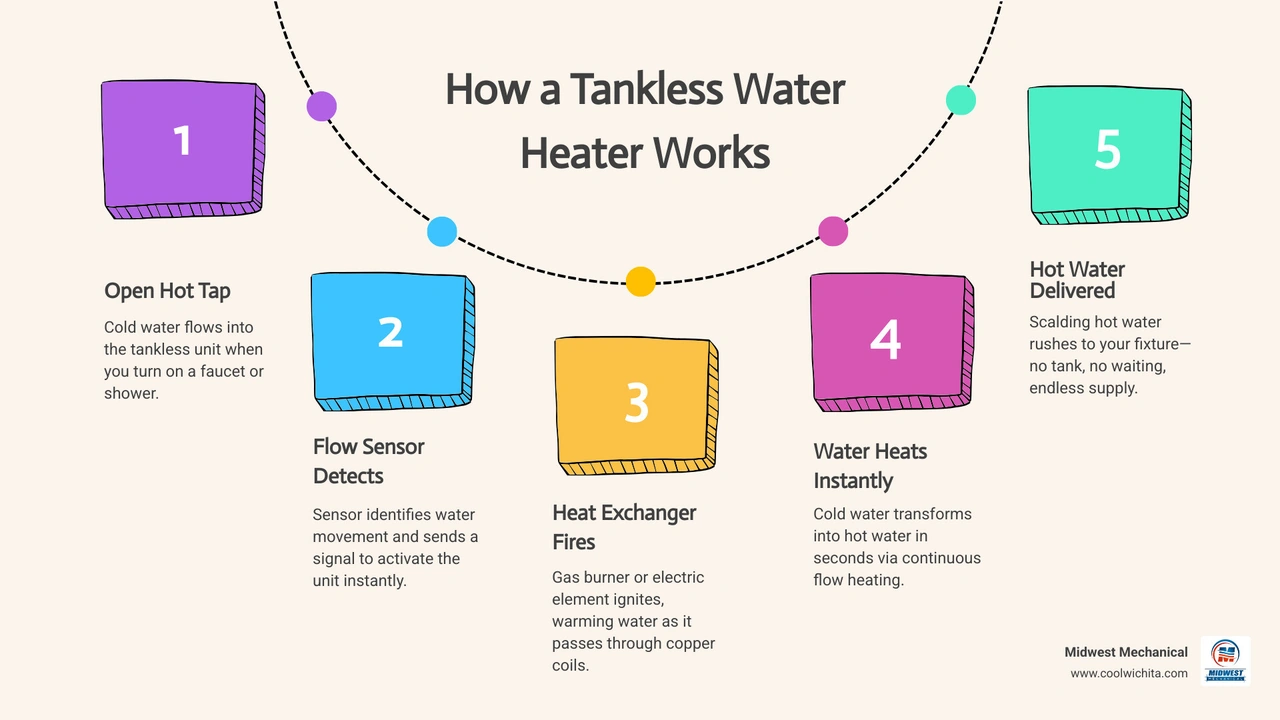
How a tankless water heater works explained simply: cold water flows into the unit when you turn on a tap, a sensor detects the flow, a burner or electric element heats the water instantly as it passes through a heat exchanger, and hot water arrives at your faucet — all without ever storing water in a tank.
Here's the basic process at a glance:
- You open a hot water tap
- A flow sensor detects water moving through the unit
- The control board fires the burner or heating element
- Water passes through a heat exchanger and heats up immediately
- Hot water travels to your fixture
- You close the tap — the unit shuts off completely
If you've ever jumped in the shower only to get hit with ice-cold water because someone else used it first, you already understand the core problem with traditional tank heaters. They store a fixed amount of hot water, and once it's gone, you wait. Tankless units flip that model entirely — they heat water on demand, only when you need it, with no storage tank sitting in the corner burning energy around the clock.
For homeowners and business owners in Wichita and the surrounding Kansas area, that shift can mean real comfort improvements and lower energy bills. This guide breaks down exactly how the process works, step by step, in plain language — no plumbing degree required.
What Is a Tankless Water Heater?
A tankless water heater is a compact appliance that heats water only when you need it. Instead of storing 40, 50, or 80 gallons of hot water in a tank, it works like a fast-response heater in the middle of your plumbing system.
Think of it as a hot water "on" switch. When you open a tap, the unit wakes up, heats the water moving through it, and sends that hot water to your shower, sink, or appliance.
That simple design creates a few big differences from a traditional tank heater:
- No large storage tank
- No constant reheating of stored water
- Wall-mounted, space-saving design in many homes
- Longer service life in many cases
- Hot water based on flow rate, not tank size
If you want a broader overview of homeowner or business owner benefits, see Benefits of Tankless Water Heaters.
How a tankless water heater works explained simply
Here is the plain-English version:
- Cold water goes in
- The unit senses water flow
- It adds heat right away
- Hot water comes out
That is really the heart of it.
Because the heater does not sit there keeping a tank warm all day, it avoids standby heat loss. That is one reason tankless systems can save roughly 27% to 50% on fuel costs compared to tank-style heaters, depending on usage and setup.
Why homeowners and business owners choose tankless
Many homeowners and business owners like tankless systems because they solve real-life annoyances, not just technical ones.
Common reasons people switch include:
- Endless hot water for normal use
- Better energy efficiency
- Wall-mounted design that frees up floor space
- Longer lifespan, often 20 years or more with proper maintenance
- Cleaner, more modern setup for smaller utility spaces
For a closer look at the upsides, read Advantages of a Tankless Water Heater.
How a tankless water heater works explained simply: step by step
Let us open the "magic box" and look at what happens inside.
A tankless heater usually includes:
- A flow sensor
- A control board
- A gas burner or electric heating elements
- A heat exchanger
- Temperature sensors such as thermistors
- Safety controls and thermostats
Step 1: Water flow tells the unit to wake up
The process starts the moment you turn on a hot water tap.
Cold water begins moving through the heater. Inside the unit, a flow sensor detects that movement. That sensor tells the control board, "Hot water is being requested."
No flowing water means no heating. That is why the unit stays off when nobody is using hot water.
Step 2: The unit calculates how much heat is needed
This is the smart part.
The control board looks at:
- How fast water is flowing
- The temperature of the incoming water
- The target output temperature you set
From there, it calculates how much heat the unit needs to add.
This matters in Kansas because incoming groundwater is not the same temperature year-round. In colder weather, the water entering the heater is colder, so the unit has to work harder to raise it to a comfortable shower temperature. That required change is called temperature rise.
So if the incoming water is colder in winter, your tankless unit may deliver a lower maximum flow at the same temperature setting unless it was sized properly from the start.
Step 3: The heat exchanger warms water instantly
Once the unit knows how much heat is needed, it gets to work.
In a gas tankless heater:
- A burner ignites
- Heat moves into a metal heat exchanger
- Water flows through copper or similar tubing and picks up heat rapidly
In an electric tankless heater:
- Powerful electric elements turn on in stages
- Water passes over or through heated chambers
- The unit ramps output up or down based on flow
Either way, the water is heated as it passes through the unit. Nothing is stored for later.
This is why most residential tankless heaters are rated by gallons per minute, or GPM, rather than tank size.
Step 4: Hot water travels to the fixture
After heating, the hot water leaves the unit and moves through your home's pipes to the faucet, shower, or appliance you turned on.
That brings up one important reality: tankless does not mean instant at the tap.
You still have to wait for:
- The unit to detect flow and begin heating
- Hot water to travel through the piping
- Cool water already sitting in the pipe to clear out
That delay may be short or a bit longer depending on pipe length, fixture distance, and incoming water temperature. Some homeowners and business owners also notice a "cold water sandwich," which is a brief burst of cooler water between two periods of hot water. It happens because of leftover water in the pipes, not because the unit forgot its job.
What happens when you shut the tap off
When you close the faucet, water flow stops.
The flow sensor notices that immediately, and the unit shuts the burner or heating elements off. Since it is not keeping a tank hot after that, standby energy loss is greatly reduced.
That start-stop cycle is the main reason tankless heaters are known for on-demand efficiency.
Tankless vs. traditional tank: what changes in real life?
Here is the practical difference: a tank heater stores hot water first and waits for you to use it. A tankless heater waits first and heats water only when you use it.
FeatureTankless Water HeaterTraditional Tank Water HeaterHow it heatsOn demandStores and reheats waterStorage tankNoYesStandby heat lossVery lowHigherHot water supplyContinuous until flow limit is reachedLimited by tank sizeTypical lifespan20+ years10-15 yearsSpace neededSmaller, wall-mounted in many homesLarger floor footprintMaintenance focusDescaling, filter cleaning, flushingTank sediment flushing, anode checks
For a side-by-side breakdown, visit Tankless vs Tank Water Heater Comparison.
The biggest advantages of tankless heaters
The benefits are easy to understand in everyday life:
- You do not "use up" a tank of hot water
- The unit only heats water when needed
- You reclaim floor space
- Life expectancy is often more than 20 years
- Some condensing models can reach efficiency levels up to 94%
Gas tankless units can also cut energy use substantially compared to older tank systems, and one of the biggest reasons is simple: no standby reheating.
The main drawbacks and limits to know
Tankless is great, but it is not magic in the superhero sense.
The main limitations are:
- Every unit has a maximum flow rate
- Running too many fixtures at once can exceed capacity
- Some homes need gas line, venting, or electrical upgrades
- Hard water can cause scale buildup inside the heat exchanger
- You may still wait a bit for hot water to reach distant fixtures
Electric whole-home models can also place a heavy demand on the electrical panel, while gas models need proper combustion air and venting.
Can a tankless water heater handle a large family?
Yes, if it is sized correctly.
A tankless unit does not usually fail because the family is "too big." It struggles when simultaneous hot water demand is greater than the heater's flow capacity.
For example, a standard shower can use around 2.5 GPM. If two showers are running and the dishwasher starts, demand can climb quickly. Some residential tankless units produce 2 to 5 GPM, while higher-output gas models can deliver much more, with top-end performance reaching around 11 GPM in the right conditions.
So for larger households in Wichita, Andover, Derby, Park City, Maize, Bel Aire, and nearby communities, sizing is everything. In some homes, one well-sized whole-house unit works perfectly. In others, multiple units make more sense.
For more sizing help, see Tankless Flow Rate Guide 2025.
Choosing the right tankless heater for your home
Buying by "gallon size" does not work with tankless. Instead, we size by demand.
The key factors are:
- Required flow rate in GPM
- Temperature rise
- Fuel type
- Number of fixtures used at once
- Local utility setup
- Hard water conditions
How a tankless water heater works explained simply when sizing by flow rate
To size a tankless heater, we add up the fixtures you may use at the same time.
A simple example:
- Shower: about 2.5 GPM
- Kitchen faucet: about 1 to 2 GPM
- Dishwasher or washing machine: variable, often around 1 to 2 GPM during draw
If your busiest time is one shower plus the dishwasher and a sink, your unit needs to handle that combined load while still raising the water to your target temperature.
That is why "endless hot water" has a small footnote: endless, as long as you stay within the heater's flow rate.
Gas vs. electric tankless water heaters
Both types use on-demand heating, but they behave differently.
Gas tankless heaters:
- Usually provide higher flow rates
- Are often better for larger households
- Need venting and combustion air planning
- May need gas line upgrades
- Commonly range in high BTU output for whole-home use
Electric tankless heaters:
- Are often smaller in physical size
- Can be very efficient at the unit level, often in the 95% to 99% range
- Do not need combustion venting
- May require major electrical capacity and panel upgrades
- Often work best for smaller homes, point-of-use setups, or homes with the right electrical infrastructure
In many family homes, gas models have the advantage on flow rate. In some smaller homes or specific applications, electric can be a strong fit. The right choice depends on your home, your utilities, and how much hot water you use at one time.
What to consider before installation
Before installing a tankless water heater, we recommend thinking through the full picture:
- Is the gas line large enough?
- Is proper venting available for a gas model?
- Can the electrical panel support an electric model?
- Where will the unit be mounted?
- Is indoor or outdoor placement appropriate for the home?
- How hard is the local water?
- How far are the main fixtures from the unit?
Professional installation matters because tankless performance depends heavily on correct sizing, safe setup, and proper configuration.
If you are researching options locally, Tankless Water Heater Wichita KS is a good next step.
Maintenance, efficiency, and common homeowner or business owner questions
Tankless units are lower-maintenance than many people expect, but they are not no-maintenance. A little routine care goes a long way.
Simple maintenance that keeps performance strong
The most important maintenance task is flushing or descaling the unit to remove mineral buildup from the heat exchanger.
Typical maintenance may include:
- Annual flushing
- More frequent descaling in hard water areas, sometimes every 6 months
- Cleaning the inlet screen or filter
- Checking burners, venting, and safety components on gas models
- Inspecting electrical connections and elements on electric models
Hard water is one of the biggest long-term enemies of tankless performance. Scale buildup can reduce efficiency, lower flow, and shorten component life.
For related troubleshooting info, see Tankless Water Heater Repair Guide.
Are tankless water heaters energy efficient?
Yes, generally very.
Their biggest efficiency advantage is that they eliminate standby heat loss. They do not keep a large tank hot all day waiting for someone to shower at 7:15 tomorrow morning.
Research commonly shows tankless units saving about 27% to 50% on fuel costs compared to tank-style systems, depending on household water use. Gas tankless heaters can also save up to around 30% on energy bills compared to traditional tank models, and condensing units can reach very high efficiency levels.
That said, actual efficiency depends on:
- Correct sizing
- Household usage patterns
- Water hardness
- Maintenance habits
- Fuel type
Rebates and tax incentives can change over time, so it is smart to check current local utility programs and applicable federal efficiency incentives before making a final decision in 2026.
How long do tankless water heaters last?
One of the biggest selling points is service life.
A well-maintained tankless water heater often lasts more than 20 years, while many traditional tank heaters last around 10 to 15 years. That longer lifespan is one reason some homeowners and business owners see tankless as a long-term upgrade rather than just a replacement.
Routine maintenance makes a real difference. Scale, neglected filters, and ignored warning signs can shorten life, while regular service helps protect performance and reliability.
For more on lifespan, visit How Long Does a Tankless Water Heater Last.
Frequently Asked Questions About Tankless Water Heaters
- Tankless heaters heat water only when a tap is on.
- They do not store hot water in a tank.
- Most residential units are sized by GPM, not gallons.
- Gas models usually deliver higher flow than electric models.
- They are energy efficient because they avoid standby heat loss.
- Maintenance usually includes flushing, descaling, and filter cleaning.
- Proper sizing is the key to good performance in larger households.
Do tankless water heaters ever run out of hot water?
Not in the same way a tank heater does.
A tankless system can keep producing hot water continuously, but only up to its rated capacity. If demand stays within that limit, hot water can keep flowing as long as needed. If demand exceeds capacity, the water may turn lukewarm or cooler because the heater cannot keep up with all fixtures at once.
Why does water sometimes take time to get hot?
There are two common reasons:
- The heater needs a brief moment to activate and start heating
- The hot water still has to travel through the pipes to the fixture
So even though the unit heats water on demand, the piping between the heater and your shower still matters. In larger homes, recirculation strategies may help reduce wait time.
Are tankless units a good fit for every home?
Not always.
They are an excellent fit for many homes, but the best choice depends on:
- Utility availability
- Electrical or gas infrastructure
- Hot water habits
- Fixture count
- Space constraints
- Water quality
Some homes are ideal candidates. Others may need upgrades before a tankless system makes sense. That is why a professional assessment is so helpful.
Conclusion
Tankless water heaters are easy to understand once we strip away the jargon. No tank, no stored hot water, no constant reheating. Just a smart system that senses water flow, heats it quickly, and shuts off when you are done.
For many homeowners and business owners in Wichita and surrounding Kansas communities, that means better efficiency, longer equipment life, and fewer cold-shower surprises. The key is choosing the right size, the right fuel type, and the right installation setup for your home.
At Midwest Mechanical, we help homeowners and business owners make sense of those decisions with clear guidance, transparent recommendations, and ongoing maintenance support. If you are exploring whether tankless is right for your home, learn more here: Tankless Water Heater Wichita KS.
Customer Testimonials
Hear from satisfied customers who trust us for reliable HVAC, plumbing and electrical service across Wichita.





We have partnered with GoodLeap to offer flexible payment options for your project. GoodLeap uses a soft credit check until funding and the highest score from all 3 bureaus to see if you qualify. It also takes just a few minutes to get started.




.svg)