


What Every Homeowner Needs to Know About Water Heater Maintenance
Water heater maintenance for homeowners is one of the most overlooked — and most important — parts of keeping a home running smoothly. Most people never think about their water heater until a cold shower forces the issue. By then, the damage is often already done.
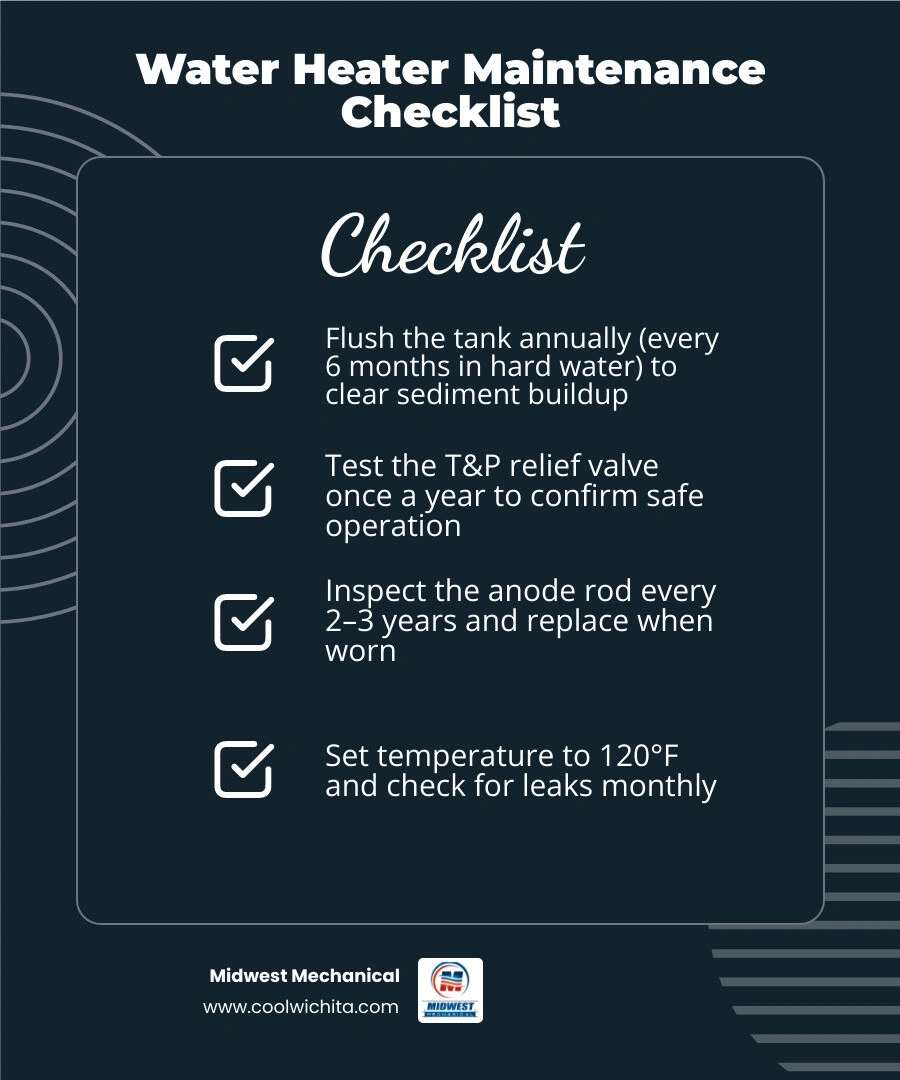
Here is a quick overview of the core maintenance tasks every homeowner should know:
- Flush the tank - Once a year (every 6 months in hard water areas like Wichita, KS) to clear sediment buildup
- Test the T&P relief valve - Annually, to confirm it opens and closes safely
- Inspect the anode rod - Every 2-3 years, and replace it when worn down
- Check the temperature setting - Should be at 120°F for safety and energy savings
- Look for leaks - Inspect connections, the drain valve, and the base monthly
- Clear the area around the unit - Gas heaters need at least 12 inches of clearance on all sides
- Schedule a professional inspection - At least once every year or two, especially for gas units
Water heaters account for roughly 18% of a home's energy use, yet most sit in a basement or garage and get ignored until something goes wrong. The good news is that about an hour of simple maintenance each year can extend the life of a standard tank unit from around 8 years to 13 years or more — a significant return for a small time investment.
Whether you have a traditional tank-style unit or a tankless system, this guide walks you through every key step so you can protect your home, your comfort, and your budget.
Know your water heater maintenance for homeowners terms:
- no hot water in house
- signs you have a hidden water leak
- plumbing problems homeowners should never ignore
Why Water Heater Maintenance for Homeowners is Essential
When you ignore your water heater, it does not just quietly go about its business. Over time, minerals like calcium and magnesium settle out of your water supply and form a thick layer of rock-hard sediment at the bottom of the tank.
This sediment accumulation acts like a thermal blanket between the burner or heating elements and the water inside. As a result, your system has to work twice as hard to heat your water, which significantly lowers your home's energy efficiency. Instead of warming your water, that heat gets trapped, causing the bottom of the tank to overheat and wear out prematurely.
By prioritizing routine care, you are actively Preventing Water Heater Failures and protecting your home from catastrophic water damage.
Additionally, understanding your Water Heater Efficiency Options Explained can help you see how much energy is lost to standby heat loss — the heat that leaks out of the tank walls when the system is not actively being used.
For homeowners in Wichita, Derby, and Maize, the local hard water makes maintenance even more critical. Our groundwater is rich in minerals, which means sediment builds up much faster here than in other parts of the country. Without regular flushing, this sediment will cause your tank to deteriorate, lose capacity, and ultimately fail years before its time.
Safety Steps and Component Inspections
Before you touch a single valve or pipe, safety must be your top priority. Water heaters store a massive amount of thermal and electrical energy (or gas), and they can cause severe burns, electrical shocks, or gas leaks if handled improperly.
Always equip yourself with the right protective gear, including safety glasses and heavy-duty work gloves to shield yourself from hot water and sharp metal edges.
- For Electric Water Heaters: Go to your home's main electrical panel and flip the circuit breaker off. Never attempt to drain or service an electric water heater while the power is live. If the heating elements are exposed to air while energized, they will burn out in seconds.
- For Gas Water Heaters: Locate the gas control valve on the front of the unit and turn the dial to the "Pilot" or "Off" position. If you ever smell gas (a rotten-egg odor) near your unit, immediately leave your home and call for professional assistance.
Additionally, make sure you know if your system has a safety expansion tank. If you are unfamiliar with how these work, our Water Heater Expansion Tank Installation Guide explains how they absorb excess pressure to prevent your pipes and tank from bursting.
Testing the T&P Valve Safely
The Temperature and Pressure (T&P) relief valve is your water heater's ultimate safety net. If the thermostat fails and the water overheats, pressure inside the tank can rise to dangerous levels. The T&P valve is designed to open automatically to release this excess pressure through a dedicated discharge pipe, preventing a potential tank explosion.
To test this valve annually, follow these safety precautions:
- Place a bucket under the discharge pipe connected to the T&P valve on the side or top of your tank.
- Gently lift the metal lever on the valve to open it. Water should flow freely out of the discharge pipe and into your bucket.
- Let go of the lever. The valve should snap shut immediately, and the water flow should stop completely.
Note: On older units that have not been maintained, mineral buildup can sometimes prevent the T&P valve from resealing properly after you test it. If the valve continues to drip or leak after you release the lever, it must be replaced immediately by a licensed plumber.
Checking the Sacrificial Anode Rod
Inside every steel tank-style water heater hangs a silent hero: the sacrificial anode rod. This rod is made of highly active metals like magnesium, aluminum, or zinc. Through a natural electrochemical process called galvanic corrosion, the anode rod attracts corrosive elements in the water, sacrificing itself to rust away so that your steel tank does not.
Because it is designed to degrade, you must check it regularly:
- Inspect the anode rod every 2 to 3 years.
- If you use a whole-home water softener, check the rod every 12 to 18 months. Softened water carries more sodium, which accelerates the degradation of the rod.
- Replace the rod if the core wire is exposed, if the rod is less than half an inch thick, or if it is heavily coated in calcium.
Replacing a worn anode rod is incredibly simple and saves you from the alternative of buying a brand-new water heater. For a detailed walkthrough on how to do this in our local area, check out our Water Heater Anode Rod Replacement Guide Derby KS.
Step-by-Step Guide to Flushing and Adjusting Your System
Flushing your water heater tank is the single most effective way to eliminate sediment and restore heating efficiency.
To help you decide which tasks you can handle yourself and which ones require our professional touch, review this quick comparison table:
| Maintenance Task | DIY Friendly? | Recommended Frequency | What It Involves |
|---|---|---|---|
| Visual Leak Inspection | Yes | Monthly | Checking connections, valves, and base for moisture |
| T&P Valve Testing | Yes | Annually | Lifting the lever to check water flow and resealing |
| Thermostat Adjustment | Yes | Seasonal / As Needed | Setting the dial to 120°F for energy savings |
| Tank Flushing | Yes | Every 6–12 months | Draining sediment through a garden hose |
| Anode Rod Replacement | Yes (With Tools) | Every 2–3 years | Unscrewing and replacing the sacrificial rod |
| Tankless Descaling | Yes (With Kit) | Annually | Pumping food-grade vinegar through the heat exchanger |
| Gas Venting / Flue Check | No | Annually | Inspecting exhaust systems for carbon monoxide safety |
| Heating Element Testing | No | As Needed | Using a multimeter to diagnose electrical faults |
How to Flush a Tank-Style Water Heater
Follow these step-by-step instructions to flush your tank safely:
- Turn off the power or gas: Shut off the electricity at the breaker or turn the gas valve to the "Pilot" position.
- Shut off the cold water: Locate the cold water inlet valve at the top of the water heater and turn it off completely.
- Connect a garden hose: Attach a heavy-duty garden hose to the drain valve located near the bottom of the tank. Route the other end of the hose to a safe floor drain, a driveway, or outdoors.
- Open a hot water faucet: Turn on a hot water faucet upstairs or elsewhere in your home. This lets air enter the plumbing system, preventing a vacuum from forming and allowing the tank to drain smoothly.
- Open the drain valve: Slowly open the drain valve using a flathead screwdriver or by turning the handle. Let the water drain completely.
- Perform a mini-flush: Once the tank is empty, turn the cold water inlet valve back on for 10 to 15 seconds, then shut it off again. This blasts fresh water across the bottom of the tank, stirring up stubborn sediment. Repeat this until the water exiting the hose runs crystal clear. Pro-tip: Run some of the draining water into a clear bucket to visually inspect how much sediment is coming out.
- Close the drain valve and refill: Disconnect the garden hose and close the drain valve tightly. Turn the cold water inlet valve back on to fill the tank. Keep the hot water faucet in your home open until water flows out of it steadily without sputtering air, then turn it off.
- Restore power: Once you are 100% sure the tank is completely full of water, turn the circuit breaker back on or relight the pilot light on your gas unit.
Specialized Care and Tankless Water Heater Maintenance for Homeowners
If you have upgraded to a modern, space-saving system, your maintenance routine looks a little different. Instead of storing water, tankless heaters pass water through a compact, high-powered heat exchanger.
Over time, hard water minerals bake onto this heat exchanger, forming a scale barrier that restricts water flow and causes the unit to overheat. To prevent this, tankless units require annual descaling. This process involves connecting a small utility pump to the service valves and circulating food-grade white vinegar through the system for about an hour to dissolve the scale.
For a complete breakdown of this process, read our Tankless Water Heater Descaling Guide. If you are still deciding which system fits your home best, our Tankless vs Tank Water Heater Comparison breaks down the long-term maintenance and efficiency differences of each.
Troubleshooting Performance Problems and Water Heater Maintenance for Homeowners
Sometimes, your water heater will tell you it needs attention before it completely stops working. Keep an eye out for these common warning signs:
- Rusty or Discolored Water: If your hot water looks rusty but your cold water runs clear, your anode rod is likely depleted, and the inside of your steel tank has started to rust.
- Strange Noises: Popping sounds, rumbling, or high-pitched whining during a heating cycle indicate that a heavy layer of sediment has trapped steam at the bottom of the tank. As the steam escapes, it bubbles violently, creating these alarming noises.
- Reduced Hot Water Supply: If your hot water runs out much faster than it used to, sediment may be taking up valuable space in the tank, or one of your electric heating elements may have burned out.
If you notice any of these symptoms, do not wait for the system to break down. Read our guide on Signs for Water Heater Repair to diagnose the issue, and familiarize yourself with the Different Types of Water Heaters for Home to understand how your specific system operates.
Frequently Asked Questions About Water Heater Care
To help you stay on top of your home's plumbing systems, we have gathered answers to the most common questions we hear from local homeowners.
How often should I flush my water heater in Wichita, KS?
Due to the high mineral content and hard water in Wichita and surrounding communities like Bel Aire, Park City, and Valley Center, we highly recommend flushing your water heater every six months. While homeowners in areas with naturally soft water can get away with annual flushing, our local Kansas water quality makes semi-annual flushes essential to keep sediment from hardening into a thick crust at the bottom of your tank.
What temperature should my water heater be set to?
The U.S. Department of Energy recommends setting your water heater's thermostat to 120 degrees Fahrenheit. This temperature is the perfect sweet spot: it is hot enough to prevent the growth of harmful bacteria like Legionella, yet cool enough to prevent accidental scalding, reduce mineral scale buildup, and save you up to 5% in energy costs for every 10-degree reduction from the factory-default 140°F setting.
How do I know if my water heater is failing?
Water heaters typically reach their age milestones between 10 and 15 years. If your unit is in this age bracket and you notice persistent leaks around the base of the tank, structural bulging, or rust-colored water that does not clear up after a flush, it is likely nearing the end of its life.
When planning a replacement, check out our Water Heater Size Guide 2026 and learn How to Calculate Your Household Hot Water Demand to ensure your next system is perfectly matched to your family's daily needs.
Conclusion
Taking the time to master water heater maintenance for homeowners is one of the smartest investments you can make in your home's long-term comfort and safety. From testing your safety valves to clearing out performance-robbing sediment, a little bit of preventative care goes a long way.
However, we know that dealing with gas lines, electrical panels, and high-pressure plumbing can feel overwhelming. If you prefer to leave these technical tasks to the experts, we are here to help. At Midwest Mechanical, we provide comprehensive plumbing maintenance, transparent pricing, and reliable service throughout Wichita, Derby, Andover, Maize, and the surrounding communities.
Let us handle the dirty work so you can enjoy endless hot water and peace of mind. Contact us today to schedule your professional Expert Plumbing Services in Wichita.
Customer Testimonials
Hear from satisfied customers who trust us for reliable HVAC and plumbing service across Wichita.





Plus, the technician, Lee was very professional, knowledgeable and informative.
We will definitely be doing business with them sometime again in the past.
I'm prompt to my appointment. Thank you Midwest Mechanical.
I'm prompt to my appointment. Thank you Midwest Mechanical.

We have partnered with GoodLeap to offer flexible payment options for your project. GoodLeap uses a soft credit check until funding and the highest score from all 3 bureaus to see if you qualify. It also takes just a few minutes to get started.




Service Areas
.svg)