

Why Dirty Filters Cause Frozen Evaporator Coils — And What Wichita Homeowners and Business Owners Need to Know
How dirty filters cause frozen evaporator coils is one of the most common — and most preventable — AC problems homeowners and business owners face, especially during the hot, humid Kansas summers in Wichita and surrounding communities.
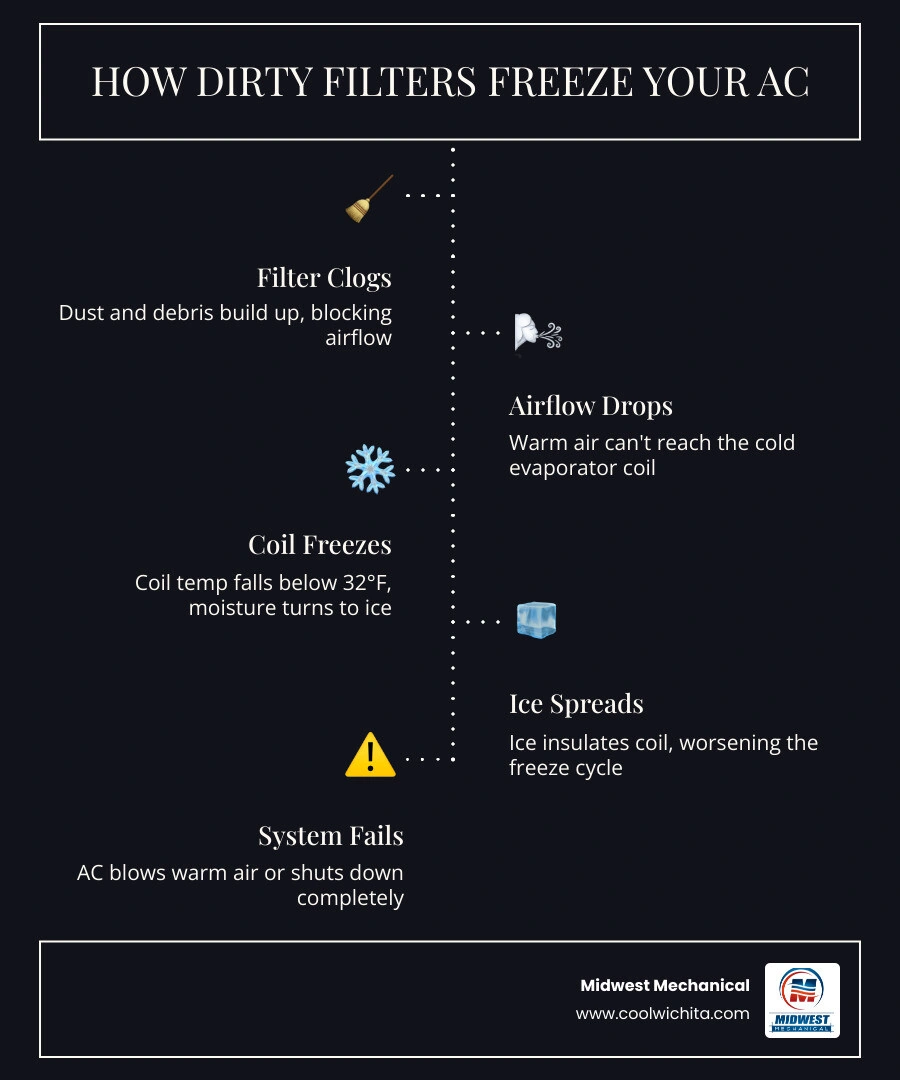
Here is the short answer:
- Filter clogs — Dust, pet dander, and debris build up on the filter over time.
- Airflow drops — The clogged filter blocks warm air from reaching the evaporator coil.
- Coil temperature falls — Without enough warm air flowing over it, the coil drops below 32°F.
- Moisture freezes — Humidity in the air condenses on the coil and turns to ice.
- Ice spreads — The ice acts as an insulator, making the problem worse fast.
- System fails — Your AC blows warm air or shuts down entirely.
In roughly 7 out of 10 service calls involving a frozen coil, a clogged air filter is the root cause — and the fix often starts with a simple filter swap.
If your AC is blowing warm air on a sweltering Wichita afternoon, or you've spotted ice on your indoor unit, a dirty filter is the first thing to check. This guide walks you through exactly how the freeze happens, how to thaw your system safely, and how to stop it from happening again.
Evaporator Coil vs. Condenser Coil: Where Does the Ice Form?
To understand why your air conditioner freezes up, it helps to know how the two main coils in your system work. Your AC doesn't actually "create" cold air; instead, it removes heat and humidity from inside your home and dumps it outside. This heat exchange process relies on two distinct coils:
- The Evaporator Coil (Indoors): Located inside your home (usually in a cabinet next to or on top of your furnace), this coil is filled with cold, low-pressure liquid refrigerant. As warm indoor air is blown across the evaporator coil, the refrigerant absorbs the heat from the air. This process also pulls moisture out of the air—much like condensation forming on a cold glass of sweet tea on a hot July afternoon.
- The Condenser Coil (Outdoors): Located in the outdoor unit, this coil receives the hot, pressurized refrigerant gas from the compressor. The outdoor fan blows air across the condenser coil to release the absorbed heat into the outside environment.
Because the indoor evaporator coil is the component that absorbs heat and condenses humidity, it is the only coil that will freeze up during summer cooling. If you notice ice forming on your outdoor unit's copper lines, it is almost always a direct result of ice that started on the indoor evaporator coil and migrated outward along the refrigerant lines.
If you want to dive deeper into why this happens, check out our guide on Ice Forming on Your AC Unit Causes and What to Do.
How Dirty Filters Cause Frozen Evaporator Coils
When your air conditioner is running normally, it requires a precise balance of refrigerant pressure and airflow. For most residential systems, this means maintaining an airflow rate of 350 to 400 cubic feet per minute (CFM) per ton of cooling capacity.
Here is the mechanical breakdown of how dirty filters cause frozen evaporator coils:

- Airflow Restriction: When your air filter is clogged with dust, pet hair, and Kansas agricultural silica, it acts as a physical barrier. The blower motor struggles to pull enough air through the dense layer of debris.
- Pressure and Temperature Drop: Because the airflow drops below the safe CFM threshold, there is not enough warm indoor air passing over the cold evaporator coil. Without this warm air to transfer heat to the refrigerant, the pressure inside the coil drops, which directly causes the refrigerant temperature to plunge well below 32°F.
- Moisture Freezes: The humidity in your home's air continues to condense on the freezing coil. Instead of dripping safely into the condensate drain pan, this moisture instantly freezes into a layer of frost.
- The Self-Feeding Freeze Cycle: Ice is an excellent thermal insulator. As a layer of ice builds up on the coil, it further blocks what little airflow remained. This causes the coil temperature to drop even lower, accelerating the ice accumulation. Within 24 to 48 hours of continuous operation with a severely clogged filter, your evaporator coil can become entirely encased in a solid block of ice holding anywhere from 5 to 20 gallons of water.
This issue not only halts your home's cooling but also places immense strain on your entire system. For a detailed look at the damage this causes, read about How Dirty Air Filters Destroy Your AC Performance.
Step-by-Step Guide to Thawing and Fixing Your AC
If you suspect your system is freezing up, you must act quickly to prevent permanent damage to your compressor.
Before you begin troubleshooting, it is helpful to understand what a healthy system looks like compared to one suffering from a frozen coil. Use this quick comparison table to identify your system's current state:
System ConditionAirflow from VentsAir TemperatureIndoor Coil AppearanceCopper Lines (Outdoors)Normal OperationStrong and steadyCool (typically 15-20°F below indoor temp)Damp, clean metal fins with light condensationCold to the touch, sweating lightlyFrozen Evaporator CoilWeak, barely noticeableWarm or lukewarmCovered in frost, ice, or completely encasedCovered in thick white ice
If your system matches the "Frozen" column, follow these steps immediately to begin Preventing AC Freezing in Wichita from turning into a major system failure.
Step 1: Shut the System Off and Run the Fan
The very first thing you must do is turn off the cooling mode at your thermostat. Do not leave the AC running hoping it will "blow through" the ice.
Set your thermostat's system switch to OFF and change the fan switch from AUTO to ON. This shuts down the outdoor compressor (stopping the freezing process) while keeping the indoor blower fan running. The fan will continuously push warm indoor air over the frozen coil, helping it thaw naturally. This process typically takes anywhere from 1 to 3 hours, though severe ice blockages can take up to 24 hours to melt completely.
To keep your system running safely, make sure you are practicing Essential Air Filter Maintenance.
Step 2: Manage the Meltwater
As those gallons of ice begin to melt, all that water has to go somewhere. Under normal conditions, condensation flows down the coil and out through the condensate drain line. However, a rapid thaw can overwhelm your drain pan, especially if the drain line is partially restricted by algae or dust.
Lay down old towels around the base of your indoor unit or furnace cabinet to catch any overflow. Keep a close eye on the drain pan to ensure water is flowing out of your home and not pooling on your floor, which can cause costly water damage to your drywall and flooring.
Step 3: Address how dirty filters cause frozen evaporator coils
While the system is thawing, locate your air filter slot and pull out the old filter. Hold it up to a light source. If you cannot see light passing through the filter, it is completely clogged and must be replaced.
Replace the dirty filter with a fresh, high-quality pleated filter. We recommend choosing a filter with a MERV rating between 8 and 11. These ratings provide an excellent balance of capturing fine dust and allergens without excessively restricting your system's airflow. Once the ice has completely melted and a fresh filter is in place, you can turn your thermostat back to COOL.
Regularly swapping your filter is one of the easiest ways to ensure your system operates at peak performance; learn more about how Air Filter Replacement Boosts Efficiency.
Preventing Future Freeze-Ups in the Wichita Climate
Living in South-Central Kansas presents unique challenges for your heating and cooling system. Our hot, humid summers demand a lot from your air conditioner, and our local environment is filled with agricultural dust, seasonal pollen, and pet dander that can quickly clog up your system.
Understanding how dirty filters cause frozen evaporator coils over time
When dust and dirt bypass a neglected or low-quality air filter, they settle directly onto the damp fins of your indoor evaporator coil. Over time, even a microscopic layer of dust — as thin as 0.02 inches — can reduce your coil's heat transfer efficiency by up to 15%.
This dust layer acts as a physical barrier, making it much harder for the refrigerant inside the coil to absorb heat from your home's air. Combined with the high static pressure caused by a dirty filter, your system has to work twice as hard to deliver half the cooling. This is why understanding the Importance of Air Filter Replacement is so critical for local homeowners and business owners.
If you want to keep your system in top shape, scheduling a professional AC Tune-Up in Derby KS or surrounding areas ensures that both your filters and coils remain clean and efficient. Keeping these components clear directly translates to better HVAC Efficiency with Quality Air Filters.
Other Common Causes of Frozen AC Coils
While a dirty filter is responsible for the vast majority of frozen coil service calls, there are several other mechanical issues that can cause the exact same symptoms:
- Low Refrigerant Levels: If your system has a refrigerant leak, the drop in pressure will cause the remaining refrigerant to run much colder than designed, freezing any moisture on the coil.
- Dirty Evaporator Coils: If dust has bypassed your filter and coated the coil itself, the lack of heat transfer will cause ice to form.
- Malfunctioning Blower Motor: If the indoor fan motor is failing or running too slowly, it won't push enough warm air over the coil, leading to a freeze.
- Collapsed or Blocked Air Ducts: Damaged ductwork or closed supply registers block the necessary airflow from returning to your system.
To make sure your system is free from these issues, refer to our comprehensive AC Tune-Up Checklist What Your Technician Should Check.
Frequently Asked Questions About Frozen AC Coils
Can I run my AC if the coils are frozen?
No. You should never run your air conditioner if the coils are frozen. Operating a frozen system puts extreme stress on your compressor—the expensive "heart" of your AC unit.
Because the coil is frozen, the refrigerant cannot evaporate into a gas and remains a liquid. If this liquid refrigerant flows back into the compressor (a problem known as "liquid slugging"), it can permanently destroy the compressor's internal valves.
How long does it take for an evaporator coil to thaw safely?
With the system turned off and the indoor fan running on "ON," a typical frozen coil will thaw safely in 1 to 3 hours. If the ice accumulation is exceptionally thick or the indoor unit is located in a cool basement, it can take up to 24 hours.
Never try to speed up the process by using a hair dryer, heat gun, or sharp tools to chip away at the ice, as you can easily puncture the delicate copper refrigerant lines or damage the aluminum fins.
How often should Kansas homeowners and business owners change their air filters?
In our local Wichita climate, we recommend checking your air filter every 30 days. For standard 1-inch pleated filters:
- Every 90 days: Standard recommendation for homes without pets or allergies.
- Every 30 to 60 days: Recommended if you have pets, suffer from seasonal allergies, or live near active construction or agricultural fields where dust levels are high.
Regular replacements do more than just prevent ice; they also Improve Indoor Air with Filter Replacement.
Keep Your Home Comfortable with Midwest Mechanical
Now that it is July 2026, keeping your home cool and safe is more important than ever. If you have followed the thawing steps, replaced your dirty filter, and find that your air conditioner is still freezing up or blowing warm air, it is time to call in the professionals.
At Midwest Mechanical, we provide expert HVAC services throughout Wichita, KS, and surrounding areas including Andover, Derby, Maize, Bel Aire, and Park City. Our experienced technicians can quickly diagnose refrigerant leaks, clean dirty coils, inspect blower motors, and get your cooling system running efficiently again.
Don't let a frozen AC ruin your summer comfort. If you need help keeping your system running smoothly, visit our Air Filter Replacement and Indoor Air Quality Services in Wichita, KS page to schedule your maintenance check today!


We have partnered with GoodLeap to offer flexible payment options for your project. GoodLeap uses a soft credit check until funding and the highest score from all 3 bureaus to see if you qualify. It also takes just a few minutes to get started.






.svg)