


Why Understanding How Electric Water Heaters Offer Simpler Installation Matters for Wichita Homeowners
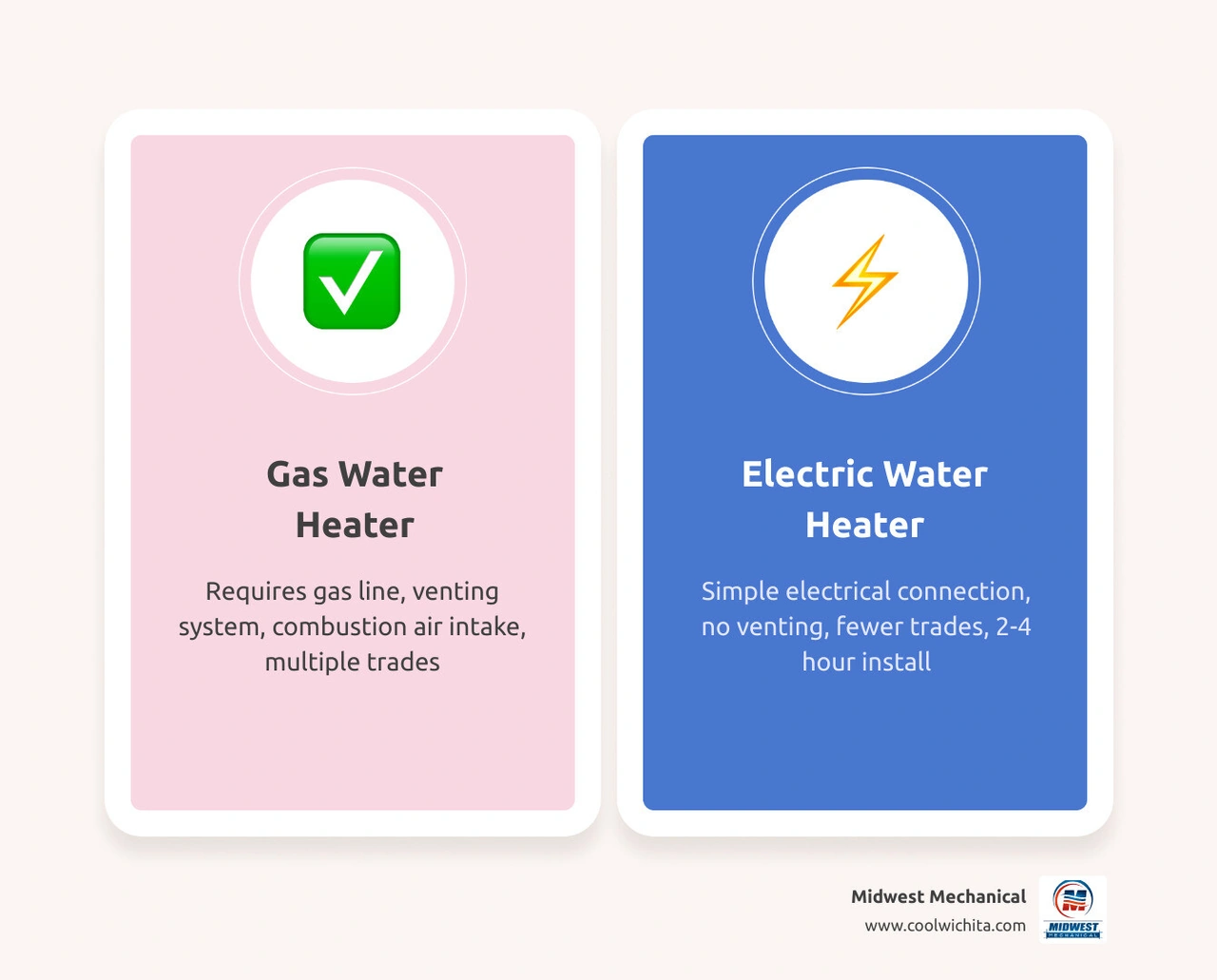
How electric water heaters offer simpler installation comes down to a few key advantages over gas models: no gas lines, no venting systems, no combustion air requirements, and a straightforward electrical connection that nearly every home already supports.
Here's a quick summary of why electric water heater installation is simpler:
- No venting required - Electric units produce no exhaust, so there is nothing to vent outside
- No gas line needed - Nearly every home is already connected to the electric grid
- Fewer trades involved - Installation typically only requires plumbing and electrical work, not gas fitting
- Faster setup - A professional can complete the job in 2 to 4 hours
- Flexible placement - Without combustion or exhaust concerns, placement options are broader
- Lower infrastructure cost - No new gas piping or exhaust system means fewer materials and less labor
Water heating accounts for roughly 12 percent of a home's total energy use — it's one of the biggest energy draws you have. When a water heater fails, the pressure to replace it quickly is real. For homeowners in Wichita and surrounding Kansas communities, that urgency makes the installation process just as important as the unit itself. A simpler install means less downtime, fewer complications, and a faster return to hot water. Electric water heaters have become an increasingly popular choice precisely because they remove several layers of complexity that come with gas-powered systems — no exhaust piping to route through walls, no combustion safety checks, and no need to tie into a gas supply line.
Whether you're replacing a failed unit or upgrading for efficiency, understanding what the installation process actually involves helps you make a confident decision.
Handy how electric water heaters offer simpler installation terms:
- choosing between gas and electric for your home
- electric on demand water heater
- gas vs electric tankless water heater differences
How Electric Water Heaters Offer Simpler Installation Compared to Gas
When evaluating a new water heater, the physical installation process plays a massive role in both the timeline of the project and the overall labor required. Gas water heaters require a complex network of utility connections. They must be connected to a natural gas or propane line, require a dedicated combustion air supply, and must be vented safely to the outdoors to prevent carbon monoxide poisoning.
Electric models bypass these issues entirely. Because they use electrical resistance elements or heat pump compressors to heat the water, they produce zero emissions. This fundamental difference eliminates the need for flues, chimneys, or specialized outdoor venting.
| Installation Step | Gas Water Heaters | Electric Water Heaters |
|---|---|---|
| Energy Source Connection | Requires gas line piping, leak testing, and shut-off valves. | Connects directly to the home's electrical panel. |
| Venting Requirements | Requires dedicated Type B vents or PVC exhaust piping to the outdoors. | No venting required; completely sealed system. |
| Combustion Air Supply | Needs minimum room volume or external air intake ducts. | No combustion air needed; safe for tight closets. |
| Safety Devices | Requires gas shut-off, sediment traps, and draft hoods. | Relies on standard electrical breakers and T&P valves. |
| Typical Installation Time | 4 to 8 hours (longer if new venting is required). | 2 to 4 hours for a professional setup. |
By eliminating the gas line, you also eliminate the need for complex pipe threading, gas leak testing, and the installation of sediment traps (drip legs) at the gas inlet. For homes in Wichita, Andover, or Derby that do not have existing natural gas service, choosing electric means you can avoid the major infrastructure projects associated with running new gas lines from the street.
Additionally, because there are no combustion processes occurring, you do not have to worry about backdrafting—a dangerous scenario where exhaust gases are pulled back into the living space by exhaust fans. This simplifies the home's overall ventilation design and offers peace of mind. For a deeper look at how these systems compare, check out our guide on Choosing Between Gas and Electric for Your Home.
Key Electrical and Plumbing Requirements for a Smooth Setup

While electric water heaters offer a much simpler installation path, they still require specific electrical and plumbing parameters to operate safely and efficiently. Understanding these requirements beforehand ensures that your home’s infrastructure is ready for the transition.
Understanding the Electrical Specifications
Standard tank-style electric water heaters are high-power appliances that operate on a dedicated electrical circuit. Unlike standard household appliances that run on 120-volt lines, a conventional electric storage water heater typically requires a 240-volt circuit.
This circuit must be protected by a dedicated 30-amp double-pole circuit breaker in your main electrical panel. To safely carry this electrical load, the system must be wired using 10-gauge solid copper wire (typically 10/2 non-metallic sheathed cable with a ground).
Before proceeding with an installation, it is essential to assess your home's electrical panel capacity. If your panel is already fully loaded, you may need to clear space or consider a subpanel. However, for homes looking to transition to tankless options, the electrical demands can be even higher. On-demand electric systems can require multiple double-pole breakers and heavier gauge wiring depending on their flow rate capacity. For more details on these high-powered systems, read our Electric On-Demand Water Heater Guide.
Essential Plumbing Connections and Code Compliance
On the plumbing side, connecting an electric water heater is highly straightforward, but local plumbing codes in communities like Park City, Maize, and Bel Aire must be strictly followed.
- Dielectric Unions: To prevent galvanic corrosion, which occurs when dissimilar metals (like copper plumbing pipes and the steel water heater tank connections) touch, installer best practices dictate the use of dielectric unions. These fittings isolate the metals electrically, extending the life of your plumbing system.
- Thermal Expansion Tank: In a closed plumbing system—which is common in homes equipped with backflow preventers or pressure-reducing valves—water expands as it heats up. This expansion can cause rapid pressure spikes that stress your pipes and appliances. Installing a thermal expansion tank on the cold water inlet side absorbs this extra volume and protects your system.
- Temperature and Pressure (T&P) Relief Valve: This is the primary safety device on any water heater. The T&P valve must have a dedicated discharge pipe that runs continuously downhill and terminates within 6 inches of the floor drain or an approved disposal point. It must never be capped, plugged, or reduced in size.
Following these core plumbing steps ensures your system remains code-compliant and safe. For a detailed breakdown of these physical connections, you can refer to our guide on Water Heater Installation Steps.
Space, Clearances, and Hybrid Heat Pump Considerations
One of the greatest benefits of electric water heaters is their flexibility in placement. Because they do not rely on combustion, they do not require a continuous supply of fresh air to feed a flame, nor do they need clearance for hot exhaust pipes.
How Electric Water Heaters Offer Simpler Installation in Tight Spaces
Standard electric resistance water heaters can be installed in tight closets, under stairwells, or in crawl spaces where a gas unit would be completely impractical due to ventilation codes. They require virtually zero clearance on the sides, though maintaining at least 6 inches of clearance is highly recommended to allow access for future servicing, such as replacing heating elements or thermostats.
When installing a water heater in an attic, closet, or any finished living space where a leak could cause property damage, a metal or heavy-duty plastic drain pan must be placed under the unit. This pan should be at least 2 inches wider than the diameter of the water heater tank and must be piped directly to an adequate drain.
Because electric tankless units are incredibly compact, they can even be mounted on walls inside utility closets or pantries, freeing up valuable floor space. You can learn more about how these spatial differences work by reading about Gas vs Electric Tankless Water Heater Differences.
Ventilation and Airflow Needs for Hybrid Heat Pump Models
If you are installing a hybrid heat pump water heater, the physical requirements change slightly. Hybrid models are incredibly efficient because they do not generate heat directly through electrical resistance; instead, they pull heat from the surrounding air and transfer it into the water tank—much like a refrigerator running in reverse.
Because they rely on ambient air heat, hybrid water heaters require:
- Adequate Air Volume: A minimum of 450 cubic feet of open airspace (roughly a 10' x 10' room with an 8-foot ceiling) to operate at peak efficiency. If installed in a smaller closet, the space must be louvered or ducted to allow proper airflow.
- Condensate Management: As the heat pump cools the surrounding air, it naturally extracts moisture, creating condensation. A dedicated PVC condensate drain line must be routed to a floor drain, or a small condensate pump must be installed to move the water outside or to a nearby sink.
- 120V Plug-in Alternatives: In 2026, many homeowners are opting for the latest 120V plug-in hybrid models. These units can plug directly into a standard, dedicated 120-volt outlet, completely avoiding the need for a 240V panel upgrade and making the transition from gas to electric incredibly simple.
For more expert advice on positioning and setting up these advanced systems, take a look at our Expert Tips for Water Heater Installation.
The Professional Installation Process and Timeline
While the simplified nature of electric water heaters makes them highly appealing, having the installation handled by a licensed professional ensures that the job is completed safely, efficiently, and in full compliance with local building codes.
Why Professional Setup Ensures Safety and Code Compliance
Working with high-voltage electricity and water connections carries inherent risks. A professional installer understands how to safely isolate the electrical supply and verify that the power is completely off using non-contact voltage testers before touching any wiring.
Furthermore, local jurisdictions like Wichita, Kechi, and Valley Center require specific plumbing permits and post-installation inspections for water heater replacements. A licensed contractor handles the entire permitting process, ensuring your home remains compliant with local safety standards.
One of the most common and costly mistakes made during self-installation is "dry-firing" the heating elements. If power is restored to the water heater before the tank is completely filled with water and all air has been purged from the plumbing lines, the upper heating element will burn out in a matter of seconds. A professional technician follows a strict sequence of steps to ensure the tank is completely full and free of air pockets before flipping the breaker. To make sure you hire the right expert for the job, read about finding a Licensed Water Heaters Contractor in Wichita KS.
Step-by-Step Timeline of a Professional Install
A standard professional electric water heater replacement is highly efficient and typically takes 2 to 4 hours to complete from start to finish. Here is what you can expect on installation day:
- Site Assessment & Safety Prep: The technician verifies the electrical panel configuration, tests the circuit to ensure it is dead, and clears a safe pathway to remove the old unit.
- Draining the Old Tank: A hose is connected to the old tank's drain valve. Draining the water completely takes roughly 30 to 45 minutes, depending on sediment buildup.
- Disconnection: The old plumbing connections and electrical lines are carefully disconnected.
- Removal & Positioning: The old unit is hauled away, and the new electric water heater is positioned inside a new drain pan, ensuring it is perfectly level.
- Plumbing Connections: The technician installs the dielectric unions, the thermal expansion tank, and connects the hot and cold water lines. The T&P relief valve discharge pipe is routed correctly.
- System Purging: The water supply is turned back on, and the hot water faucets throughout the home are opened to purge all trapped air from the system.
- Electrical Hookup: The electrical connections are made inside the junction box on top of the water heater, utilizing proper grounding and strain relief fittings.
- Testing & Walkthrough: The circuit breaker is turned on, the system is monitored for leaks, and the technician walks you through the temperature settings (ideally set to 120°F to prevent scalding).
For a comprehensive guide on what to expect during this process in the local area, refer to our Water Heater Installation Wichita Guide.
Post-Installation Maintenance and Long-Term Efficiency
Once your new electric water heater is safely installed, keeping it running at peak performance requires very little effort compared to gas units.
How Electric Water Heaters Offer Simpler Installation and Maintenance Over Time
Because electric water heaters do not have burners, gas valves, or venting systems, they have fewer moving parts that can fail over time. However, a few basic maintenance tasks will keep your system running smoothly for years:
- Annual Sediment Flushing: Over time, minerals and hard water scale can settle at the bottom of the tank, burying the lower heating element and reducing efficiency. Flushing a few gallons of water out of the drain valve annually removes this debris.
- Anode Rod Inspection: Every tank-style water heater contains a sacrificial anode rod that attracts corrosive elements in the water, protecting the steel tank from rusting. Inspecting this rod every 2 to 3 years and replacing it when the wire core is exposed can double the life of your water heater.
- T&P Valve Testing: Gently lifting the lever on the T&P relief valve once a year ensures that the valve mechanism operates freely and is not clogged by mineral deposits.
- Air Filter Cleaning: If you have a hybrid heat pump model, simply sliding out the air filter and rinsing it every 6 to 12 months keeps the compressor operating efficiently.
For residents in surrounding communities like Peck, local water conditions can impact system longevity. Check out our Water Heater Installation Peck KS Guide for more localized maintenance tips.
Maximizing Efficiency and 2026 Rebates
Standard electric resistance water heaters are incredibly efficient, boasting Energy Factor (EF) ratings higher than 0.9. This means over 90% of the energy consumed is converted directly into heat, compared to conventional gas heaters which lose significant energy through venting.
If you choose a hybrid heat pump water heater, the efficiency gains are even more substantial, often cutting water heating energy use by up to 70%.
Furthermore, in 2026, choosing an energy-efficient electric or hybrid water heater makes you eligible for significant financial incentives. Federal programs like the Inflation Reduction Act (IRA) offer substantial tax credits for qualifying heat pump water heaters. Local utility companies in the Wichita area also provide rebates to help offset the initial purchase of high-efficiency electric models. To learn more about available incentives, explore our page on Water Heater Installation Wichita KS.
Frequently Asked Questions about Electric Water Heaters
Do electric water heaters require venting?
No, electric water heaters do not require any venting. Because they do not burn fuel, they produce no combustion exhaust, carbon monoxide, or greenhouse gases. This lack of venting requirements allows for incredibly flexible placement throughout your home, including tight closets, basements, and crawl spaces. For households looking to maximize their space, this makes Professional Tankless Water Heater Replacement in Wichita KS an incredibly clean and straightforward option.
Can I install an electric water heater myself?
While some highly experienced DIYers may feel comfortable with plumbing connections, we strongly recommend professional installation. Working with 240-volt electrical circuits carries severe risk of electrical shock if not handled properly. Additionally, mistakes like dry-firing the heating elements can permanently damage your new unit instantly. Hiring a professional guarantees that the installation complies with local Kansas building codes, maintains your manufacturer's warranty, and includes proper permitting.
What is the lifespan of a modern electric water heater?
A standard tank-style electric water heater typically lasts between 10 and 12 years with proper maintenance, such as regular tank flushing and timely anode rod replacement. Electric tankless water heaters have an even longer expected lifespan, often lasting 20 years or more because they do not store water constantly, which significantly reduces the rate of tank corrosion.
Conclusion
When it comes to upgrading your home's hot water system, the simplicity of electric water heaters is hard to beat. By removing the need for gas lines, complex venting paths, and combustion air requirements, electric models provide a faster, cleaner, and more flexible installation experience. Whether you are looking to maximize space with a tankless unit or cut your energy bills with a hybrid heat pump, the transition to electric is a smart move for long-term comfort and reliability.
At Midwest Mechanical, we are dedicated to ensuring your home remains a haven of comfort. We provide expert plumbing and water heater installation services throughout Wichita, Andover, Derby, and the surrounding areas. Our team handles everything from local permitting to precise electrical hookups, ensuring your new system is set up safely and efficiently.
Ready to simplify your home comfort? Reach out to us today to explore your options on our Midwest Mechanical Water Heater Services page.
Customer Testimonials
Hear from satisfied customers who trust us for reliable HVAC and plumbing service across Wichita.





Plus, the technician, Lee was very professional, knowledgeable and informative.
We will definitely be doing business with them sometime again in the past.
I'm prompt to my appointment. Thank you Midwest Mechanical.
I'm prompt to my appointment. Thank you Midwest Mechanical.

We have partnered with GoodLeap to offer flexible payment options for your project. GoodLeap uses a soft credit check until funding and the highest score from all 3 bureaus to see if you qualify. It also takes just a few minutes to get started.




Service Areas
.svg)