


Why Getting the Right Water Heater Size Matters for Your Wichita Home
Figuring out what size water heater do I need is one of the most important decisions you'll make when replacing or upgrading your home's plumbing system. Pick one too small and you're left with cold showers mid-morning. Pick one too large and you're wasting energy heating water you never use.
The good news? You can nail the right size by following a simple, step-by-step process — and this guide walks you through exactly that.
Quick Answer: What Size Water Heater Do You Need?
| Household Size | Tank (Gas) | Tank (Electric) | Tankless (Gas GPM) |
|---|---|---|---|
| 1-2 people | 30-40 gallons | 40-50 gallons | 3-4 GPM |
| 3-4 people | 40-50 gallons | 50-65 gallons | 4-5.5 GPM |
| 5-6 people | 50-75 gallons | 65-80 gallons | 5.5-7 GPM |
| 7+ people | 75-80+ gallons | 80+ gallons | 7+ GPM |
These are starting points. Your actual answer depends on your peak hot water demand, fuel type, and — if you're going tankless — Wichita's local groundwater temperature. The five steps below give you the full picture.
Heating water accounts for roughly 18 percent of a home's total energy use, according to the Department of Energy. That means getting this decision right isn't just about comfort — it's about keeping your utility bills in check too.
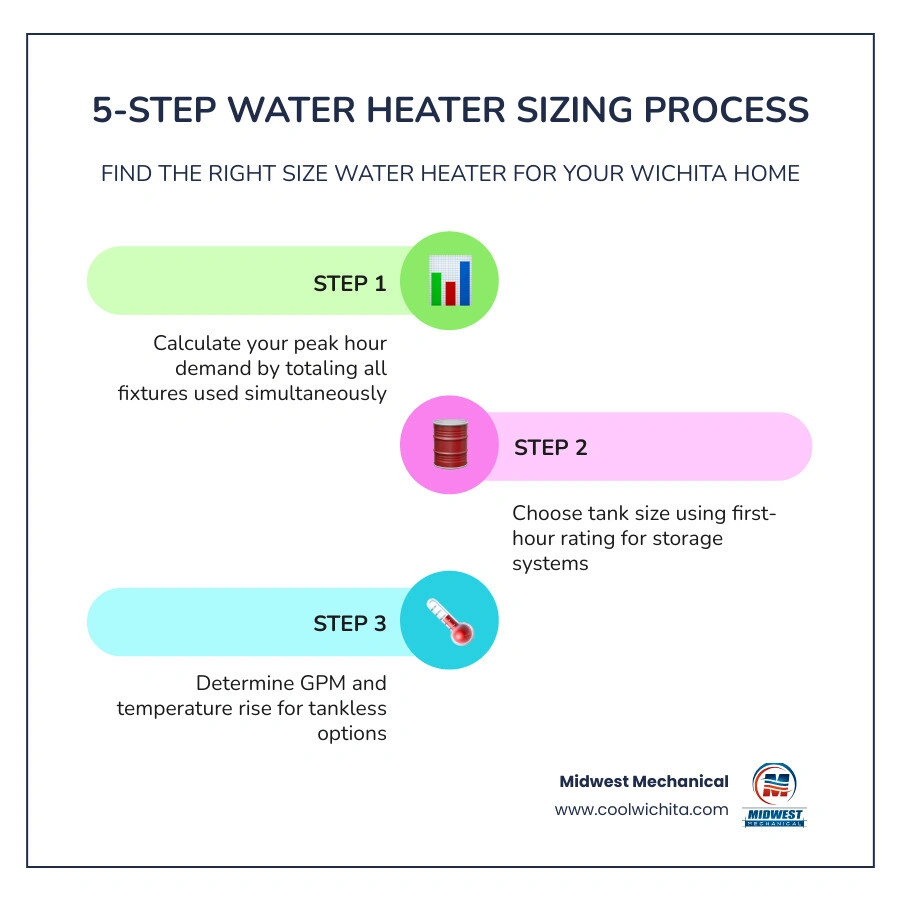
Simple what size water heater do i need glossary:
- how to choose the right water heater for your home
- tankless vs tank water heater comparison
- water heater efficiency options explained
Step 1: Understand Your Household Hot Water Demand
Before looking at different models, we must determine how much hot water your home actually uses during its busiest times. Many people assume they should size a water heater based solely on the physical size of their house or the number of bedrooms. While those factors offer general clues, they do not tell the whole story.
Instead, we look at peak hour demand. This refers to the single hour of the day when your household consumes the absolute most hot water. For most families in Wichita, Andover, and Derby, this peak occurs in the morning when multiple family members shower back-to-back, or in the evening when the dishwasher and washing machine run simultaneously.
To start mapping this out, we can use the resources in How to Calculate Your Household Hot Water Demand to get an accurate estimate of your home's unique patterns. Failing to evaluate this properly often results in buying a system that cannot keep up with your lifestyle.
Calculating Peak Hour Demand for Your Home
To calculate your peak hour demand, you do not need a degree in engineering. You simply need to look at the typical activities that happen at the same time in your home. Let's break down the typical hot water usage values for common residential activities:
- Shower: 20 gallons (assuming a standard 10-minute shower using a 2.0 to 2.5 GPM low-flow showerhead)
- Tub bath: 15 to 25 gallons
- Shaving: 2 gallons
- Hand dishwashing: 3 gallons
- Automatic dishwasher: 7 to 10 gallons per cycle
- Washing machine (top-loader): 25 gallons per load
- Washing machine (front-loader / high-efficiency): 15 gallons per load
By identifying the single busiest hour in your household, you can add up these values. For example, if your morning routine between 7:00 AM and 8:00 AM consists of three family members taking showers, one person shaving, and a quick round of hand dishwashing, your math looks like this:
- 3 showers × 20 gallons = 60 gallons
- 1 shaving session = 2 gallons
- Hand dishwashing = 3 gallons
- Total Peak Hour Demand = 65 gallons
This means you need a water heating system capable of delivering at least 65 gallons of hot water within a single hour. For more details on how usage habits shift these numbers, check out our Tips Choosing Right Water Heater Size.
Step 2: Determine What Size Water Heater Do I Need for a Tank System
Conventional storage tank water heaters remain highly popular throughout Kansas homes because they are reliable, simple, and capable of handling high simultaneous demand. When choosing a tank system, we must look beyond the physical storage capacity listed on the side of the tank.
While a tank might hold 40 or 50 gallons of water, what matters most is how much hot water that tank can deliver in its first hour of operation starting with a full tank. This is known as the First-Hour Rating (FHR). If you want to dive deeper into how storage capacities function, see our Tank Water Heater Gallon Size Guide for Homeowners.
What Size Water Heater Do I Need for a Family of 4?
For a typical family of four living in areas like Maize, Bel Aire, or Park City, hot water needs can add up quickly. A family of four might take several showers, run the dishwasher, and wash a load of laundry, easily exceeding 100 gallons of hot water across a single day.
For a family of four with two bathrooms and moderate hot water habits, we generally recommend:
- A 50-gallon gas water heater, which typically provides an FHR of 75 to 90 gallons.
- A 65-gallon electric water heater, which compensates for the slower heating recovery of electric elements.
If your family has teenagers who take exceptionally long showers, or if you have a large soaking tub, you might want to step up to a 65-gallon or 75-gallon gas unit to ensure you never run out. You can compare these different options directly by reading What Size Water Heater Does Your Home Need.
First-Hour Rating (FHR) Explained
The First-Hour Rating (FHR) is the key metric for sizing storage water heaters. This rating represents the total amount of hot water the unit can supply in one hour when starting with a fully heated tank. You can find this number clearly printed on the yellow and black EnergyGuide label on any new water heater.
FHR is calculated using a simple formula:
The tank capacity is multiplied by 0.70 because as cold water enters the bottom of the tank to replace the hot water being drawn out, it eventually dilutes the remaining hot water, making about 30% of the tank's volume unusable at the target temperature during continuous draw. The recovery rate is the number of gallons the burner or heating elements can heat back up to temperature in one hour.
Because gas burners heat water much faster than electric resistance elements, a 40-gallon gas water heater can have a higher FHR than a 50-gallon electric water heater. When shopping for a new system, always choose a model with an FHR that is equal to or greater than your calculated peak hour demand. Learn more about matching these ratings to your home in Choose the Right Water Heater for Your Home.
Step 3: Calculate Flow Rate and Temperature Rise for Tankless Systems
Tankless water heaters, also known as demand-type or on-demand water heaters, do not store hot water. Instead, they heat water instantly as it flows through the unit. Because there is no tank to empty, they can theoretically provide an endless supply of hot water.
However, tankless systems have a different limitation: they can only produce a certain amount of hot water at any given moment. To size a tankless system correctly, we must calculate two main factors: flow rate in Gallons Per Minute (GPM) and required temperature rise. You can read a thorough breakdown of how this compares to traditional systems in our Tankless vs Tank Water Heater Comparison.
What Size Water Heater Do I Need for Tankless On-Demand Flow?
To determine the required flow rate for a tankless system, we look at the maximum number of hot water fixtures you expect to run at the exact same time.
First, list the GPM requirements of your fixtures:
- Low-flow showerhead: 1.5 to 2.0 GPM
- Standard showerhead: 2.5 GPM
- Bathroom faucet: 0.5 to 1.5 GPM
- Kitchen faucet: 1.0 to 2.2 GPM
- Dishwasher: 1.0 to 2.0 GPM
- Washing machine: 2.0 to 3.0 GPM
If you want to be able to run two showers (2.5 GPM each) and the kitchen sink (1.5 GPM) at the same time, your required flow rate is:
Your tankless water heater must be able to deliver at least 6.5 GPM. For more on selecting the right GPM capacity for your home, see our Water Heater Buying Guide for Kansas Homes.
Calculating Temperature Rise in Wichita
The second half of the tankless equation is temperature rise. This is the difference between the temperature of the cold water entering your home and your desired hot water output temperature (typically set to 120°F).
In the Wichita area, including surrounding communities like Valley Center, Kechi, and Mulvane, the average winter groundwater temperature is approximately 57°F.
To reach a comfortable output temperature of 120°F, we calculate the required temperature rise as follows:
This means your tankless water heater must be rated to deliver your required GPM at a 63°F temperature rise. If a manufacturer's brochure says a unit can deliver 7.0 GPM, but that rating is based on a mild southern climate with 70°F groundwater (requiring only a 50°F rise), that same unit will deliver significantly less hot water during a cold Kansas winter.
We always recommend sizing your system using local winter temperatures to prevent lukewarm showers when the weather gets cold. Discover more about how local factors influence your choice in Different Types of Water Heaters for Home.
Step 4: Factor in Climate, Fuel Types, and Recovery Rates
Your choice of fuel type — natural gas, propane, or electricity — plays a massive role in how your water heater performs. The fuel type determines the unit's recovery rate, which is how quickly it can heat cold water back up to your target temperature.
- Gas Water Heaters (Natural Gas or Propane): Gas burners deliver a massive amount of heat quickly. A typical residential gas water heater can recover between 35 and 50 gallons of hot water per hour. This rapid recovery means gas tank systems can be slightly smaller than electric ones while meeting the same household demand.
- Electric Resistance Water Heaters: Conventional electric water heaters rely on upper and lower heating elements inside the tank. They recover much slower, typically heating only 20 to 25 gallons of water per hour. Because of this slow recovery, we often recommend stepping up to a larger tank size (such as a 50-gallon or 65-gallon tank instead of a 40-gallon tank) to ensure you have enough stored hot water to get through peak usage periods.
Additionally, gas water heaters generally cost less to run than conventional electric resistance models, making them a popular choice for homes with existing gas lines. To help weigh these factors for your home, check out How to Know Which Type of Water Heater is Best.
Step 5: Choose the Right Technology for Your Home
Now that you understand your peak demand, FHR, flow rates, and fuel recovery speeds, you can compare the primary water heating technologies available for your Kansas home.
| Feature | Storage Tank (Gas/Electric) | Tankless (On-Demand) | Heat Pump / Hybrid |
|---|---|---|---|
| Upfront Equipment Cost | Low to Moderate | Moderate to High | Moderate to High |
| Lifespan | 8 to 12 years | 15 to 20+ years | 10 to 15 years |
| Space Required | High (takes up floor space) | Very Low (wall-mounted) | High (needs air volume) |
| Energy Efficiency | Standard | High (up to 30% savings) | Extremely High (up to 70% savings) |
| Standby Heat Loss | Yes | No | Yes |
To maximize your long-term energy savings and find the perfect balance for your home, we encourage you to read our detailed guide on Water Heater Efficiency Options Explained.
Heat Pump and Hybrid Water Heaters
If you have an all-electric home and want to lower your energy bills, a heat pump water heater (also known as a hybrid water heater) is an option worth serious consideration. Instead of generating heat directly through electric resistance, these advanced systems pull heat out of the surrounding air and transfer it into the water tank.
According to the Department of Energy, heat pump water heaters are two to four times more energy-efficient than conventional electric water heaters.
However, they do have specific installation requirements:
- Air Volume: They require at least 700 to 1,000 cubic feet of unconditioned surrounding space (such as an unfinished basement or utility room) to capture enough heat from the air.
- Cooling Effect: Because they exhaust cool air, they can slightly cool down the room they are installed in.
- Slower Recovery: In pure heat pump mode, they recover slower than gas units. However, hybrid models can temporarily switch to standard electric resistance elements when hot water demand is exceptionally high.
Frequently Asked Questions About Water Heater Sizing
What is the difference between a 40-gallon and a 50-gallon water heater?
While the physical storage difference is only 10 gallons, the real-world performance difference comes down to the First-Hour Rating (FHR). A 50-gallon gas water heater can deliver significantly more hot water during your peak usage hour than a 40-gallon unit. If you have a small household of 1 to 2 people, a 40-gallon tank is usually plenty. For a growing family or homes with 2 or more bathrooms, upgrading to a 50-gallon tank provides a safety margin so you don't run out of hot water during back-to-back showers.
Why does my water heater run out of hot water so quickly?
If your water heater suddenly stops providing enough hot water, it could be due to several common issues:
- Undersized Unit: Your household's demand may have grown beyond the capacity of your current unit.
- Broken Dip Tube: The dip tube directs cold incoming water to the bottom of the tank to be heated. If it cracks or breaks, cold water mixes with hot water at the top of the tank, sending lukewarm water to your fixtures.
- Failed Heating Element: In electric water heaters, if the upper or lower heating element burns out, the unit's recovery rate drops by half.
- Sediment Buildup: Over time, minerals in our local Kansas water settle at the bottom of the tank, creating an insulating layer that prevents the burner or element from heating the water efficiently.
How does cold weather affect my tankless water heater's performance?
During winter in South-Central Kansas, groundwater temperatures drop. When incoming water is colder, your tankless water heater has to work much harder to heat that water up to 120°F. Because it takes more energy to achieve this higher temperature rise, the system automatically slows down the water flow rate (GPM) to ensure the water stays hot. If your tankless system is undersized, you may notice lower water pressure or lukewarm water when running multiple hot water fixtures simultaneously in the winter.
Conclusion
Sizing a water heater correctly requires balancing your household's peak demand with local ground temperatures and fuel recovery rates. When you take the time to calculate your actual hot water needs, you ensure your home stays comfortable and energy-efficient for years to come.
If you are ready to upgrade your system or need help determining the perfect setup for your home, our team at Midwest Mechanical is here to help. We provide professional plumbing services across Wichita, Andover, Derby, Haysville, Park City, Maize, and Bel Aire.
Let us help you find the ideal solution for your home's hot water needs. To schedule an appointment or speak with one of our local experts, visit our Midwest Mechanical Water Heaters Service Page.
Customer Testimonials
Hear from satisfied customers who trust us for reliable HVAC and plumbing service across Wichita.





Plus, the technician, Lee was very professional, knowledgeable and informative.
We will definitely be doing business with them sometime again in the past.
I'm prompt to my appointment. Thank you Midwest Mechanical.
I'm prompt to my appointment. Thank you Midwest Mechanical.

We have partnered with GoodLeap to offer flexible payment options for your project. GoodLeap uses a soft credit check until funding and the highest score from all 3 bureaus to see if you qualify. It also takes just a few minutes to get started.




Service Areas
.svg)