


The Sudden Musty Odor: What Happens When the Heat First Kicks On
September is finally here in the Midwest, and as the morning air takes on that unmistakable early fall chill, your main concern shouldn't be mold in your ductwork: identifying the musty smell when the heat turns on is a necessary step for many homeowners firing up their systems for the first time. Here at Midwest Mechanical, we frequently hear from customers who walk over to the thermostat, switch it from cooling to heating, and wait for that comforting rush of warm air during their September first-furnace-run. But within minutes, instead of cozy warmth, their home is filled with a sudden, overwhelming blast of damp, stale air that smells like a wet basement or a pile of old gym socks.
That immediate alarm is entirely understandable. When a foul odor blasts out of your vents, it is natural to assume the worst about the air you are breathing. You are suddenly faced with an important decision: is this just a harmless, temporary seasonal quirk that will fade away, or is it a sign of active microbial growth that requires professional attention?
Many homeowners panic, assuming their entire ventilation system is compromised. The truth is usually highly localized, but it still requires action. When you prioritize your home's indoor air quality and stay ahead of the curve with a proactive HVAC maintenance plan, you can prevent these seasonal surprises entirely. Understanding exactly what happens inside your heating and cooling equipment during this critical early fall transition is the first step toward clearing the air.
The Real Culprit: Evaporator Coil Pans vs. Mold in Your Ductwork: Identifying the Musty Smell When the Heat Turns On
In our years of servicing Wichita area homes, the Midwest Mechanical team frequently sees customers immediately suspect deep duct mold when they smell a musty odor. It makes logical sense—the smell is blowing out of the vents, so the problem must be growing inside the vents, right? However, this is one of the most common misconceptions we encounter in residential heating and cooling.
The Anatomy of the Odor
The true source of that damp, earthy smell is almost always the air conditioning evaporator coil and its attached condensate drain pan. To understand why, you have to look at how your HVAC system is built. The evaporator coil sits inside your indoor air handler or furnace plenum. It acts as the gateway for your home's airflow. Whether you are running the air conditioner or the heater, all the air circulated by the blower fan passes directly over this coil before it ever reaches your ductwork.
Dirty Sock Syndrome Explained
If there is any biological growth, standing water, or bacterial buildup on the coil or in the drain pan beneath it, the resulting odors are immediately picked up by the rushing air and blown through the entire duct system. The ductwork itself is usually clean metal or flexible tubing; it is simply acting as the delivery method for the smell, not the source.
The HVAC industry actually has a specific term for this phenomenon: "Dirty Sock Syndrome." It refers to the specific microbial growth that thrives on indoor coils and drain pans during the transition periods between cooling and heating. Identifying the musty smell when the heat turns on means recognizing that the issue is centralized at the coil, not spread across dozens of feet of hidden ductwork.
How Late Summer Humidity Fuels 'Dirty Sock Syndrome'
As local HVAC professionals, we always tell our customers that to understand why your furnace smells bad in the fall, you have to look backward at what your air conditioner was doing at the end of the summer. The transition from cooling to heating is a physical and mechanical shift that creates the perfect storm for bacterial growth.
The Late Summer Moisture Trap
Our technicians know firsthand that during August and early September, Wichita's specific late-summer humidity often exceeds 65%. To keep your home comfortable, your air conditioner doesn't just cool the air; it acts as a massive dehumidifier. It extracts gallons of moisture from your indoor air every single day. This condensation drips off the cold evaporator coil and pools into the condensate drain pan beneath it, where it is supposed to flow outside through a drain line.
The September Stagnation
As the weather begins to cool in September, you naturally turn your air conditioner off. However, the inside of your air handler is still a dark, enclosed box. If the drain pan doesn't empty completely, or if the coil remains wet, that stagnant water just sits there. Without the constant flow of cold air to suppress it, the warm, dark, and damp environment becomes a perfect breeding ground for bacteria and mildew.
The First Furnace Cycle
When that chilly September first-furnace-run finally happens, the heat exchanger kicks on and the blower fan ramps up. The sudden introduction of heat bakes the damp, bacteria-laden coil, instantly vaporizing those odors and pushing them straight into your living space. This trapped, stagnant moisture is one of the primary causes of foul AC odors that stubbornly carry over into the heating season, catching homeowners completely off guard.
Burning Dust vs. Musty Mildew: Diagnosing the Scent
Not every smell that comes from your furnace in the fall is a sign of microbial growth. In fact, there is a very common, entirely normal odor that happens during the first heating cycle of the year. At Midwest Mechanical, we believe helping Wichita area homes differentiate between a normal seasonal transition and a diagnostic issue is crucial for peace of mind.
The "Burning Dust" Phenomenon
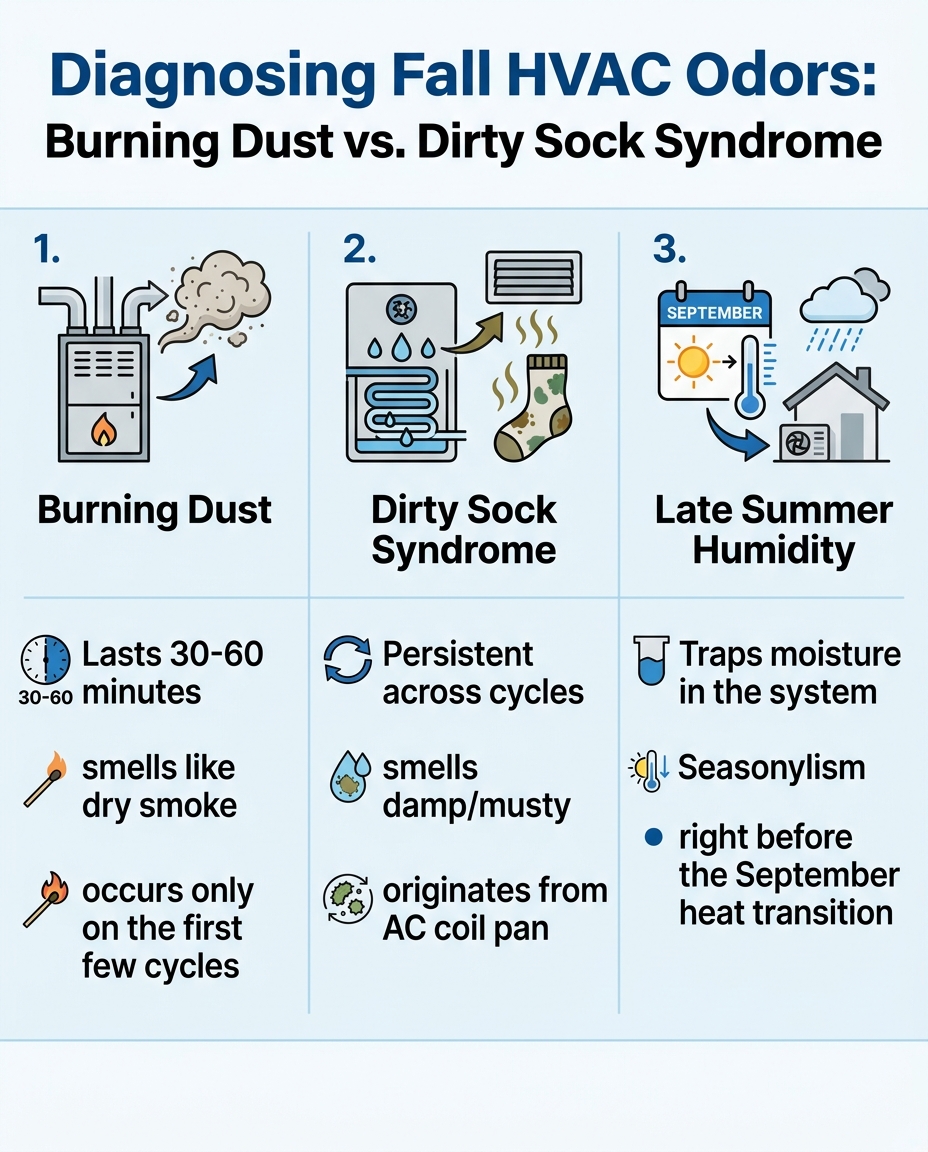
Over the long summer months, while your furnace sits idle, fine dust particles naturally settle on the heat exchangers and burners. When you turn the heat on for the first time, these settled dust particles get roasted. This produces a distinct, smoky, "burning dust" odor. It might smell slightly like a space heater or a hot clothes iron. This is a completely normal part of the seasonal transition. The dust burn-off smell typically dissipates within 30 to 60 minutes as the system clears itself out.
The "Dirty Sock" Mildew Smell
In contrast, a musty, mildew-like odor is not normal. It smells damp, stale, and earthy. Unlike burning dust, which fades quickly, the dirty sock smell is persistent. It will often return every single time the blower fan kicks on, lingering across multiple heating cycles.
Here is a simple rule of thumb our team uses: If the smell is smoky and disappears within an hour, it is just dust. If the smell is damp, reminds you of a wet towel, and persists for days, you are dealing with trapped moisture and bacterial growth that requires intervention.

The Risks of Ignoring Stagnant Condensation
Hoping a musty smell will just go away on its own is a risky strategy. When you ignore the signs of a fouled evaporator coil and a blocked drain pan, you open your home up to a cascade of secondary problems that go far beyond a bad odor during your September first-furnace-run.
Compromised Indoor Air Quality
The most immediate impact is on the air you breathe. Every time the blower fan engages, it forces air directly over the contaminated coil. This action picks up microscopic spores and bacteria, distributing them through the vents and into your bedrooms, living room, and kitchen. During the fall and winter months, when windows are closed tight to keep the cold out, this continuous circulation of poor-quality air can become highly irritating, especially for those sensitive to dust and allergens.
Hidden Water Damage
If the musty smell is caused by a clogged condensate pan that isn't draining, that standing water has to go somewhere. Eventually, a blocked pan will overflow. This water can spill down into the furnace cabinet, rusting out the heat exchangers, or leak out of the bottom of the unit, causing severe water damage to your surrounding flooring, drywall, or ceiling if the unit is located in an attic.
Reduced System Efficiency
A coil that is caked with biological growth and debris cannot transfer heat effectively. It physically restricts the airflow passing through the system. This restriction forces your heating services to work much harder to push warm air into your home. When your system works harder, it runs longer cycles, experiences more mechanical wear and tear, and ultimately reduces the overall efficiency of your equipment.
Why Evaporator Coil Sanitization is Not a DIY Project
When Wichita area homes develop a musty smell, we often see ambitious homeowners head to the hardware store looking for a quick fix. However, attempting to clean an evaporator coil yourself is highly discouraged and can lead to dangerous consequences. The coil is not designed for easy consumer access; it is sealed tightly inside the plenum or air handler, often requiring specialized tools and training to open without damaging the delicate casing.
Here is what our technicians recommend you should absolutely avoid doing if you suspect you have Dirty Sock Syndrome:
1. Do not use household bleach: Pouring bleach into your HVAC system is incredibly destructive. Bleach is highly corrosive to the delicate, thin aluminum fins of the evaporator coil. It can rapidly eat through the metal, causing catastrophic and irreversible refrigerant leaks.
2. Do not cut into the ductwork: Trying to pry open sealed panels or cut into the sheet metal to reach the coil can permanently ruin the static pressure of your system. Improper reassembly leads to massive air leaks, and if your system shares a blower with a gas furnace, a botched reassembly can create severe carbon monoxide risks by altering the system's draft.
3. Do not spray air fresheners into the intake: Blindly spraying aerosols or perfumes into your return vents only masks the odor temporarily. Worse, it introduces volatile organic compounds (VOCs) into your airstream and leaves a sticky residue on the coil that actually attracts more dust and bacteria over time.
The Environmental Protection Agency (EPA) strictly recommends moisture control and professional cleaning as the only safe, effective methods for managing biological pollutants in residential HVAC systems.
Professional Solutions for a Fresh-Smelling Fall Transition
Resolving a musty HVAC odor requires a precise, methodical approach. When you bring in a professional to address that September first-furnace-run smell, they follow a strict protocol to ensure your system is sanitized, safe, and ready for the winter workload.
Working with our NATE-certified local experts at Midwest Mechanical means you are getting technicians who have the specialized training to safely access the sealed evaporator coil without voiding your manufacturer warranties. Here is what our professional sanitization process looks like:
• Coil Access and Inspection: The technician carefully removes the access panels to expose the A-coil, inspecting the delicate aluminum fins for biological growth, dirt buildup, and corrosion.
• Non-Corrosive Foaming Cleaners: Instead of harsh chemicals, professionals use specialized, expanding foaming cleaners. These cleaners push deep into the dense fins to lift out dirt, bacteria, and microbial growth without damaging the metal.
• Drain Line Flushing: The stagnant water has to be removed. The technician will flush and clear the condensate drain line to ensure no standing water remains from the air conditioning system. During a routine early-fall service call last year, one of our Midwest Mechanical technicians found a completely clogged condensation pipe for a customer's AC unit. By diagnosing the issue and unclogging the pipe quickly, the customer avoided a major overflow and a foul-smelling transition into fall—getting great value out of a simple maintenance visit.
• Biocide Treatments: Once clean, an EPA-registered biocide treatment is often applied to the drip pan. These treatments are designed specifically for HVAC systems to actively prevent future growth as the seasons change.
• Comprehensive Tune-Up: Finally, the system is fully reassembled, sealed, and tested to ensure both the cooling and heating components are operating cleanly and safely.
Frequently Asked Questions About Fall HVAC Odors
Why does my house smell musty when the heat comes on?
It is usually caused by stagnant summer condensation left in the AC evaporator coil pan getting baked into the airstream. When the heat kicks on for the first time, it warms up this damp, dark environment, pushing the smell of mildew and bacteria through your vents. It rarely means you have mold growing throughout your entire ductwork system.
Is it normal for a heater to smell musty?
A burning dust smell is normal for the first cycle, but a damp, musty odor indicates trapped moisture and is not normal. The smoky dust smell should fade within an hour of running the furnace. If the smell is earthy, resembles dirty socks, and persists across multiple days, you have an underlying moisture issue in the air handler.
How do I get rid of the musty smell in my heating vents?
The source must be treated at the evaporator coil and drain pan by a professional, as the smell is rarely localized to the vents themselves. Cleaning the vent covers will not solve the problem. A licensed technician must access the sealed indoor unit, apply specialized foaming cleaners to the coil, and clear the condensate drain to permanently remove the odor.
How do I know if my furnace smell is dangerous?
While dirty sock syndrome is primarily a nuisance, persistent mold spores can irritate allergies, and any smell of rotten eggs or electrical burning requires immediate emergency service. A musty smell in Wichita area homes indicates poor indoor air quality but isn't usually an immediate safety hazard. However, as our emergency dispatch team always advises, if you ever smell gas, sulfur, or melting plastic, shut the system down and call a professional immediately.
Can changing my air filter stop the musty smell?
A clean filter improves airflow and captures some particles, but it cannot eliminate the source of the odor if mold is growing in the coil pan. The filter sits before the blower and the coil in the airstream, meaning it cannot catch odors generated after the air passes through it. While changing your filter is crucial for maintenance, it will not cure Dirty Sock Syndrome.
Clear the Air for a Comfortable Heating Season
Our team wants you to know that a sudden musty smell during your September first-furnace-run is a clear signal of lingering summer moisture, not necessarily a ruined duct system. By understanding that the evaporator coil and drain pan are the true culprits, you can stop worrying about widespread duct contamination and focus on the real solution.
There is immense peace of mind that comes with knowing your system is clean, professionally sanitized, and operating safely. Don't let a foul odor ruin the comfort of your home as the temperatures drop. Before the deep winter cold sets in and your furnace is running around the clock, take action to resolve stagnant moisture issues. The best way to prevent mold in your ductwork: identifying the musty smell when the heat turns on is to schedule a thorough inspection with Midwest Mechanical and enroll in a proactive HVAC maintenance plan today.
Customer Testimonials
Hear from satisfied customers who trust us for reliable HVAC and plumbing service across Wichita.





Plus, the technician, Lee was very professional, knowledgeable and informative.
We will definitely be doing business with them sometime again in the past.
I'm prompt to my appointment. Thank you Midwest Mechanical.
I'm prompt to my appointment. Thank you Midwest Mechanical.

We have partnered with GoodLeap to offer flexible payment options for your project. GoodLeap uses a soft credit check until funding and the highest score from all 3 bureaus to see if you qualify. It also takes just a few minutes to get started.




Service Areas
.svg)