


The Frustration of a Furnace That Sparks But Stays Cold
As the early fall pre-heating-season arrives in Wichita, encountering gas valve issues: when the furnace sparks but won't light is one of the most frustrating ways to start your seasonal test run. You turn up the thermostat as the evening temperatures begin to drop, expecting the familiar whoosh of warm air. Instead, you hear the inducer motor hum, followed by a rapid, endless clicking sound from the ignition system. The furnace is trying its hardest to start, but the heat never arrives.
This specific scenario forces a critical decision point for homeowners: trying to determine if the issue lies with a failing ignitor module that cannot quite finish the job, or a stuck gas valve assembly that is refusing to release fuel. While the endless clicking might sound alarming, hearing that spark is actually a highly helpful diagnostic clue. It immediately rules out several upstream communication errors and narrows down exactly where the sequence is failing.
Resolving this precise intersection of electrical spark and combustible fuel is not a matter of simply resetting a breaker. It requires professional heating services to safely evaluate the fuel delivery system, and it highlights exactly why a comprehensive preventative heating maintenance plan is so vital before the deep winter freeze sets in.
Understanding Your Furnace's Ignition Sequence of Operation
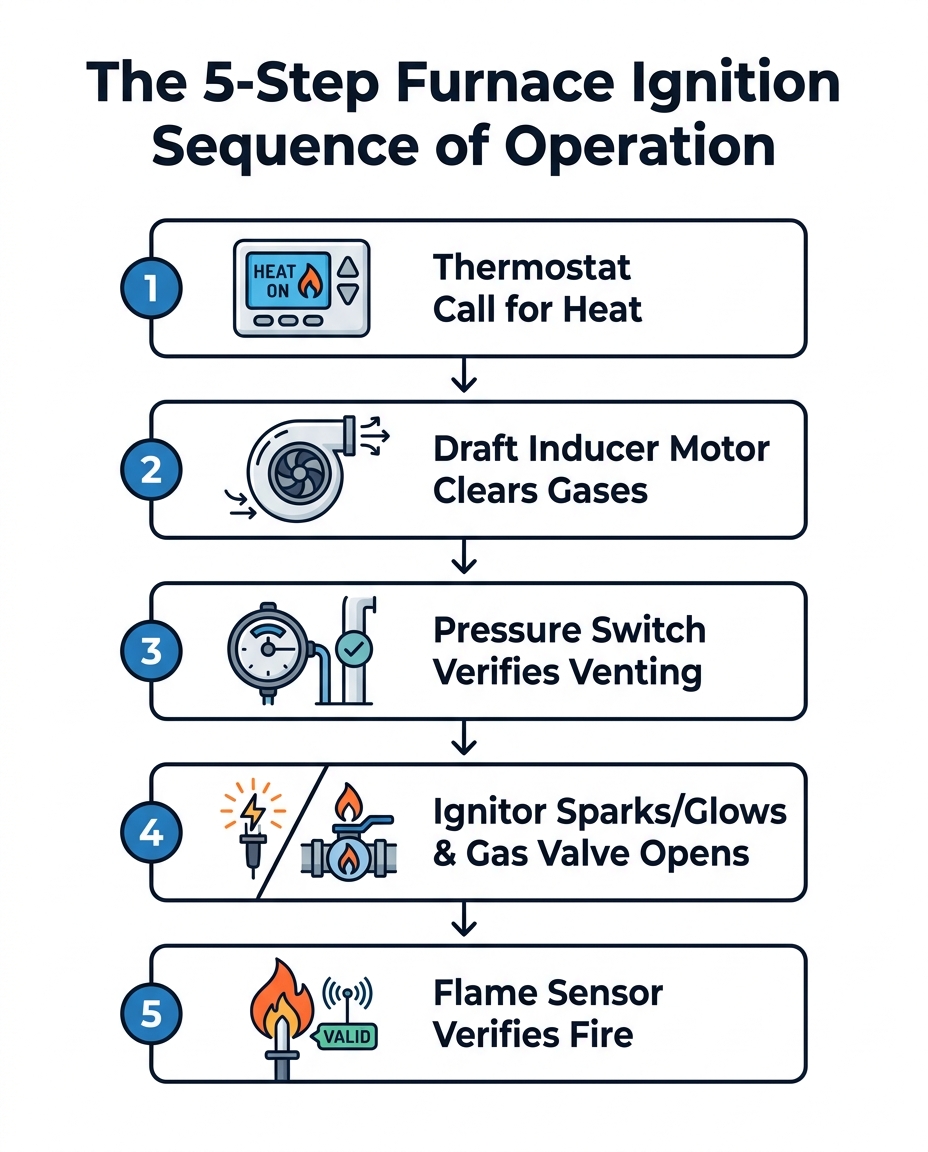
To understand why your furnace is sparking without producing a flame, it helps to know exactly what is happening inside the cabinet. Modern furnaces do not just turn on all at once; they follow a strict, sequential checklist designed to ensure safe operation. If any single step fails, the entire process halts.
1. Step 1: The Thermostat Call for Heat. When the temperature in your Wichita home drops below your set point, the thermostat sends a low-voltage electrical signal to the furnace control board, requesting heat.
2. Step 2: The Draft Inducer Motor Starts. Before any sparks or gas are introduced, the control board turns on the draft inducer motor. This small fan pulls air through the heat exchanger to clear out any residual, potentially dangerous gases leftover from the previous heating cycle.
3. Step 3: The Pressure Switch Verifies Venting. As the inducer motor runs, it creates negative pressure. A mechanical pressure switch detects this draft to verify that the exhaust flue is completely clear of blockages (like bird nests or debris). Once verified, it signals the board to proceed.
4. Step 4: The Ignitor Activates and Gas Valve Opens. The control board sends voltage to the ignition system (either a hot surface ignitor that glows bright orange or a direct spark ignitor that clicks). Simultaneously, the board sends a 24-volt signal to the gas valve, commanding it to open and release fuel over the active ignitor.
5. Step 5: The Flame Sensor Verifies Fire. Once the gas ignites, a small metal rod called a flame sensor detects the presence of the fire. If the flame is strong and steady, the sensor tells the control board to keep the gas flowing and turns on the main blower motor to distribute warm air throughout your home.

Is It the Ignitor Module or the Gas Valve Assembly?
When a furnace stalls at the fourth step of the ignition sequence, the primary suspects are the ignitor module and the gas valve assembly. Building an understanding of how these two components interact is crucial for accurate troubleshooting during the early fall pre-heating-season.
If you stand near the furnace and hear a distinct, rapid clicking sound—or if you can look through the sight glass and see a bright blue spark or a glowing orange element—the control board and the ignitor are likely doing their jobs correctly. The electrical command is reaching the ignition source.
This scenario heavily contrasts with diagnosing a bad ignitor. When an ignitor fails, the spark is either entirely absent, or a hot surface ignitor fails to reach the necessary temperature to ignite the gas. In those cases, the fuel might be present, but there is no heat source to light it.
However, when the spark is clearly present and firing vigorously, but absolutely no flame appears, the diagnostic focus immediately shifts away from the electrical spark and toward the fuel source: the gas valve. The technical handoff between the spark and the fuel is the most critical fraction of a second in the entire sequence of operation. If the valve fails to open, the spark has nothing to ignite.
• Visual Evidence — Failing Ignitor Module: No spark visible, or element fails to glow brightly. — Stuck Gas Valve Assembly: Strong spark or bright glow is clearly visible.
• Audible Evidence — Failing Ignitor Module: No clicking sound, just the hum of the inducer motor. — Stuck Gas Valve Assembly: Rapid clicking sound, followed by silence.
• System Response — Failing Ignitor Module: Furnace aborts the cycle before releasing any gas. — Stuck Gas Valve Assembly: Furnace attempts to light multiple times, then locks out.
• Primary Cause — Failing Ignitor Module: Cracked element, electrical failure, or bad control board. — Stuck Gas Valve Assembly: Seized internal mechanics, bad solenoid, or blocked fuel line.
Why Gas Valves Stick After Summer Dormancy
Gas valves are not just simple open-and-shut pipes; they are complex mechanical components with internal solenoids, springs, and diaphragms. Like any mechanical device, they are highly susceptible to seizing or sticking after sitting completely idle for months on end.
During the first early fall test run of the season, a dormant gas valve may receive the correct 24-volt electrical signal from the control board, commanding it to open. However, because the internal mechanisms have been sitting motionless through the humid summer months, the valve may physically fail to move. The electrical command is there, but the mechanical action fails.
Other potential causes for a valve failing to open include a degraded wire connection between the control board and the valve assembly, or a failing control board that is sending weak or incorrect voltage. Catching a stuck valve early in September is absolutely critical. Wichita experiences rapid temperature drops in late fall, making it vital to identify stuck valves and dormant system failures before the harsh winter wind chills set in and create an emergency no-heat situation.
The Role of the Solenoid
Inside the gas valve assembly sits an electromagnetic component known as a solenoid. When the control board sends voltage to the valve, that electricity energizes the solenoid coil, creating a magnetic field that lifts a small metal plunger, allowing gas to flow into the burner manifold.
Over time, dust infiltration, lack of use, or general mechanical wear can cause this plunger to stick in the closed position. The coil may energize perfectly, but if the mechanical friction is too high after a long summer dormancy, the solenoid simply cannot lift the plunger. The result is a healthy spark, but zero fuel.
The Safety Lockout Mode: Protecting Your Home from Raw Gas
If you have been listening to your furnace attempt to start, you have likely noticed a pattern: it clicks for a few seconds, stops, waits, and then tries again. After a few attempts, the entire system shuts down completely and refuses to respond to the thermostat. This can feel like a massive system failure, but it is actually a highly engineered safety protocol.
Modern furnaces are designed in accordance with strict safety protocols (such as ASHRAE standards) to prevent the dangerous buildup of raw, unburned gas inside your home. If the control board signals the gas valve to open, but the flame sensor does not detect a fire within approximately three to four seconds, the system immediately cuts the voltage to the valve, snapping it shut.
The sequence of a safety lockout generally follows this pattern:
• Attempt 1: The system sparks, opens the valve, and checks for a flame. If no flame is detected, it shuts down and purges the heat exchanger.
• Attempt 2: After a short delay, the system tries the exact same sequence again.
• Attempt 3: If the third attempt fails, the control board registers a critical fault.
• Hard Lockout: The furnace disables the ignition sequence entirely for a set period (often one to three hours) or until the power is manually reset.
A hard lockout during your early fall pre-heating-season test is not a malfunction. It is a critical safety feature working exactly as intended to protect your property from explosive fuel accumulation.
The Dangers of DIY Gas Valve Diagnostics
When homeowners encounter a furnace that sparks but will not light, a quick internet search often yields tutorials suggesting the use of a multimeter to test the voltage at the gas valve terminals. While understanding the theory behind this is helpful, physically attempting these diagnostics is highly dangerous.
Interacting directly with explosive fuel components requires specific training. An improper repair, a slipped tool, or a diagnostic attempt that misaligns the valve body can easily lead to undetectable, slow gas leaks inside the home. Furthermore, diagnosing whether the issue is the control board failing to send the correct voltage, or the valve's internal mechanics failing to respond to that voltage, requires specialized diagnostic tools that go beyond a standard home toolkit.
In one instance, a Wichita homeowner experiencing winter furnace issues recognized they were not handy with mechanical systems and opted to call for professional help rather than attempting a DIY fix. A technician quickly arrived, assessed the gas and ignition problem safely, and explained the necessary repair process, resulting in a fully restored, safe heating system.
Working with NATE-certified technicians means your system is being evaluated by professionals who have passed rigorous, real-world exams specifically testing their knowledge of gas flow, electrical diagnostics, and combustion safety. The safest and most effective next step when a stuck valve is suspected is to contact a heating technician to evaluate the equipment without putting your home at risk.
Proactive Steps to Prevent Ignition Failures
The best way to avoid the stress of a stuck gas valve or a failing ignitor on a freezing night is to prevent the issue from occurring in the first place. A thorough pre-season inspection during the early fall pre-heating-season is the most effective defense against summer dormancy issues.
Professional technicians do much more than just fix broken parts; they conduct comprehensive evaluations to ensure every component of the sequence of operation is communicating correctly. During a routine system maintenance visit, a technician will thoroughly check the equipment, clean the flame sensors, verify that the inducer motor is pulling the correct draft, and measure the exact voltage dropping across the gas valve terminals.
In a recent scenario, a homeowner scheduled routine system maintenance and troubleshooting; the technician thoroughly checked the system, identified minor wear, and provided clear guidance on keeping the system running well through the winter. Routine checks ensure that minor wear and tear—like a slightly sticky solenoid or a dusty flame sensor—is addressed long before it causes a full system lockout. Understanding how your system operates gives you the peace of mind that your home will stay warm and safe reliably all winter long.
Frequently Asked Questions About Furnace Ignition Failures
Why does my furnace spark but not light?
If your furnace is sparking but failing to light, it usually means the electrical ignition system is working, but the fuel source is absent. This is most commonly caused by a stuck gas valve that fails to open, a blocked gas supply line, or a failing control board that isn't sending the correct voltage to the valve. Because the spark has no fuel to ignite, the flame sensor shuts the system down to prevent safety hazards.
How do you tell if a furnace gas valve is stuck?
The clearest sign of a stuck gas valve is hearing the rapid clicking of the ignitor (or seeing the bright glow of a hot surface ignitor) followed by the system shutting down without producing a flame. A professional technician will use a multimeter to verify that the valve is receiving the correct 24-volt signal from the control board. If the voltage is present but the valve does not open, the internal mechanics are seized.
What causes a furnace safety lockout?
A safety lockout is triggered when the furnace's internal sensors detect a failure in the sequence of operation, usually to prevent raw gas from building up inside the home. If the flame sensor does not detect a steady fire within a few seconds of the gas valve opening, it aborts the cycle. After three consecutive failed attempts, the control board initiates a hard lockout to force a diagnostic intervention.
Can a furnace spark but get no gas?
Yes, this is a very common issue, particularly after a furnace has sat dormant over the summer. The ignition system and the gas delivery system operate on separate commands from the control board. The ignitor can spark perfectly fine, but if the gas valve's internal solenoid is stuck, or if the main gas supply to the furnace is turned off, no gas will reach the burners.
Is a stuck gas valve dangerous?
A stuck gas valve inherently triggers the furnace's safety mechanisms, which are designed to shut the system down and prevent immediate danger. However, attempting to force a stuck valve open, striking it with tools, or trying to bypass the safety controls is extremely dangerous and can cause severe gas leaks. Any suspected gas valve issue must be handled by a licensed professional.
Restoring Your Heat Safely and Effectively After Gas Valve Issues: When the Furnace Sparks but Won't Light
Understanding the strict sequence of operation inside your heating system empowers you as a homeowner. By recognizing the diagnostic difference between an electrical ignitor issue and a mechanical fuel delivery failure, you are better equipped to understand exactly what your system is experiencing during its early fall pre-heating-season test run.
While hearing that persistent spark without feeling any heat is frustrating, it is important to remember that your furnace's safety lockouts are operating exactly as they should to protect your home. Because dealing with combustible fuel components carries inherent risks, professional intervention remains the only valid and safe next step for resolving a stuck valve.
If you are facing gas valve issues: when the furnace sparks but won't light, do not attempt to bypass the safety controls or test the internal voltage yourself. Schedule a comprehensive preventative maintenance visit with a certified technician to ensure your heating system is evaluated safely, restoring your heat and your peace of mind before the harsh winter weather arrives.
Customer Testimonials
Hear from satisfied customers who trust us for reliable HVAC and plumbing service across Wichita.





Plus, the technician, Lee was very professional, knowledgeable and informative.
We will definitely be doing business with them sometime again in the past.
I'm prompt to my appointment. Thank you Midwest Mechanical.
I'm prompt to my appointment. Thank you Midwest Mechanical.

We have partnered with GoodLeap to offer flexible payment options for your project. GoodLeap uses a soft credit check until funding and the highest score from all 3 bureaus to see if you qualify. It also takes just a few minutes to get started.




Service Areas
.svg)