


Why Growing Families Suddenly Run Out of Hot Water
Your morning routine is running like clockwork until the second shower of the day turns ice cold. When deciding on upgrading from a 40-gallon to a 50-gallon water heater: is it worth it? For many growing households, the answer comes down to a frustrating daily reality. A tank that easily supported two people often struggles when teenagers are added to the mix, leaving family members shivering and schedules disrupted. This usually forces a critical decision point: do you simply replace a failing 40-gallon unit with the exact same size, or do you make the leap to a larger 50-gallon tank to secure more consistent comfort?
If you are tired of scheduling your family's morning routines around tank recovery times, exploring professional plumbing services can help you evaluate your household's actual demand. However, stepping up in size is not just a matter of adding ten more gallons of water to your basement. It requires a thorough understanding of physical space limitations, seasonal impacts, and the mechanical requirements of your home's utility room.
The September transition to colder groundwater often serves as the tipping point for these decisions. A unit that seemed perfectly adequate in July suddenly cannot keep pace with back-to-back showers in early fall. To understand why this happens—and whether a larger tank will actually solve the problem—we have to look past the label on the side of the tank and examine how these systems actually operate under pressure.
Understanding First Hour Rating (FHR) vs. Pure Capacity
Most homeowners assume that a 40-gallon water heater provides exactly 40 gallons of hot water before running out. Here is the thing: that is physically impossible. As hot water leaves the top of the tank to travel to your shower, cold water enters the bottom to replace it. This cold water immediately begins diluting the remaining hot water. By the time you have used about 70 percent of the tank's stated capacity, the water at the showerhead is already turning lukewarm.
This is why plumbers rely on a metric called the First Hour Rating (FHR) rather than pure tank capacity. If you are considering water heater installation and replacement, the FHR is the most important number on the energy guide label. It represents the total amount of fully heated water the unit can deliver in a single busy hour, combining the tank's stored volume with its recovery speed (how fast the burner can heat new incoming water).
The Math Behind Your Morning Showers
To understand how quickly a busy family depletes their hot water, you have to look at the math of a standard morning routine:
• Standard showerheads: Most modern fixtures use between 2.0 and 2.5 gallons of water per minute.
• Average shower duration: A typical 10-minute shower consumes 20 to 25 gallons of mixed hot and cold water.
• The 40-gallon limit: A standard 40-gallon gas water heater typically has an FHR of about 65 to 70 gallons. Two back-to-back 10-minute showers can easily consume 40 to 50 gallons of that rating. By the time the third person steps in, the burner simply cannot heat the incoming cold water fast enough to keep up.
• The 50-gallon advantage: A standard 50-gallon gas unit typically pushes the FHR up to 85 or 90 gallons. That extra margin is often exactly what is needed to support a third consecutive shower without a noticeable drop in temperature.
A typical pattern we see in Wichita area basements and utility closets is that homeowners focus entirely on the 10-gallon difference in the tank's name, missing the fact that the larger burner and higher FHR are what actually keep the water hot during that crucial third shower.
How Dropping Fall Temperatures Impact Recovery Rates
If you have noticed that your hot water seems to disappear much faster in October than it did in July, you are not imagining things. The performance of your water heater is directly tied to the temperature of the incoming municipal or well water, and this seasonal shift is often the catalyst that exposes an undersized system.
The Groundwater Temperature Gap
Your water heater's job is to raise the temperature of incoming cold water to your set point, which is typically 120 degrees Fahrenheit. During the peak of summer, the groundwater traveling through underground pipes might arrive at your home at a relatively mild 70 degrees. In this scenario, your water heater only needs to raise the temperature by 50 degrees. It can accomplish this quickly, resulting in a fast recovery rate.
However, as the September transition to colder groundwater begins, the dynamics change entirely. By late fall and winter, that same groundwater might enter your home at 50 degrees or even colder. Now, the water heater must raise the temperature by 70 degrees or more. This larger temperature differential requires significantly more energy and substantially more time. A 40-gallon tank that recovered just fast enough to support your family in the summer will suddenly fall behind, leaving you wondering why your hot water runs out so quickly.
Wichita's Seasonal Catalyst
With the distinct seasonal shifts we experience in the Midwest, Wichita's colder fall and winter groundwater acts as a strict stress test for plumbing systems. The recovery rate slows down just as families are taking longer, hotter showers to warm up from the cold weather outside. Upgrading to a 50-gallon tank provides a larger buffer of stored hot water, meaning the slower winter recovery rate is less likely to interrupt your morning routine.
The NAECA 2015 Footprint Challenge for Older Homes
While the performance benefits of a 50-gallon tank are clear, the physical reality of putting one in your home is a completely different challenge. If your current water heater was installed before 2015, you are going to face a significant sizing hurdle due to federal energy regulations.
What Changed in 2015?
In April 2015, the Department of Energy implemented the National Appliance Energy Conservation Act (NAECA) update. This mandate required all new residential water heaters to achieve higher energy efficiency ratings. To meet these strict new standards without completely redesigning the internal mechanics, manufacturers took the most straightforward path: they added more insulation to the outside of the tanks to reduce standby heat loss.
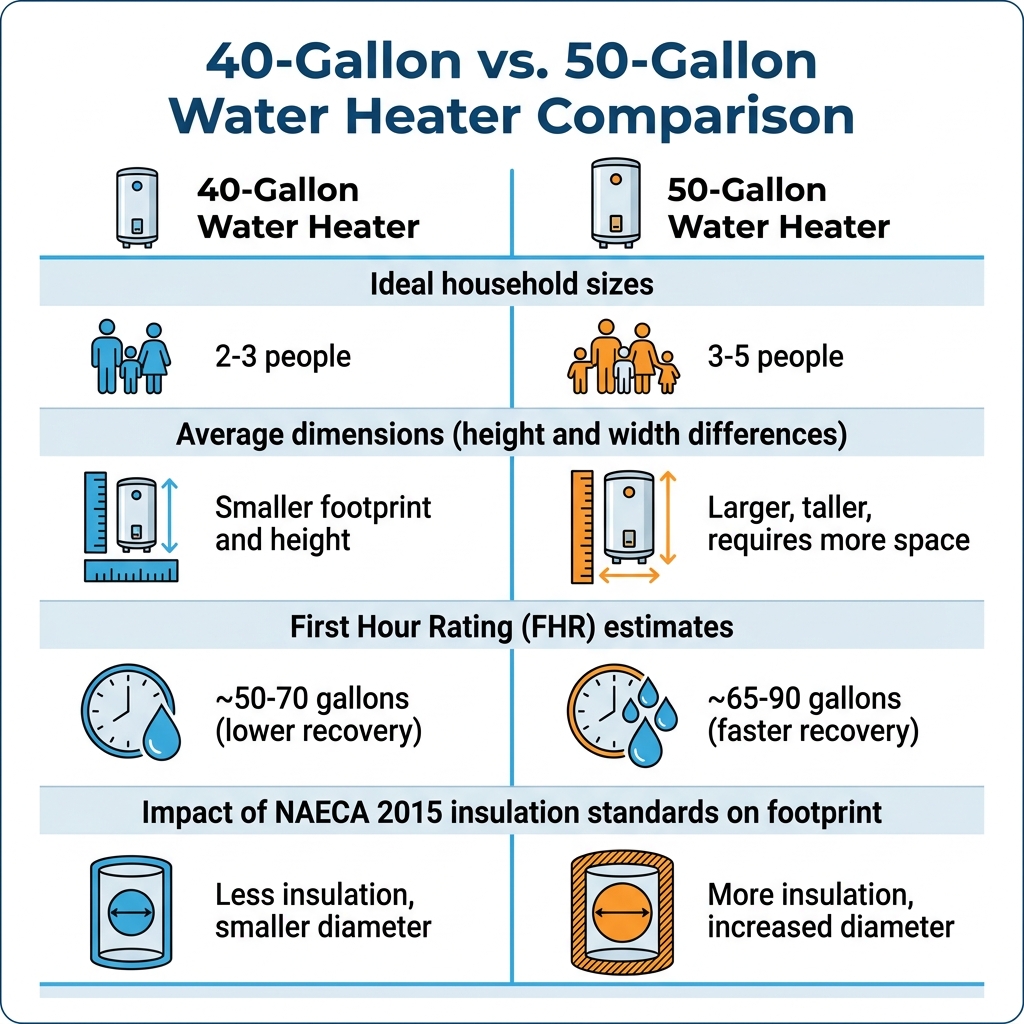
As a result, modern water heaters are significantly bulkier than their older counterparts. A modern 40-gallon tank is often two inches wider and two inches taller than a pre-2015 40-gallon tank. If you attempt to upgrade to a 50-gallon unit, you are looking at a system that could be up to four inches wider and several inches taller than your old 40-gallon unit.
Measuring Your Existing Utility Space
Because of these dimensional changes, a typical pattern we see in Wichita area basements and utility closets is that a new 50-gallon tank simply will not fit into the footprint left by an older unit. Before committing to an upgrade, a professional assessment will follow these essential steps:
1. Measure the door frame: Utility closet doors in older homes are notoriously narrow. The new tank must be able to physically pass through the doorway, including the door stops and hinges.
2. Check the floor footprint: The wider diameter of a modern 50-gallon tank means it might encroach on nearby HVAC equipment, sump pumps, or structural pillars.
3. Assess vertical clearance: The added height of a larger tank can interfere with existing overhead plumbing, ductwork, or the slope of the venting pipe.
4. Verify combustion air spacing: Gas water heaters require a specific amount of empty space around them to draw in oxygen for safe combustion. Cramming a larger tank into a tight closet can suffocate the burner.
Venting and Plumbing Adjustments for Larger Tanks
Beyond the physical footprint, increasing your tank's capacity often means increasing its heating power. A larger volume of water requires a larger gas burner to maintain an acceptable recovery rate. Moving from a 40,000 BTU burner to a 50,000 BTU burner triggers a cascade of mechanical requirements that must be addressed to keep your home safe.
BTU Demands and Gas Line Sizing
If your old 40-gallon water heater was running on a half-inch gas line, that line might not deliver enough volume to fuel a larger 50-gallon burner safely. When a burner is starved for gas, it operates inefficiently and can produce excess carbon monoxide. A professional assessment will determine if your existing gas piping can handle the increased BTU load or if a larger three-quarter-inch line needs to be run from the manifold.
Flue Sizing and Draft Requirements
More gas burned means more exhaust gases produced. Standard atmospheric gas water heaters vent their exhaust through a metal flue pipe that runs up through your roof or chimney. The size of this flue pipe is strictly dictated by the BTU output of the appliances attached to it.
If you increase the size of your water heater, your existing Type B vent pipe might be too narrow to safely carry the larger volume of exhaust gases outside. If the flue is undersized, the exhaust can backdraft, spilling dangerous carbon monoxide into your utility room. Upgrading the venting infrastructure is a non-negotiable safety requirement if the math demands it.
Because these hidden technical requirements can significantly alter the scope of an installation, working with a company that provides upfront customer pricing ensures you are never hit with surprise fees. A thorough evaluation of your utility closet's dimensions, gas lines, and venting flues will be completed before the work begins, giving you a clear and accurate picture of what the capacity upgrade actually requires.
Side-by-Side Comparison: 40-Gallon vs. 50-Gallon Capacities
To help you weigh the pros, cons, and physical requirements of each option, it helps to look at the data side-by-side. Keep in mind that while a 50-gallon tank offers superior performance, it demands a more accommodating physical environment.
• Ideal Household Size — Modern 40-Gallon Water Heater: 2 to 3 people — Modern 50-Gallon Water Heater: 3 to 5 people
• First Hour Rating (FHR) — Modern 40-Gallon Water Heater: Typically 65 to 70 gallons — Modern 50-Gallon Water Heater: Typically 85 to 90+ gallons
• Consecutive Showers Supported — Modern 40-Gallon Water Heater: Usually 2 standard showers — Modern 50-Gallon Water Heater: Usually 3 to 4 standard showers
• Physical Footprint — Modern 40-Gallon Water Heater: Approx. 20-22 inches wide — Modern 50-Gallon Water Heater: Approx. 22-24+ inches wide
• Venting Requirements — Modern 40-Gallon Water Heater: Standard existing flues usually suffice — Modern 50-Gallon Water Heater: May require upsized flue for higher BTUs
• Cold Weather Performance — Modern 40-Gallon Water Heater: Struggles during heavy morning demand — Modern 50-Gallon Water Heater: Maintains consistent temp with larger buffer
Regardless of which size you ultimately choose, keeping the system operating at peak efficiency requires attention. Sediment buildup in the bottom of the tank will drastically reduce the FHR of either unit, making routine plumbing and water heater maintenance vital to protecting your investment and ensuring the burner transfers heat effectively, especially during the September transition to colder groundwater.

Frequently Asked Questions About Water Heater Upgrades
How much bigger is a 50-gallon water heater than a 40-gallon?
A modern 50-gallon water heater is typically two to three inches wider in diameter and several inches taller than a modern 40-gallon unit. However, if you are replacing an older, pre-2015 40-gallon tank, the new 50-gallon model could be up to four inches wider due to updated federal insulation standards. This size difference frequently causes clearance issues in tight utility closets.
Can I replace a 40-gallon water heater with a 50-gallon?
Yes, you can upgrade your capacity, provided your home's physical infrastructure can support it. A professional must assess your utility room's floor space, door width, and vertical clearance to ensure the larger tank fits safely. Additionally, the gas lines and venting flues must be evaluated to ensure they can handle the increased BTU output of a larger burner.
Is a 50-gallon water heater big enough for a family of 4?
A 50-gallon water heater is generally considered the ideal sweet spot for a family of four. It provides a high enough First Hour Rating (FHR) to support three to four consecutive showers without a significant drop in water temperature. This larger capacity ensures that morning routines can proceed without family members having to wait for the tank to recover.
Why do I run out of hot water faster in the winter?
During the winter, the groundwater entering your home from municipal pipes or wells is significantly colder than it is in the summer. Your water heater has to work much harder and longer to raise this freezing water to the standard 120-degree set point. This drastic temperature differential slows down the system's recovery rate, causing the tank to deplete faster during heavy use.
Will a larger water heater increase my energy bills?
A 50-gallon tank does have a slightly higher standby heat loss simply because there is more surface area and more water being kept hot 24/7. However, modern water heaters feature highly advanced, thick foam insulation that minimizes this loss. The slight increase in operational costs is usually negligible compared to the massive improvement in household comfort and consistent hot water delivery.
Evaluating Your Home's Hot Water Needs
Deciding whether upgrading from a 40-gallon to a 50-gallon water heater is worth it ultimately comes down to balancing your family's comfort against the physical realities of your home. For growing families dealing with cold morning showers, the increased First Hour Rating of a 50-gallon tank provides undeniable peace of mind. You will no longer have to stagger shower times or rush through your morning routine just to ensure the last person gets warm water.
However, that comfort upgrade is only feasible if your infrastructure can support it. Because of the strict NAECA 2015 insulation standards, a typical pattern we see in Wichita area basements and utility closets is that space is the ultimate deciding factor. Before you make a final decision, have a professional evaluate your physical dimensions, gas line sizing, and venting requirements. With a thorough assessment, you can make a confident, informed decision that ensures your family enjoys reliable hot water safely and consistently for years to come.
Customer Testimonials
Hear from satisfied customers who trust us for reliable HVAC and plumbing service across Wichita.





Plus, the technician, Lee was very professional, knowledgeable and informative.
We will definitely be doing business with them sometime again in the past.
I'm prompt to my appointment. Thank you Midwest Mechanical.
I'm prompt to my appointment. Thank you Midwest Mechanical.

We have partnered with GoodLeap to offer flexible payment options for your project. GoodLeap uses a soft credit check until funding and the highest score from all 3 bureaus to see if you qualify. It also takes just a few minutes to get started.




Service Areas
.svg)